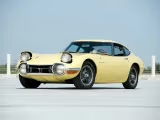
Toyota 2000GT, 1968
Toyota 2000GT
Toyota 2000GT•
•116 views
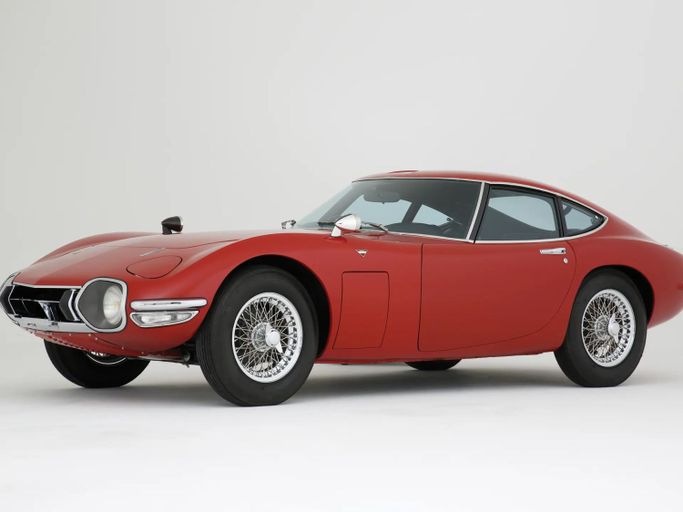
Chassis No.: MF10-10174
Location: Monte Carlo, Monaco
€728,000 EUR | Sold
- Beautifully restored in dark red with chrome Borrani-style wire wheels
- Japan’s iconic sports car
Addendum
Please note this car is equipped with a period-correct factory spare “3M” engine block. It is also fitted with Borrani-style wire wheels.
150 bhp, 2,000 cc Yamaha DOHC hemi-head inline six-cylinder engine, triple Solex twin-choke side-draft carburettors, five-speed fully synchromesh manual transmission, four-wheel independent suspension, and four-wheel power-assisted Dunlop disc brakes. Wheelbase: 2,329 mm
Inline six-cylinder engine with Yamaha cylinder head, 2,000 cc, 150 hp, twin overhead camshafts, three twin-choke Solex carburettors, fully synchronized five-speed manual gearbox, independent suspension on all four wheels, Dunlop power-assisted disc brakes on all four wheels. Wheelbase: 2,329 mm.
Perhaps the attendees at the 1965 Tokyo Motor Show didn’t realise it at the time, but they were witnessing a paradigm shift in the automotive industry, as Toyota had just announced the 2000GT, which is the car that would be Japan’s first entry into the global sports car market. It was a bold move by Toyota, a company that had never produced a sports car, but they wanted to show that it could compete with the automotive superpowers from Europe and the United States, and the 2000GT certainly put them on notice.
The 2000GT’s story starts not with Toyota but with Yamaha, who decided to design a sports car after years of producing motorcycles. Yamaha first marketed its design to Nissan, who ended up not taking on the project, so the car was then marketed to Toyota, who saw this tiny little sports car as an opportunity to shed its reputation of producing rather conservatively designed automobiles. Some inside the company might have considered this move to be a gamble for a company who had never sold such an automobile, but it was clear that the 2000GT could give Toyota and Yamaha’s designers and engineers a chance to compete on the world stage.
The 2000GT was powered by a 150-horsepower variant of the inline-six cylinder engine that was originally used in the Toyota Crown, and Yamaha adapted it for use in a sports car by installing double overhead camshafts. Tipping the scales at just 2,400 pounds, with a 49/51 weight distribution, it was quite light on its feet, and it could reach a top speed of 135 mph. Despite being considered the underdog, the 2000GT certainly got a lot of exposure.


Both Toyota and Carroll Shelby found success with the 2000GT on the race track. It won the 1967 Fuji 24 Hour endurance race in the hands of its manufacturer, and Shelby’s team took four chequered flags in the 1968 season with the 2000GT. One specially constructed example even found its way onto the silver screen in the James Bond film You Only Live Twice, with Toyota having to produce a convertible version in order to fit actor Sean Connery comfortably. Even though the car appeared onscreen for a small portion of the film, it monumentally increased the 2000GT’s exposure to the public, along with Toyota’s.
Toyota initially planned to produce and sell nearly 1,000 examples annually, but by the time production ceased in 1970, just 351 examples had been built. Many potential consumers found it difficult to justify the $7,000 cost of the 2000GT, as that was $1,000 more expensive than a Jaguar E-Type or Porsche 911 and over $2,500 more expensive than a Chevrolet Corvette, especially considering that Jaguar, Porsche, and Chevrolet were much more established, especially in the United States, than Toyota was at the time. Whilst Toyota did not hit is goal of 1,000 examples annually, the 2000GT definitely received all the exposure it was due thanks to its racing endeavours with Carroll Shelby and its stint on the silver screen.
Chassis MF10-10174 was produced on 19 January 1968, finished in Pegasus White, and delivered new to its home market of Japan as a right-hand drive model. This 2000GT, being offered today from its native country, has recently completed a restoration, where it was repainted in a striking shade of burgundy and fitted with chrome Borrani-style wire wheels. The brilliant paint colour is beautifully accented by the chrome details on the car, and it attractively showcases the design features of this stunning sports car. Surely this would be a wonderful example to drive and enjoy, as it showcases Toyota’s brilliant European-inspired design.
The 2000GT is a hugely important car in the history of the automobile. Without the 2000GT, there might not have been a Honda NSX or a Nissan 240Z, and the industry on the whole might have looked very different from what it is today. The 2000GT shattered the preconceived notions of what the world thought a Japanese car could be, and it changed the automobile industry for the better. Collectors have finally come to realise the importance of these wonderful little sports cars, and they have become quite desirable in recent years. This 2000GT oozes a sporting elegance that is wonderfully stated by its dark red paint and Borrani-style wire wheels, which work to accentuate its brilliant design. It would be a wonderful example to drive and enjoy.
Perhaps visitors to the 1965 Tokyo Motor Show did not realise it at the time, but they were witnessing a paradigm shift in the automotive industry. Toyota had just unveiled the 2000 GT, the car that would mark Japan’s first entry into the global sports car market. It was a bold move for Toyota, a marque that had never produced a car in this category and wanted to show that it could compete with the high-end automobiles of European and American manufacturers. The 2000 GT certainly caught their attention.
The story of the Toyota 2000 GT begins not with Toyota but with Yamaha, which decided to design a sports car after years of producing motorcycles. Yamaha first presented its project to Nissan, which ultimately declined it. The project was then submitted to Toyota, which saw this little sports car as an opportunity to shed its reputation as a maker of rather conventional cars. Some within the company may have considered this decision a real gamble for a manufacturer that had never sold a car of this type, but it was clear that the 2000 GT could give Toyota and Yamaha’s designers and engineers the chance to compete on the international stage.


The 2000 GT received a modified 150 hp version of the inline six-cylinder engine usually fitted to the Toyota Crown. Yamaha adapted its configuration for a sports car, with a cylinder head featuring twin overhead camshafts. Weighing 1,088 kg, with a 49/51 weight distribution, the car was quite light and could reach a top speed of 210 km/h. Although considered an underdog, the 2000 GT enjoyed considerable exposure.
With the 2000 GT, Toyota and Carroll Shelby both found success on the track. It won the Fuji 24 Hours in the hands of its manufacturer, and the Shelby team scored four victories with the 2000 GT during the 1968 season. A specially built example even appeared in the James Bond film You Only Live Twice, with Toyota producing a convertible version so that the great Sean Connery could sit comfortably in it. Although the car appeared on screen only briefly, this appearance gave the 2000 GT considerable exposure among the general public and, in turn, promoted Toyota.
The manufacturer planned to produce and sell nearly 1,000 examples a year, but when production ended in 1970, total output had reached only 350 units. Many potential customers struggled to justify the 2000 GT’s $7,000 price tag—$1,000 more than a Jaguar E-Type or Porsche 911, and $2,500 more than a Chevrolet Corvette—especially since Jaguar, Porsche, and Chevrolet were much more firmly established than Toyota at the time, particularly in the United States. Although Toyota did not reach its target of 1,000 cars a year, the 2000 GT received all the exposure it could have hoped for, thanks to the racing successes of Carroll Shelby’s team and its appearance on the silver screen.
This Toyota 2000 GT (chassis no. MF10-10174) left the factory on 19 January 1968, finished in Pegasus White, and was delivered new to Japan in right-hand drive. It has recently undergone a full restoration and has been repainted a beautiful burgundy, with chrome Borrani-style wire wheels. The superb paintwork is beautifully complemented by the car’s chrome trim, highlighting the distinctive styling of this remarkable sports car. This is surely a wonderful example to drive and enjoy, showcasing Toyota’s superb European-inspired lines.
The 2000 GT is an exceptionally important car in automotive history. Without it, there might never have been a Honda NSX or Nissan 240Z, and the market might have developed very differently from the way it has today. The 2000 GT challenged the world’s preconceived ideas about what a Japanese car could be and changed the automotive world for the better. Collectors have finally recognised the importance of this superb sports car, which has become highly sought-after in recent years.
This 2000 GT exudes sporting elegance, beautifully underscored by its dark paintwork and Borrani-style wire wheels, which accentuate its brilliant styling. This superb example offers an unmissable opportunity to enjoy an important and original car.
https://rmsothebys.com/auctions/mc14/lots/r162-1968-toyota-2000gt/
Mileage
210 km
Cost
3,009,954 AED