
Aston Martin Speed Model Type C, 1940
Aston Martin V12 Speedster
Aston Martin V12 Speedster•
•10 просмотров
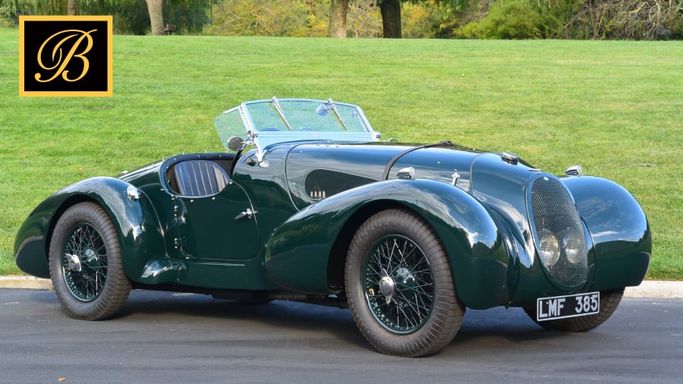
Chassis No.: G40/726/U
- Exterior: Green
- Interior: Black
- Comprehensive restoration completed by Ecurie Bertelli
- 1 of 23 competition-specification Speed models produced
- 1 of only 8 Type C conversions
- Introduced to the public at the 1938 Earls Court Motor Show
- Striking aerodynamic design
- 1,949cc/125 HP SOHC inline 4-cylinder engine
- Twin SU carburetors
- 4-speed manual transmission
- Front and rear live-axle suspension
- Lockheed 4-wheel hydraulic drum brakes
- 102 inch wheelbase
Founded by Lionel Martin and Robert Bamford in 1913, Aston Martin persisted through years of financial strains and ever-changing ownership to become recognized, finally gaining notoriety when the company set international speed records at home and in Europe with a series of 1.5L-powered racers. One of the most influential figures in the early history of this most English of carmakers was in fact an Italian-born Welshman. Born in 1890 in Genoa, Italy, Augustus Cesare “Bert” Bertelli immigrated at the age of four with his family to Cardiff, Wales, where he took an engineering apprenticeship as a teenager.
Upon completing the course, he returned to Italy and joined Fiat’s experimental and test department and began racing with the factory team, eventually returning to England just prior to the outbreak of the Great War. Circumstances eventually brought him to Aston Martin in 1926, when he and business partner William Renwick joined the board of the newly formed Aston Martin Motors Ltd. Working in collaboration with their protégé, young draftsman Claude Hill, Bertelli and Renwick had already developed a 1.5L inline overhead-cam 4-cylinder engine using Renwick’s patented combustion chamber, which was immediately put to use to jump-start the new company.
Despite continuing financial woes and revolving ownership, the Bertelli era solidified Aston Martin’s reputation for producing lightweight, hand-built midsized cars noted for their elegant design, speed, excellent handling characteristics and solid durability. From 1926 until his resignation in 1937, Bertelli served as both technical director and chief designer, producing a long line of sports cars that were among the best in their class, including the 1.5L T-Type, International, the 1935 Le Mans-winning Ulster and the 2.0L 15/98 and its racing derivative Speed Model introduced in 1936. By then, Sir Arthur Sutherland had assumed control of Aston Martin, naming his son, Engineer R.
Gordon Sutherland, joint-managing director with Bertelli. Conflict ensued between Bertelli and Gordon Sutherland when the latter insisted on producing a less intricate, and therefore less expensive, sporting car using the Hill-designed 2.0L engine and simpler drivetrain.


Not long after winning the company’s first Le Mans victory in 1935, Bertelli resigned, leaving behind Claude Hill to build on the solid engineering foundation he laid down over the course of his tenure building “the best cars I ever made.” As history has recorded, none of the 23 competition-specification Speed Models would ever run at Le Mans; the 1936 race was canceled at the last minute, a casualty of labor unrest in France that led to a strike and dashed Aston Martin’s hope of a second consecutive win at the Sarthe circuit.
The team cars entered for the 1936 race were sold off to regain some of the costs, but the staggering world economy made sales of the remaining 23 Speed models difficult. By the middle of 1938, a number of the 1936 Speed Model chassis remained unsold following development through thirteen E. Bertelli-bodied “A” and two “B” models with Abbey coachwork. In a two-pronged effort to entice reluctant potential buyers and increase top speed, company designers employed the emerging science of aerodynamics to produce striking streamlined factory coachwork for the Type C, which was introduced to the public at the 1938 Earls Court Motor Show.
One of the last Aston Martins delivered before World War II, this 1940 Type C Speed 6 is one of the eight Speed Models converted to that configuration. Built on a 102-inch wheelbase and equipped with live-axle suspension and Lockheed 4-wheel hydraulic drum brakes, it is powered by Claude Hill’s 2.0L inline-4 with twin Solex carburetors, a high-lift cam and dry-sump lubrication, all backed by a 4-speed manual transmission.
This combination of streamlined coachwork, 125 HP, a highly developed suspension and one of the most effective braking systems until the advent of discs made for an outstandingly well-rounded sports car that earned a Type C first in class its first time in competition at the Donington Tourist Trophy race. As one of just eight built, the Type C is one of the rarest of the interwar period and enjoys an honored place in Aston Martin history. This example, part of the Blackhawk Exposition Sale at Mecum Monterey 2019, presents in excellent overall condition, the result of a comprehensive restoration by world-renowned marque experts Ecurie Bertelli.
https://www.mecum.com/lots/388749/1940-aston-martin-speed-model-type-c/


