


How Often Should You Change the Rear Differential Oil in a Toyota Hiace?
Toyota HiAce
Toyota HiAce•
•35 مشاهدة
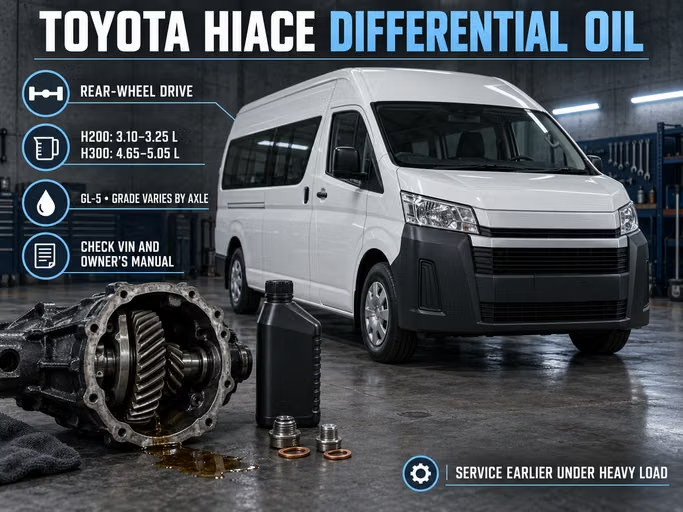
For a rear-wheel-drive Toyota Hiace, a practical service reference is to check the oil level and condition every 20,000 km or once a year, then plan replacement at 40,000–60,000 km under severe use and up to 80,000 km in normal service. The exact schedule, capacity and viscosity depend on the generation, axle code and VIN.
How Can You Tell That the Rear Differential Oil in a Toyota Hiace Needs Changing?
The Hiace rear differential continuously transmits substantial torque, and commercial vehicles often operate with a payload and on long routes. Heat, oxidation and contact with fine metallic debris gradually age the oil. Even when a specific service booklet does not state a fixed replacement date, the lubricant should be assessed through several practical signs.
- Listen for a steady hum from the rear that rises with road speed rather than engine speed.
- Note any howl or change in tone when moving from acceleration to overrun.
- Look for damp traces around the pinion seal, axle shafts, and the fill or drain plugs.
- Inspect the oil: it should not be opaque, smell burnt, or contain glitter and visible metallic suspension.
- Consider clunks when selecting a direction or changing load, especially when driveline play appears together with differential noise.
One symptom alone does not prove that the ring-and-pinion set is worn. Wheel bearings, universal joints, the propeller-shaft centre bearing and unevenly worn tyres can produce similar sounds. Begin diagnosis by checking the oil level, looking for leaks and locating the noise on a lift before ordering parts.
Check the level through the fill opening while the vehicle is standing level. If the oil sits noticeably below the opening, topping up is not enough: the source of the loss must be found. Common leak points include the pinion seal, axle-shaft seals and plugs. Airflow can carry oil along the underbody, so clean and dry the differential housing before the follow-up inspection.
When to Shorten the Interval
More frequent checks are sensible for vehicles that carry passengers or cargo every day, spend long periods at highway speed, tow a trailer, regularly pull away at full gross weight, or work in hot and dusty conditions. After driving through deep water, inspect the oil without waiting for scheduled maintenance: an emulsion weakens the lubricating film and accelerates corrosion.
For a vehicle with an unknown maintenance history, start by inspecting the plugs, breather and seals, then check the level and take an oil sample. Replace the fluid regardless of mileage if it is very dark, water-contaminated or clearly overdue. Retained invoices and job cards can help distinguish preventive service from repeated repair of the same leak.
The interval should also be reconsidered when the vehicle changes role. A passenger minibus, a van permanently loaded with tools and an empty privately used Hiace place different demands on the same driveline. Mileage is only one factor; hours in motion, average load, housing temperature after a route and the share of journeys with frequent acceleration also matter.
What Happens If You Do Not Change the Rear Differential Oil in a Toyota Hiace?
The consequences develop gradually. First, the oil film loses strength; temperatures and contact loads on the gear teeth then increase. The risk is particularly relevant when a Hiace is fully loaded because the differential may continue operating without a dashboard warning while wear is already accelerating.
1. The oil becomes less able to maintain a strong film between the hypoid gear teeth and bearing surfaces.
2. Temperature, wear debris and noise under power or on overrun increase.
3. Pitting develops on the teeth, bearing races become damaged and pinion-flange play grows.
4. Heat and runout damage the seals, and the resulting leak lowers the oil level even further.
5. The differential requires adjustment or rebuilding; if the final-drive gears fail, the assembly may need replacement.
As a broad UAE estimate, an oil change and repair of a minor leak cost far less than differential work. Replacing bearings and seals may be around AED 1,200–2,500, while rebuilding the final drive or replacing the assembly may reach roughly AED 3,500–8,000 or more. These are market estimates rather than fixed quotations; generation, parts availability and the extent of damage all affect the final amount.
Do not continue driving with a loud howl, obvious play or a substantial leak. A low level can quickly turn a seal replacement into a differential rebuild. If the housing is unusually hot and the oil has a sharp burnt smell or contains large fragments, arrange diagnosis without a long journey under the vehicle's own power.
Wear does not always progress at a constant rate. Once pits appear on the teeth, metallic debris acts as an abrasive and accelerates damage to neighbouring surfaces. A magnetic plug captures some ferrous material, but it cannot remove contamination already circulating through bearings and the oil film. Delaying service until the next major inspection is therefore risky when distinct chips are already present.
Fresh oil may reduce noise when the cause was a low level or loss of viscosity. It cannot correct bearing preload, damaged races or an incorrect tooth-contact pattern. After replacement, compare the sound under the same driving conditions. If the tone remains or becomes louder, continue the diagnosis instead of successively trying ever-thicker lubricants.
Which Rear Differential Oil Does Toyota Recommend for the Hiace?
Different Hiace generations use several rear axles. H200 models may have an open or limited-slip differential, while the H300 uses a housing with a different capacity. Buying lubricant by model name alone is therefore unreliable. The body code, model year, differential type and data for the exact vehicle must all be identified first.
GL-5 describes the performance class required for hypoid gears, but it does not replace the viscosity or differential-type requirement. Toyota lubricant labels such as LT, LX and LSD refer to different applications. An alternative product is suitable only when its class, viscosity and compatibility with the friction packs in the particular axle all match the specification.
| Parameter | Hiace H200 | Hiace H300 | What to Check |
|---|---|---|---|
| Drive | Rear-wheel drive; 4WD in selected markets | Rear-wheel drive | On 4WD models, the front differential and transfer case are serviced separately |
| Oil grade | API GL-5 | API GL-5 | An LSD requires oil with the correct friction characteristics |
| Viscosity | 75W-85 or 85W-90, depending on market and axle | 75W-85 for common H300 axles | Do not substitute viscosity from habit without checking vehicle-specific data |
| Reference capacity | Approx. 3.10–3.25 L for the standard rear axle | Approx. 4.65–5.05 L | Fill to the check level with the vehicle horizontal |
| Factory interval | Defined by the market and service schedule | Defined by the market and service schedule | There is no single interval for every Hiace |
| Service-planning reference | Inspect at 20,000 km; replace at 40,000–60,000 km in severe use | Inspect at 20,000 km; replace at 40,000–60,000 km in severe use | Consider up to 80,000 km only in normal service with clean oil |
Toyota publishes data for the current GDH300R, GDH303R, GDH320R, GDH322R, GRH300R and GRH320R model codes in its service and repair manual. For a vehicle from another market or generation, confirm the values by VIN: the same engine does not necessarily mean the same rear axle.
How to Interpret Capacity Data
The listed capacity is a reference for a dry or completely filled assembly, not a promise that every routine change will take exactly that amount. Some lubricant remains inside the housing, and the observed level changes with vehicle angle. During normal service, use the lower edge of the fill opening as the reference while the Hiace is level and at the temperature required by the procedure.
Do not automatically use open-differential oil in an H200 fitted with an LSD. Incorrect friction characteristics can cause chatter or binding during turns. If the axle marking is unreadable, identify the unit from the build code and parts catalogue. For an H300, confirm the exact rear-axle code as well, because the capacity range reflects more than one version.
Buy a little more lubricant than the calculated fill because some remains in the pump or hose and container sizes rarely match the axle capacity exactly. A sealed surplus can be retained for a later level check, but do not mix it with unidentified leftovers. Check the batch marking, seal integrity and complete specification printed on every container.
How to Change the Oil Without Common Mistakes
- Identify the axle type, required API class and viscosity before starting work.
- Loosen the fill plug before the drain plug so the vehicle is not left with an empty differential and an inaccessible fill opening.
- Keep the vehicle horizontal and use secure stands or a lift rated for its weight.
- Clean the magnets and plugs, replace damaged sealing washers and use the tightening torque specified for the axle.
- Fill to the check level, then inspect for leaks again after a short drive.
A short drive before draining helps the oil flow, but it should not be hot enough to burn the technician. Examine the drained fluid in a clean container under good light. Do not tighten plugs with an impact tool unless torque is controlled: damaged housing threads turn a simple service into a casing repair. After filling, make sure the breather moves freely and is not blocked by dirt.
Do not flush a sound differential with solvents or add universal treatments unless Toyota calls for them. Such products may change GL-5 behaviour and hide noise without addressing wear. If the drained oil contains large particles, retain a sample and show it to a specialist together with the material collected on the magnetic drain plug.
When assessing a used vehicle, compare differential condition, mileage and maintenance history; to review model years and specifications, it is useful to browse current listings. This does not replace an inspection on a lift, but it helps establish which generations and driveline variants are currently represented on the market.
Old Rear Differential Oil: Why Does a Toyota Hiace Howl While Driving?
A howl develops when the final-drive gears and bearings no longer run in their intended contact. Old oil transfers heat less effectively and holds abrasive particles, but the sound can also reflect wear that has already formed or an incorrect adjustment. Changing the lubricant alone will not always restore quiet operation.
| Cause | What Happens | How It Appears |
|---|---|---|
| Oxidised or overheated oil | The film separates loaded surfaces less effectively | The hum grows after warm-up and under load |
| Low level | Bearings and teeth receive less lubrication and run hotter | Noise rises quickly; a leak is often visible on the housing |
| Water or emulsion | Lubricity falls and corrosion begins | The oil is cloudy; a howl may follow wading or pressure washing |
| Wrong viscosity or grade | Film thickness and hypoid-mesh behaviour change | A hum appears when cold or after recent servicing |
| Bearing wear | The shafts develop radial or axial play | Tone follows road speed and may change in a bend |
| Worn or incorrectly meshed final-drive gears | Load shifts across the tooth-contact pattern | The howl differs during acceleration, steady power and overrun |
| Blocked breather | Pressure forces oil past the seals | Fresh leaks appear after driving and the level drops |
What to Check Before Repairing the Differential
First record exactly when the sound occurs: road speed, power application, overrun, cornering and assembly temperature. Then inspect the tyres, wheel bearings, propeller shaft, centre bearing and flange play. This sequence reduces the risk of dismantling a sound differential because the noise came from another component.
After removing the plug, assess both oil level and condition. A thin paste on the magnet can be normal after long service, but needle-like swarf, large fragments or a bronze-coloured sparkle call for deeper investigation. Do not use heavier oil as a diagnostic shortcut: it may soften the symptom but cannot restore tooth geometry or bearing preload.
The character of the sound can narrow the search. A howl heard mainly under acceleration more often relates to the drive side of the teeth, while pronounced noise on overrun can point to the coast side or bearing adjustment. A rumble that changes during a gentle lane change may come from a wheel hub. These clues do not replace measurements, but they help establish the correct inspection order.
If the howl began immediately after service, verify viscosity, GL-5 approval, LSD suitability, fill quantity and plug sealing. If it grew over several months, measure backlash and inspect the contact pattern and bearings. After any correct adjustment, refill only with a specification that matches the axle code.
During disassembly, the technician should preserve component relationships and measure preload before removing the flange. Simply replacing a bearing without checking the shims can change pinion depth. After reassembly, backlash and the contact pattern must be verified, followed by a road test. For a commercial Hiace, it is particularly important to rule out overheating on a route that reflects its normal working load.
Conclusion
For a Toyota Hiace, matching service to the specific axle matters more than following one universal mileage figure. Check the oil every 20,000 km, shorten the interval under heavy load and heat, and always confirm viscosity, capacity and LSD fitment by VIN.


