


Toyota Hiace engine air filter inspection and replacement
Toyota HiAce
Toyota HiAce•
•43 مشاهدة
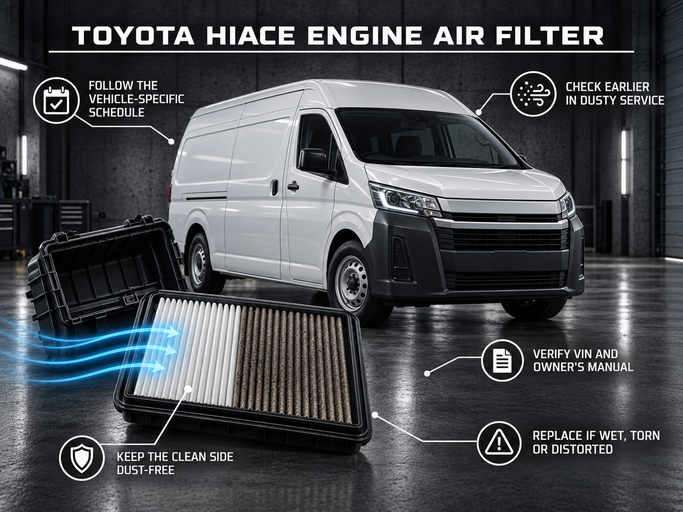
The service timing for a Toyota Hiace engine air filter depends on the generation, engine and operating conditions. H200 and H300 vehicles, petrol and diesel engines, and cargo and passenger configurations cannot all be maintained to one universal interval. For a van that carries people or freight every day in heat and dust, the schedule for its exact specification and the actual condition of the element both matter.
Signs that call for an engine air filter inspection
A commercial vehicle should not be left until an obvious loss of power develops. Gradual restriction can be disguised by a familiar route, while the driver may attribute slower response to payload, traffic or air-conditioning use. A more reliable check covers the pleats, sealing frame, clean side of the housing and intake duct connections.
- A dense layer has formed between the pleats. Separate the pleats at several points and shine a light across them. Fine dust retained deep in the media and covering a large area matters more than a light surface coating on the incoming-air side.
- Particles are visible downstream of the filter. The chamber leading to the engine should remain clean. Grit or a dry dust trail beyond the element requires inspection of the frame, groove, lid and duct even when no tear is visible in the paper.
- The seal is crushed or lifted. A wavy edge, hardened material or a folded corner prevents even clamping. This defect creates a bypass route for air and justifies replacement regardless of the colour of the pleats.
- Maintaining speed under load has become harder. Intake restriction is more noticeable with a full payload, on an incline or during a long acceleration. The fuel system, diesel boost circuit, transmission and other components can produce a similar effect, so the symptom must be confirmed by inspection.
- An airflow or mixture-related fault code has appeared. Read the stored code first, then inspect connectors and intake sealing. Sensors and their locations differ between engines, so replacing a service item at random is not a substitute for diagnosis.
Why the same mileage does not mean the same contamination
A Hiace used for intercity travel on clean paved roads and a van that enters construction sites every day may cover the same distance with very different filter loading. Dust also accumulates while following other vehicles, parking beside a sandy shoulder or stopping near operating machinery.
Before opening the air cleaner housing, remove loose dirt from the lid and the area around its fasteners. Lift the element without tilting it toward the clean chamber. Do not wash the paper element; use compressed air only when the manufacturer of that specific filter expressly permits the procedure.
When the filter should be replaced ahead of schedule
Do not postpone replacement if the paper is torn, the pleats are separating, the frame is cracked, the element is wet, an oily mark is present or the seal has swollen. Remove the element from service as well when distortion prevents it from sitting fully in the groove around the entire perimeter.
Inspect the housing and its fasteners. Intake access and engine-bay layout differ across Hiace generations, so a removal sequence remembered from another version should not be repeated automatically. A broken clip, distorted lid or cracked housing will remain a source of leakage after a new element is installed.
What happens when the filter is restricted or the seal leaks
Loaded filter media restricts the designed airflow, while a gap along the edge allows air to bypass the paper. In the first case the engine cannot draw air freely under load; in the second, abrasive particles bypass the protection. Servicing should correct the actual cause rather than merely improve the appearance of the element.
- The available airflow reserve decreases. The change may be difficult to notice at a steady speed, but acceleration with passengers or cargo requires greater flow. The response depends on the engine, transmission, vehicle mass and road gradient.
- The control system applies greater corrections. Engine management adjusts throttle operation and fuelling as it tries to maintain the requested output. Fuel consumption may change, but that alone does not prove an air filter fault.
- The air-fuel balance of a diesel can be affected. Restricted intake flow may influence pulling power and smoke under load. A turbocharger, boost hoses, injectors and the recirculation system can cause similar symptoms, so a conclusion should follow diagnosis.
- Dust reaches sensitive and moving components. Particles passing through a tear or an unsealed edge continue along the intake tract. On a turbo-diesel they can contact the compressor section before reaching the cylinders and accelerating wear.
- The consequences can extend beyond the service item. If the clean-side chamber has remained dusty for a long period, it should be cleaned safely and downstream components should be checked. A new filter does not prove that sensors and ducts previously exposed to dust are undamaged.
How to establish the Toyota Hiace air filter service schedule
If a manual for the exact Hiace version is not published, confirm the inspection procedure and intervals by VIN with a Toyota dealer. The schedule must be established again from the VIN and original vehicle documentation for a different generation, engine or source market.
| Situation | Petrol Hiace | Diesel Hiace |
|---|---|---|
| Scheduled service | Inspect according to the schedule for the applicable year and engine | Inspect according to the schedule for the exact diesel version |
| Intensive dusty operation | Add an inspection after significant exposure | Add an inspection after significant exposure |
| Scheduled replacement | Follow the documents for the applicable petrol specification | Follow the diesel documentation; do not copy a petrol interval |
| Immediate replacement | Replace if damaged, wet, distorted or unable to seal correctly | Replace if damaged, wet, distorted or unable to seal correctly |
| Part confirmation | VIN, H200/H300, engine, market and part number | VIN, generation, diesel engine, market and part number |
How commercial duty and hot conditions affect inspection
For a Hiace, severe exposure is not limited to desert roads. Deliveries to work sites, travel through industrial areas, repeated stops on dusty shoulders and operation near loading equipment can create concentrated dust clouds. After an unusually dirty shift, an inspection is more useful than simply waiting for the next calendar date.
Long idling periods and slow movement in heat do not create a universal shortened interval unless Toyota specifies one. Record these conditions in the service history and use them as a reason to assess the media more often, without presenting a preventive choice as an official schedule.
Passenger and cargo use change the type of load but do not identify the correct filter by body purpose alone. Different engines and specifications exist even within the H300 series, while the used-vehicle market also contains vans originally supplied to other countries.
A new, clean element is not proof that the whole intake system is in good condition. When inspecting a working van, look for downstream dust traces, damaged clips and evidence that the previous filter was repeatedly cleaned by rough methods.
Faults that can resemble a restricted air filter
If loss of power, a whistle or a warning remains after servicing, extend the diagnosis. On a petrol Hiace, the throttle, ignition and fuel delivery can produce similar symptoms; on a diesel, check the boost pipes, turbocharger, injectors and exhaust gas recirculation system (EGR). The table separates an observation from a final diagnosis.
| Observation | Possible cause | Next check |
|---|---|---|
| Pulling power drops at full load | Filter is heavily loaded or the air intake is partly obstructed | Inspect the pleats and inlet path, then compare intake data |
| A dust trail remains beyond the element | Frame is distorted, seal is damaged or the wrong filter is fitted | Clean the groove, inspect the lid and confirm the part number by VIN |
| A whistle appears after reassembly | The lid is unevenly closed or an intake connection is loose | Check every clip, joint and the position of the frame |
| Diesel produces smoke during acceleration | Insufficient air, a boost leak, an EGR fault or a fuel-system issue | Read fault codes and check intake, boost and fuel-system data |
| Water or an oily mark is visible on the paper | Moisture has entered the intake or an aerosol is reaching the tract | Find the source, assess drainage and clean the downstream chamber |
| The lid will not seat without force | The frame height is wrong, debris is in the groove or a latch is damaged | Verify the part number and reassemble the housing without forcing it |
Inspecting a Hiace after a dusty work shift
- Clean the exterior before opening the housing. Wipe the lid, edges and areas around the fasteners. This reduces the chance of spilling loose material onto the engine side during disassembly.
- Note how the old element is positioned. Before lifting it out, observe how the frame sits in the groove and where the seal runs. A witness mark from misalignment can help explain a downstream dust trail.
- Keep the incoming and clean-air chambers separate. Debris before the filter is expected; debris after it is not. Photograph suspicious traces before cleaning so useful diagnostic evidence is retained.
- Inspect the full depth of the pleats. Check more than the top surface: examine the spaces between pleats, adhesive joints and frame corners. Moisture and local clumps require separate attention.
- Record the operating conditions. Note the date, mileage, route, approximate payload and part number. Later inspections will show the actual contamination rate for that particular vehicle.
Mistakes when servicing the Hiace air cleaner housing
- Opening a dirty lid without preparation. Dust from the outer surface can fall into the clean chamber and create a new contamination path during the service itself.
- Judging service life by the colour of one pleat. The shade depends on dust composition and lighting. Base the decision on the full area, depth of loading, frame condition and cleanliness downstream of the filter.
- Ordering an element by engine displacement alone. The same displacement does not guarantee the same air cleaner housing. The VIN, model code, year and original specification are required.
- Blowing the paper with a powerful air jet. Pressure can enlarge pores, damage joints and move fine particles to the clean side. Use only a method expressly permitted by the filter manufacturer.
- Forcing the fasteners closed. A tight latch usually indicates misalignment, debris in the groove or an incorrect frame height. Forcing it locks the element in the wrong position.
- Continuing to operate with a cracked housing. A fresh element cannot seal damaged plastic or restore a broken mounting point. Repair the fault before returning the vehicle to service.
Checks after installing a new filter
Run a finger around the entire frame and make sure no corner is lifted. The lid should lower squarely and the fasteners should close with normal, comparable effort. Refit every duct and electrical connector removed for access in its original position.
After starting the engine, listen for a new whistle and check the instrument panel. A short drive without a heavy load can confirm correct assembly, but it is not a power test. Diagnose any pre-existing faults separately.
Conclusion
Service the Hiace engine air filter according to the documents for its exact generation, engine and market, and judge its condition against the vehicle's real operating pattern. You can compare configurations in the current listings, but order the filter only after checking the VIN and part number. A clean downstream chamber, intact media, an even seal and a lid that closes freely indicate that the engine is properly protected.


