


How Often Should You Change the Oil Filter on a Toyota Hiace?
Toyota HiAce
Toyota HiAce•
•32 views
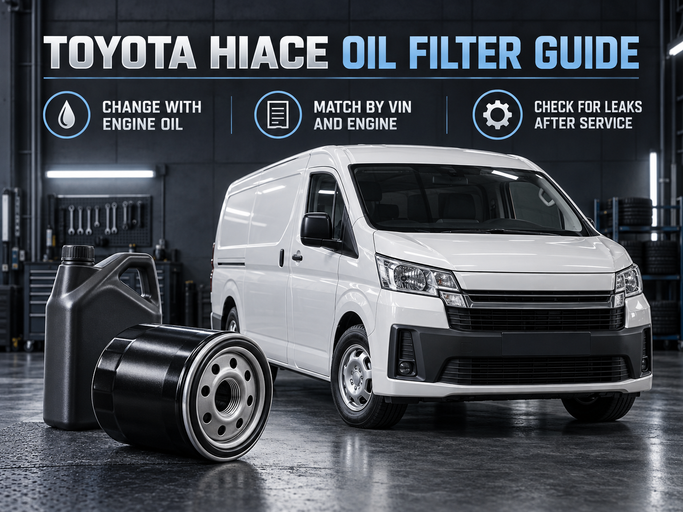
On a Toyota Hiace, the oil filter should be replaced together with the engine oil, not on a separate schedule. If the documentation for the specific van calls for service every 10,000 km or six months, install a new filter at the same service. For continuous delivery work, prolonged idling, or regular exposure to dust and sand, review the oil condition and service timing at around 5,000 km. The exact interval must be confirmed from the VIN, engine code, model year, and the documentation issued for the vehicle’s original market.
4 Signs of a Clogged Oil Filter on a Toyota Hiace
A sealed oil filter cannot be judged reliably from its exterior. A possible restriction is suggested by the service history, the engine’s behaviour immediately after start-up, and the condition of the lubrication system. Each sign below calls for inspection because the underlying fault may be elsewhere in the system.
- The oil-pressure warning stays on longer than usual. A red oil-can warning after start-up or while driving requires the engine to be stopped safely. Check the oil level, leaks, pressure sensor, pump, and actual oil pressure; replacing the filter at random is not a sufficient diagnosis.
- The previous service date is unknown. A sticker under the bonnet or a reset maintenance reminder does not prove that the consumable was renewed. Without a record showing the date, mileage, and part number, it is safer to begin a new service cycle with both oil and filter.
- An unfamiliar metallic sound appears after start-up. Brief dry-sounding noise may be linked to delayed oil delivery, unsuitable flow capacity, or an incorrectly operating anti-drainback valve. The source still needs to be diagnosed before parts are changed.
- Fresh oil marks appear on the housing or undertray. A post-service leak may come from a damaged sealing ring, an old gasket left on the mounting face, a cracked housing, or incorrect tightening. Find the leak and verify the level before driving the van.
Why Commercial Use Can Load the Filter Faster
A working Hiace may complete dozens of starts in one shift, make repeated short stops, carry passengers or cargo, and idle for long periods with the air conditioning running. The odometer does not fully reflect those engine hours. Meanwhile, the filter continues to capture oxidation products, wear particles, and contaminants suspended in the oil.
Sand does not normally enter the oil filter directly from outside. It increases the overall load on the vehicle, however, and an intake leak or heavily loaded air filter can allow solid particles into the engine and accelerate wear. Service planning should therefore consider the route, engine hours, payload, and parking conditions as well as mileage.
The calendar limit also matters for a standby or seasonal van. Occasional short starts may not warm the oil fully, while a long period in storage does not restart the lubricant’s ageing process. Low annual mileage is not a reason to postpone the oil-filter change indefinitely.
What Happens If You Do Not Change the Oil Filter on a Toyota Hiace?
Filter media has a finite dirt-holding capacity. As deposits accumulate, the resistance to oil flow rises. The bypass valve can protect the engine from an immediate loss of supply, but it cannot restore full filtration.
- Contaminants fill the pores in the media. The useful open area gradually shrinks even when the metal canister or plastic cap still looks undamaged.
- Oil meets greater resistance through the element. The pump must move lubricant through loaded or overly restrictive media. Cold starts and the first start after a long parking period are especially sensitive.
- The bypass valve may open. Part of the oil then travels around the filter media. Flow is preserved, but the cleaning effect is reduced until normal conditions return or the filter is replaced.
- Abrasive particles remain in circulation longer. They can increase wear on bearings, friction surfaces, valve-train components, and the turbocharger where the diesel version is equipped with one.
- The risk of expensive damage increases. The outcome depends on oil level, actual pressure, operating time, and engine design. If the pressure warning appears, diagnose the fault instead of estimating repair costs from mileage alone.
Which Oil Filter Does Toyota Recommend for the Hiace?
According to the current information on toyota.ae, the Hiace range includes 2.7- and 3.5-litre petrol engines as well as a 2.8-litre diesel. One part number cannot be transferred automatically between these versions. Toyota selects the filter from the parts catalogue for the exact VIN; the model name without the year and engine is not enough.
Check the service parameters in the documentation for the correct model year and original market. If a specific manual is not available, confirm the filter and procedure by VIN with an authorised Toyota service centre. A package marked “fits Hiace” does not replace a vehicle-specific check.
Price and canister size do not prove that a filter is suitable. Correct fitment, media quality, flow capacity, and valve operation all matter. A genuine part selected by VIN reduces the chance of a mismatch. A quality equivalent is reasonable only when its cross-reference and technical data match the exact Hiace specification.
| Parameter | What Matters for the Hiace | How to Verify |
|---|---|---|
| Powertrain | Petrol and diesel versions with different displacements exist | VIN, model year, and engine code |
| Replacement point | Renew the filter with the engine oil | Schedule for the specific vehicle |
| Filter design | Housing, thread, or cartridge depends on engine and market | Part number, dimensions, and installation layout |
| Valves and flow | Parameters must match the lubrication system | Toyota catalogue or a verified manufacturer cross-reference |
| Seal | Size, profile, and position must match | New part and installation instructions |
| Post-service checks | Check pressure, leaks, and level after the system is filled | Warning light, visual inspection, and dipstick |
How to Confirm Fitment for a Specific Specification
Begin with the VIN, model code, model year, and engine code. For an imported vehicle, also establish its original sales market. Two Hiace vans that appear identical can use different parts catalogues or service procedures.
When considering an equivalent filter, compare more than thread size and overall height. Check media area, rated flow, bypass and anti-drainback valve specifications, and the seal’s resistance to operating temperature. A dimensional match alone does not show how the filter will behave when the oil is cold or the engine is under load.
Treat the quoted fill quantity as a guide, not the final level. After refilling, start the engine, confirm that the oil-pressure warning goes out normally, and inspect the filter and drain plug. Then stop the engine, wait as directed by the vehicle documentation, and make the final dipstick check on level ground.
When assessing a used van, compare the claimed mileage, workshop dates, and recorded part numbers with the range of years and specifications shown in current listings. That variety is a practical reminder that the Hiace badge alone cannot identify the correct filter. If the service history is incomplete, perform a basic diagnosis, replace the oil and filter, and establish a documented baseline for future maintenance.
When to Schedule the Next Replacement
- Clear history and steady routes. Follow the schedule specified for the vehicle and install a new filter at every engine-oil change.
- Delivery work and frequent stops. Include calendar time and engine hours in the decision. A short daily distance can still involve many starts and long periods of idling.
- Regular passenger or cargo load. Avoid stretching the interval to its maximum when the engine repeatedly operates under high thermal load.
- Dusty sites and sandy roads. Review the oil and intake system at around 5,000 km. This is a condition-based inspection point, not a universal factory interval for every Hiace.
- Unknown maintenance history. After checking the oil level and ruling out active faults, renew the consumables, record the installed part, and set a VIN-based schedule.
Keep a simple service record with the date, mileage, engine hours where available, oil brand and specification, filter number, and any leak observations. This is more useful at the next service than a reset dashboard reminder on its own.
Clogged Oil Filter: What Problems Can It Cause on a Toyota Hiace?
Risk is not determined by mileage alone. Filter quality, engine compatibility, oil condition, seal integrity, and installation all affect the result. The symptoms in the table do not prove that the filter is at fault, but they show when the lubrication system needs prompt inspection.
| Problem | What Happens | What the Owner May Notice |
|---|---|---|
| Dirt-holding capacity exhausted | Flow resistance rises and filtration reserve falls | There may be no obvious signs for a long time |
| Bypass valve operating | Some oil circulates without full filtration | Start-up noise or no visible symptoms |
| Incorrect filter | Flow, valve settings, or seating do not match the engine | Delayed warning light, noise, or a leak |
| Damaged seal | Oil escapes between the housing and mounting face | Oil smell, a wet undertray, or a falling level |
| Old seal left in place | A double seal cannot hold operating pressure | A rapid leak immediately after start-up |
| Damaged housing | Heat or vibration opens a crack or deformation | Drops under the vehicle and an oil-stained engine bay |
Checks After the Service
- The part number is recorded on the work order. This makes the next purchase traceable and helps identify an incorrect cross-reference.
- The mounting face is clean. No fragment of the old gasket, dust, or packaging material should remain under the new seal.
- The housing is tightened according to the procedure. Use the specified method and torque where provided instead of relying on maximum hand force.
- The oil-pressure warning goes out normally. A delay or repeat warning requires inspection before the vehicle returns to service.
- The connections remain dry. Inspect the filter, drain plug, and nearby surfaces after the initial run and again after a short trip.
- The level is confirmed by dipstick. Make the final reading on level ground after the waiting period stated for the vehicle.
Common Hiace Service Mistakes
- Selecting a part from a photograph. Matching exterior shapes can conceal different threads, valve settings, and internal construction.
- Copying a part number from another specification. Codes can differ by engine, model year, and source market.
- Leaving the old filter with fresh oil. Residual contamination and reduced capacity weaken the oil change.
- Tightening the housing without a specification. Too much force can damage parts; too little can cause a leak.
- Adding the calculated quantity without checking the level. Retained oil and filter capacity affect the final dipstick reading.
- Resetting the reminder without recording the work. A reset does not record the oil specification, filter number, date, or mileage.
Conclusion
Replace the Toyota Hiace oil filter at every engine-oil change. Use the VIN, engine, model year, and original-market documentation to set the interval and part number, accounting for engine hours and harsh operating conditions.


