


How Often Should You Change the Automatic Transmission Fluid in a Toyota Hiace?
Toyota HiAce
Toyota HiAce•
•30 views
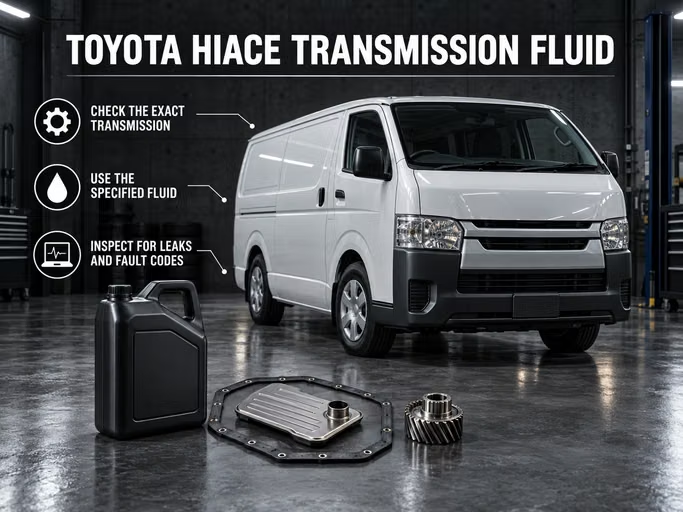
The transmission-fluid service point for a Toyota Hiace is not determined by mileage alone. First identify the generation, model year, engine, automatic-transmission code, body configuration, operating load, and original market. Then check the required specification and level-control procedure in the manual for that exact vehicle. Requirements for an earlier Hiace should not be carried over automatically to the current generation, and manual-transmission data do not apply to an automatic gearbox.
In an automatic transmission, the fluid lubricates components, removes heat, transfers hydraulic pressure, and supports the intended operation of the friction elements. Temperature, cargo weight, and long periods at low speed matter especially in a commercial vehicle: the same mileage can represent very different operating loads.
5 Signs Your Toyota Hiace Transmission Fluid Needs Inspection
A Hiace often works longer than a typical passenger car: it may complete several runs in succession, idle between jobs, or carry passengers or cargo. A fault should therefore be assessed by the repeatability of the symptoms and diagnostic results, not by a single change in fluid colour.
D or R engages with a consistent delay. Check the level at the specified temperature, inspect for leaks, and assess hydraulic pressure, control valves, and powertrain mounts.
Shifts are accompanied by jolts or slipping. Fluid can be a factor, but similar symptoms may result from solenoids, the valve body, worn friction elements, the propeller shaft, or engine-control faults.
Fluid traces appear on the pan, transmission housing, or near the heat-exchanger connections. Repair the source of the leak first, then set the level using the procedure for the specific transmission.
A sharp smell appears after congestion, a climb, or a trip at full load. If a warning also appears, drive force drops, or jolts become stronger, stop applying further load.
The transmission enters a limited operating mode. Before clearing faults, save the diagnostic codes, freeze-frame records, and live data: they help establish the conditions in which the fault occurred.
Why One Jolt Is Not Enough for a Diagnosis
A single harsh engagement after a cold start, battery disconnection, or abrupt throttle change does not by itself prove that the ATF has deteriorated. Repeat the check with the transmission cold and warm, read the codes, inspect the mounts and driveline, and verify the fluid level at the required temperature.
What Happens When Hiace Transmission Service Is Delayed?
During prolonged operation under load, the fluid gradually loses heat resistance while wear material circulates through the passages. The rate depends on the transmission design, duty cycle, cooling-system condition, and sealing integrity.
Heat resistance declines. Oxidation accelerates deposit formation and weakens the fluid during the next heat cycle.
Hydraulic operation becomes less consistent. Contamination in passages and valves may cause delays, harsh shifts, and unstable pressure.
Friction elements and bearings wear faster. A low level, overheating, or unsuitable ATF disrupts the intended lubrication and friction conditions.
Heat removal deteriorates. Foaming, leakage, or restricted flow can create local overheating even without an obvious dashboard warning.
A fluid change alone may no longer be enough. Metal debris, persistent slipping, pronounced noise, or fail-safe operation requires diagnosis and internal inspection.
| Problem | What Changes Inside | What the Driver May Notice |
|---|---|---|
| Overheating | ATF oxidises faster, and deposits interfere with fluid passages. | Smell, changed shift quality, or a warning. |
| Low fluid level | Lubrication and hydraulic-pressure stability deteriorate. | Delayed D/R engagement, noise, or slipping. |
| Overfilling | The fluid foams, making pressure and temperature unstable. | Irregular operation, leakage, or discharge through the breather. |
| Contamination | Particles affect valves, bearings, and working surfaces. | Jolts, delays, or diagnostic codes. |
| Incorrect ATF | Friction and viscosity properties do not match the transmission. | Harsh shifts, vibration, or accelerated wear. |
| Mechanical wear | Friction elements, bushes, bearings, or gears are damaged. | Persistent slipping, noise, or metal debris. |
How to Determine the Fluid Inspection and Replacement Interval
There is no single interval for every Toyota Hiace. Different series have used different automatic transmissions, petrol and diesel engines, and market specifications. The correct approach is to identify the vehicle by VIN and model plate, establish the transmission code, and check the maintenance schedule for that exact version. An instruction to “inspect” does not automatically mean “replace.”
If the service history is unknown, begin with diagnostics, a leak inspection, and evaluation of a fluid sample. Immediate machine-assisted replacement of a large volume, without knowing the transmission condition, is not a universally safe first step.
When to Inspect the Transmission Earlier
Regularly carrying heavy cargo or many passengers. Added mass increases transmitted torque and thermal load during acceleration.
Long urban shifts with frequent stops. Operating hours and the number of shift cycles rise faster than the odometer reading suggests.
Extended climbs, slow manoeuvring, and driving in high temperatures. Cooling airflow decreases while the transmission continues to generate heat.
Towing, where permitted for the exact version. Confirm the conditions and allowable mass in the vehicle documentation.
Any leak, overheating smell, or change in transmission behaviour. In these cases, inspect the system outside the normal schedule.
Which Fluid Should Be Used in a Toyota Hiace Automatic Transmission?
Toyota Genuine ATF WS is specified for many automatic Hiace variants, but the model name alone does not confirm compatibility. Earlier series and certain markets may require another specification. Before purchasing fluid, check the VIN, model code, transmission designation, and documentation for the relevant year.
Fluid colour is not an approval standard, and the words “universal ATF” do not replace an exact Toyota specification. Mixing unknown products makes their properties harder to assess and can alter friction-element operation.
Why Total Capacity Is Not the Same as the Replacement Volume
After the drain plug is removed, some fluid remains in the torque converter, passages, and heat exchanger. The full reference capacity must therefore not be poured in after a routine drain without calculation. Determine the amount from the selected procedure, the measured drained volume, and the service method, then check the level at the specified temperature.
| Item to Confirm | Why It Matters | Practical Action |
|---|---|---|
| VIN and model code | The Hiace name covers different series and markets. | Match the vehicle data to its manual. |
| Transmission code | The number of gears does not uniquely identify the unit. | Check the model plate and diagnostic data. |
| ATF specification | Fluids differ in viscosity and friction properties. | Use only a confirmed product. |
| Type of procedure | Draining, removing the pan, and a full exchange require different volumes. | Define the procedure and material quantity in advance. |
| Level-check temperature | The fluid level changes as temperature rises. | Follow the specified range and sequence for the transmission. |
| Operating load | Mileage does not show operating hours, mass, or number of stops. | Inspect the unit more often under severe duty. |
Why Can a Hiace Shift Harshly on Old Fluid?
Overheated or contaminated ATF can change hydraulic pressure and friction-element behaviour. However, harsh shifts can also originate from solenoids, the valve body, adaptations, engine mounts, propeller-shaft joints, the final drive, or powertrain faults. Replacing the fluid without diagnosis may not remove the cause.
Practical Checklist Before Service
□ Identify the vehicle. Record the VIN, series, model year, engine, original market, and automatic-transmission code.
□ Reconstruct the history. Find invoices, dates, mileage records, the ATF used, and a description of the previous procedure.
□ Record the symptoms. Note temperature, load, speed, and the moment when a delay, smell, or jolt appears.
□ Read the faults. Save codes, freeze-frame records, and parameters before resetting adaptations or disconnecting the battery.
□ Check for leaks. Inspect the pan, plugs, seals, hoses, and heat exchanger; repair any leak before setting the level.
□ Select the service materials. Choose ATF, gasket, washers, and filter for the specific transmission and VIN.
□ Verify the result. Set the level at the required temperature, confirm that there are no leaks, and conduct a road test without excessive load.
Mistakes to Avoid
Assigning the same interval to every Hiace. Series, market, engine, transmission, and operating load affect the requirements.
Selecting fluid by colour or a photograph of the container. Compatibility is established by the specification for the exact transmission.
Overfilling the transmission. Foaming disrupts pressure, lubrication, and heat transfer.
Adding the full reference capacity after a routine drain. Some old fluid remains inside the unit.
Clearing faults before saving the data. The operating conditions recorded with the codes are lost as well.
Performing a machine-assisted exchange on a vehicle with unknown history before assessing it. Inspect the fluid, pan, and signs of wear first.
Conclusion
For a Toyota Hiace, the correct automatic-transmission service point depends on the exact version and its real duty cycle. The VIN, transmission code, and manual matter more than a universal mileage figure, while high loads, heat, and frequent stops justify earlier inspection. When considering a used vehicle, compare current listings only after checking the service history, sealing integrity, diagnostic data, and transmission behaviour when cold and fully warmed up.


