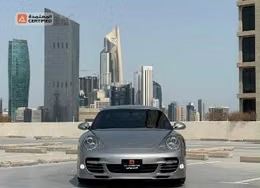
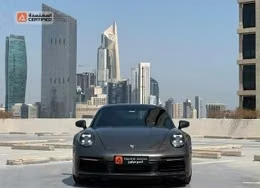
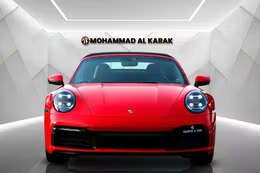
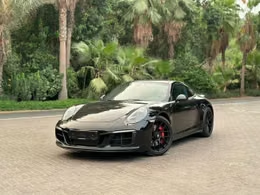
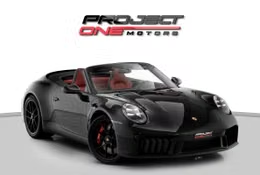
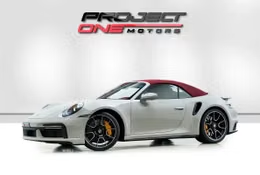
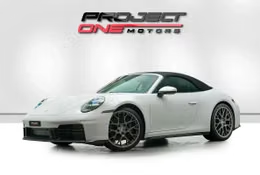
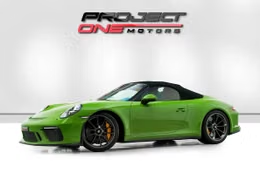
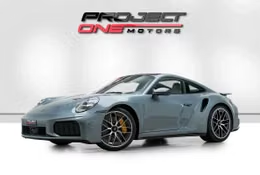
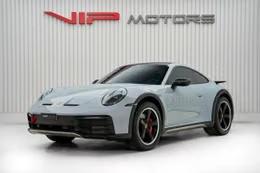
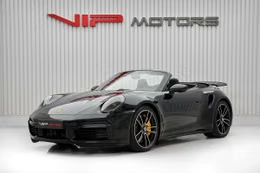
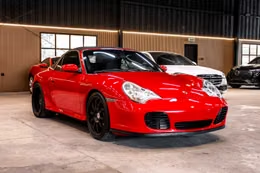
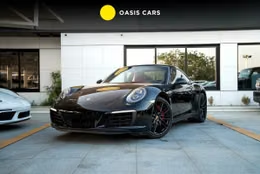
911 Carrera 2025 GCC Al Nabooda
10 500 km
Agency warranty till 12/2027
Original paint
High quality PPF
Porsche Exclusive Manufacture - special order from the factory
Exclusive color, rims, interior
Front axle lift
Ventilated seats & loniser
Adaptive cruise control
Extended leather
2025
10,500 كم
عدد الكيلومترات منخفض
589,000 AED
التمييز باللون
طريق رائع لجذب انتباه الآخرين إلى عرضكم، حيث سيكون أكثر بروزاً في نتائج البحث.
يوضح الرسم البياني ديناميكيات متوسط سعر الطراز في سوق السيارات المستعملة خلال العام الماضي. تساعدك هذه البيانات على تقييم جدوى الشراء وتوقع القيمة المستقبلية للسيارة.
قد تختلف الأسعار على AUTO.AE عن تكلفة البيع الفعلية. تستند البيانات إلى قاعدة بياناتنا من السيارات المباعة والإعلانات الحالية. للحصول على تقييم دقيق، استخدم أداتنا.
After nearly 40 years of transforming modern Porsches into wider, faster machines, TechArt has taken an unexpected step back in time. Its new GTclassic is based on the air-cooled 964-generation Porsche 911, combining the character of the original with carefully chosen modern upgrades. At its heart is a naturally aspirated 3.8-liter flat-six producing up to 380 PS / 375 hp / 279 kW, driving the rear wheels through a five-speed manual, according to Motor1. Upgraded suspension, motorsport engine mounts and stronger brakes make the GTclassic more than a visual restomod. The design blends old and new, with modern LED lights, a vented ducktail and 18-inch forged wheels inspired by classic Fuchs rims. Inside, Hanhart stopwatches and bespoke trim meet Apple CarPlay and navigation. Naturally, Singer comes to mind. But can TechArt’s decades of Porsche experience give the GTclassic its own identity? And if you had to choose, would you take the Singer approach or this TechArt interpretation?
أخبار
This Porsche 911 Is Worth $650K
The 1997 Porsche 911 Turbo S is one of the rarest and most desirable versions of the final air-cooled 911 Turbo—and this Guards Red example is now heading to auction. It isn’t Michael Jordan’s car, but it looks remarkably similar to the Turbo S seen in The Last Dance. Only 176 U.S.-spec examples were originally sold, making the 993 Turbo S an increasingly valuable collector car. This one has just 24,000 miles, a black leather interior and a Porsche Certificate of Authenticity. It was also comprehensively serviced in 2023, including replacement of aging belts and seals. The Turbo S added larger turbochargers, upgraded cooling and engine management, and more boost than the standard Turbo. Its 3.6-liter engine produced 424 hp, sent through a six-speed manual transmission to all four wheels. The current bid has already reached $650,000, despite the car being nearly three decades old. That’s enough for two new 911 Turbo S models—and makes this air-cooled icon a serious investment as well as a spectacular grand tourer. Could this 993 Turbo S set a new auction record? How high could the bidding go? Would you spend $650,000 on an air-cooled Porsche? 👇 Auction ends September 18
تعديل
Porsche 911 Turbo S (992.1) M1000 — 952 HP / 1,091 Nm
# The Project This Porsche 911 Turbo S was built around a more demanding objective than simply producing a large dyno number. The idea was to create one configuration capable of doing three very different jobs without changing the car between them: daily road use in Dubai, circuit sessions at Yas Marina and Dubai Autodrome, and nine-second quarter-mile runs at Yas Marina. The starting point was a completely stock 992.1 Turbo S producing 641 HP and 800 Nm from its 3.7-litre twin-turbo flat-six. The finished M1000 configuration produces 951.5 HP and 1,090.8 Nm — while remaining street-registered and regularly driven. More importantly, the calibration used for the car’s 9.33-second quarter mile is the same calibration it can run on the road. Powertrain At this level, the turbochargers cannot be treated as an isolated upgrade. Increasing airflow through one part of the engine only moves the restriction somewhere else, so the entire induction, charge-air and exhaust path was addressed as a system. The 3.7-litre MDB.CB flat-six received upgraded turbochargers mounted to upgraded exhaust manifolds, followed by catless downpipes to reduce restriction on the exhaust side. On the charge side, the car uses upgraded intercoolers, charge pipes and an upgraded plenum, allowing the engine to move and cool the additional volume of air required at higher boost pressure. A water-methanol injection system was incorporated into the setup to reduce charge temperature and provide additional knock margin under sustained high-load operation. The factory MAP sensors were also replaced. This is a small component with a major role in a build like this. Once manifold pressure exceeds the measurement range of the standard sensor, the ECU no longer receives an accurate pressure value. The signal effectively reaches its ceiling even if actual boost continues to rise. On a torque-based ECU, that affects far more than a boost gauge. Pressure information feeds directly into the engine’s load and torque calculations, meaning the control strategy needs an accurate signal throughout the entire operating range. Upgraded MAP sensors extend that range and allow the ECU to continue seeing the real manifold pressure at the boost levels required by the M1000 setup. ECU / Calibration The engine is controlled by a Bosch MG1CP007, and the calibration work goes considerably deeper than increasing a boost target. The 992 Turbo S uses a torque-based engine management strategy. The ECU continuously calculates requested and delivered torque and uses that model to coordinate boost pressure, throttle position, ignition, fueling and multiple protection functions. For the M1000 setup, the torque model and boost targets were developed together, followed by ignition, lambda and the relevant thermal and protection windows. At the same time, the eight-speed PDK had to be calibrated around the same torque target. The standard Turbo S produces 800 Nm. This car reaches almost 1,091 Nm, meaning the transmission is being asked to handle roughly 290 Nm more torque than in factory specification. Leaving the gearbox on its standard limits would create a hidden bottleneck. Even if the engine ECU requests full output, the transmission can intervene when its calculated torque ceiling is exceeded and effectively trim engine performance during the run. For that reason, the PDK torque limits and clutch-pack clamping pressure were recalibrated to match the increased engine output. The objective was to make the engine ECU and transmission work from the same torque model rather than have one system constantly trying to limit the other. Dyno Results Final calibration was validated on the DEIZ rolling road in Dubai. With the V002 calibration, 98 RON fuel and water-methanol injection, the car produced: 951.5 HP at the engine 822.5 HP at the wheels 1,090.8 Nm at 4,150 RPM Peak power was recorded at 6,810 RPM. The run was completed at 32.4°C ambient temperature and 101.2 kPa atmospheric pressure, with an SAE J1349 correction factor of 0.991. A second back-to-back run was then performed using the same calibration with MS109 race fuel added. That produced 945.7 HP at the engine, 818.1 HP at the wheels and 1,083.0 Nm at 4,170 RPM, with peak power at 6,900 RPM. Ambient temperature had increased to 34.5°C. The difference between the two runs was only around six horsepower despite the hotter conditions. For a car at this output level, that repeatability is more useful than producing one unusually high peak figure under ideal conditions. Torque is already on its plateau by approximately 4,150 RPM, while power continues to carry towards 6,900 RPM, giving the car a very broad operating window rather than a narrow top-end-only power delivery. SAE J1349 vs SAE J607 The quoted figures use SAE J1349 correction, allowing them to be compared on a more conservative basis with the factory-rated 641 HP and 800 Nm. The same runs expressed using SAE J607, a correction standard still commonly seen on performance dynos, would read approximately 999 HP and 1,145 Nm. The hardware has not changed between those figures — only the correction method has. For this project, the reference result remains 951.5 HP and 1,090.8 Nm under SAE J1349. Real-World Performance The dyno was only one part of the validation process. On the drag strip at Yas Marina, the Turbo S recorded a personal best quarter mile of 9.33 seconds. Acceleration testing from the same development program produced: 0–100 km/h — 2.23 seconds 100–200 km/h — 4.22 seconds An earlier stage of the project had already recorded a 9.44-second quarter mile, before further development moved the car deeper into the 9.3-second range. For drag testing, Mickey Thompson tyres were fitted to maximise traction. The more interesting part of the project, however, is that the car was not developed only for straight-line use. At Dubai Autodrome, an earlier configuration recorded a 2:13.30 lap on the Grand Prix Circuit. Continued development later brought the car into the 2:08 range, with repeatable laps at both Dubai Autodrome and Yas Marina. That creates a very different calibration challenge. A drag pass asks for maximum performance over approximately nine seconds. A circuit session asks the engine, cooling system, turbochargers and transmission to repeat high-load operation lap after lap without allowing temperatures, ignition correction or torque delivery to drift away from the target. The same M1000 calibration was developed to deal with both. And after the track session, the car can still be driven home. Monitoring and Validation Throughout development, we used high-speed RAM datalogging of the ECU’s internal parameters rather than relying only on the dyno curve. That allows us to see what the control system is actually doing during a pull or a track session. Parameters including requested versus measured pressure, per-cylinder ignition correction, lambda and intake-air temperature were monitored throughout development. Every change to boost, ignition or torque strategy was evaluated against those traces. The aim is not to find a single pull where the engine briefly reaches the target number. The aim is to develop a state where the engine can repeatedly hold the requested output while the ECU’s protection strategies continue to operate correctly. This becomes especially important in Dubai. The calibration was deliberately developed with 35°C-plus Gulf conditions in mind, with margin retained in boost, ignition and thermal protection rather than using every available degree or every possible pressure target for one headline dyno run. Water-methanol injection adds charge cooling and knock resistance, but it works alongside the ECU protection strategy rather than replacing it. The result is visible in the consistency: back-to-back dyno pulls in 32–35°C ambient, repeated circuit laps and nine-second quarter-mile performance from the same street-driven car. Final Result The finished Porsche 911 Turbo S M1000 moves from the factory 641 HP / 800 Nm to 951.5 HP / 1,090.8 Nm. That represents an increase of approximately 311 HP and 291 Nm. But the purpose of the project was never to create a dyno-only 992. It was to build one Turbo S capable of performing across road, circuit and drag use without requiring a different engine calibration for each discipline. The upgraded turbochargers, charge-air system, MAP sensors, water-methanol injection, ECU torque model and PDK calibration were developed as parts of the same system. The result is a street-registered 992 Turbo S capable of a 9.33-second quarter mile, 2.23-second 0–100 km/h, 4.22-second 100–200 km/h and repeatable circuit running in the 2:08 range — in Gulf conditions. All calibration, dyno development, logging and validation were completed at DEIZ GARAGE in Dubai. 951.5 HP. 1,090.8 Nm. 9.33 seconds. One calibration for road, circuit and drag. Technical Specification Vehicle: Porsche 911 Turbo S (992.1) Engine: 3.7-litre MDB.CB twin-turbo flat-six Factory output: 641 HP / 800 Nm Final output: 951.5 HP / 1,090.8 Nm Power gain: +311 HP Drivetrain: All-wheel drive ECU: Bosch MG1CP007 Transmission: 8-speed PDK Turbochargers: Upgraded Exhaust manifolds: Upgraded Downpipes: Catless Intercoolers: Upgraded Charge pipes: Upgraded Plenum: Upgraded MAP sensors: Upgraded extended-range sensors Injection: Water-methanol Fuel: 98 RON / MS109 during additional testing Calibration: M1000 Quarter mile: 9.33 s 0–100 km/h: 2.23 s 100–200 km/h: 4.22 s Circuit performance: 2:08 range Explore Our Services: https://deiz.ae Follow Our World: Instagram | Facebook Text or Call Us: WhatsApp | +971 4 608 68 08
أسئلة وأجوبة حول Porsche 911 (FAQs)
قد تشمل إعلانات Porsche 911 الفئات التالية: Carrera، Turbo S، Carrera GTS، وCarrera S، وغيرها. تعتمد القائمة الحالية على الدولة المختارة وسنة الصنع وتوفر السيارات. استخدم فلتر «الفئة» لمقارنة الخيارات المتاحة.
ينبغي تقييم المسافة المقطوعة إلى جانب عمر السيارة وحالتها وسجل صيانتها. قارن المسافة المقطوعة بسيارات مماثلة من سنة الصنع نفسها، وتحقق من سجل الصيانة والحالة الفعلية للسيارة قبل الشراء.
تتراوح أسعار الإعلانات الحالية لسيارة Porsche 911 على AUTO.AE من ١٢٠٬٠٠٠ إلى ٢٬٠٩٩٬٠٠٠ AED. يعتمد السعر على سنة الصنع والمسافة المقطوعة والفئة والحالة والمواصفات الإقليمية. تستند هذه البيانات إلى الإعلانات النشطة وقد تتغير.
قد يعرض البائع الخاص سعراً أقل، بينما قد يقدم معرض السيارات خدمات إضافية مثل التمويل أو الضمان أو المساعدة في التأمين. تختلف الشروط، لذا تحقّق من معلومات الإعلان ووثائق السيارة وبيانات البائع.
تحقّق من بطاقة تسجيل المركبة «الملكية» (Mulkiya)، ومن تطابق رقم الهيكل (VIN) على السيارة وفي الوثائق، وبيانات المالك، وسجل الصيانة، وسجل الحوادث. وتأكد أيضاً من عدم وجود قرض قائم أو مخالفات أو قيود أخرى على السيارة. ويُفضّل إجراء فحص مستقل قبل إتمام الصفقة.
نعم. يمكنك الاتفاق مع البائع على إجراء فحص فني مستقل في مركز خدمة من اختيارك. يساعد الفحص على تقييم حالة المحرك وناقل الحركة والهيكل والأنظمة الإلكترونية والمكوّنات الأخرى.
يعني مصطلح GCC Specs أن السيارة صُنعت وفق المواصفات المعتمدة لأسواق دول مجلس التعاون الخليجي. وعادةً ما تكون هذه الإصدارات مصممة لتناسب الظروف المناخية المحلية. لكن GCC Specs بحد ذاتها لا تثبت حالة السيارة ولا تعني وجود ضمان ساري؛ لذا يجب التحقق من حالة السيارة والضمان بشكل منفصل.
تقدم بعض معارض السيارات خيارات تمويل. وعند توفرها، قد تُذكر الشروط أو قيمة القسط الشهري التقديرية في الإعلان. تعتمد نسبة الفائدة النهائية والموافقة على البنك والدفعة الأولى وبيانات المشتري.