How Often Should You Change the Transfer Case Oil in a Toyota Land Cruiser 200?
Toyota Land Cruiser 200 Series 200 Series Facelift 2
Toyota Land Cruiser 200 Series 200 Series Facelift 2•
•70 مشاهدة
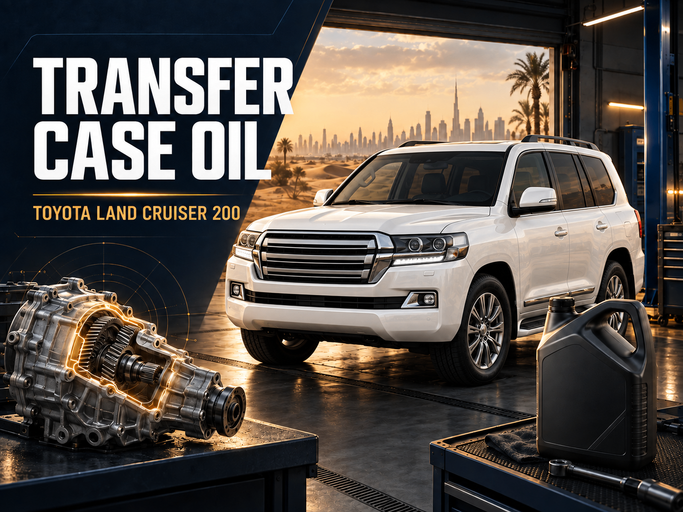
For the Toyota Land Cruiser 200, the baseline is to inspect the transfer case oil every 40,000 km or 48 months, whichever comes first. In Toyota's schedule, this means checking the oil and its level, then correcting or replacing it as necessary rather than changing it automatically. Do not wait for the scheduled interval after water exposure, prolonged driving in sand, a leak, or a new noise.
The current Toyota manual for the LC200 gives a reference refill capacity of 1.45 L and specifies Toyota Genuine Transfer Gear Oil LF or an equivalent, with SAE 75W viscosity. The generation was produced for many years, however, and early manuals specify API GL-5 SAE 75W-90. Select the oil by production year, VIN, and the manual for the individual vehicle, not simply by the name 'Land Cruiser 200'.
How Can You Tell When the Land Cruiser 200 Transfer Case Oil Needs Checking or Changing?
The transfer case is continuously involved in transmitting torque to both axles. On an older LC200, mileage is only part of the picture: seals age, breathers can become contaminated, and a previous owner may have used the wrong oil. The decision to replace it should consider the level, sealing, oil condition, wear debris, and the nature of any noise.
- The next scheduled inspection is due. If 40,000 km or four years have passed since the last documented check, inspect the transfer case. Without repair orders or records identifying the oil, a baseline service is more reliable than treating the seller's verbal description as a complete maintenance history.
- Fresh oil traces are visible on the housing. Inspect the drain and fill plugs, housing joint, output-shaft seals, and the areas beside the propeller shafts. Slight sweating is not the same as an active leak, but the level may fall gradually. Low oil is more dangerous to the transfer case than old oil because lubrication and heat removal deteriorate.
- The oil is cloudy or contains water. A milky appearance, foam, or a pale emulsion suggests moisture ingress. A water crossing, damaged breather, or leaking seal may be responsible. Refilling alone is not enough: identify the entry path first, replace the oil, and then recheck the unit.
- A hum, whine, or knock has appeared during load changes. Noise that grows under load, on overrun, or when low range is selected calls for diagnosis. Wheel bearings, propeller-shaft joints, differentials, and the automatic transmission can create similar sounds. Replacing the oil before isolating the source may achieve nothing.
- The maintenance history is unknown after purchase. This matters particularly on the LC200 because the difference between early and late specifications makes a random container of 75W-90 or 75W a risky choice. Before servicing, establish the production year and regional version, review the records, and, where possible, inspect the drained oil and plug magnet.
Why Heat, Sand, and Vehicle Age Call for Closer Inspection
High ambient temperature does not override the factory specification or justify choosing a thicker oil. Towing, dune driving, low speed at high torque, and extended four-wheel-drive operation add heat. On a high-mileage LC200, ageing seals, damaged underbody protection, and a restricted breather can add further risk.
An automatic oil change is not required after ordinary driving on dry tracks. Remove dense deposits from the underside and check the housing for fresh leaks. The approach should be stricter after water exposure: Toyota warns that water can enter the differentials, transmission, and transfer case and reduce the oil's lubricating qualities. Inspect the oil outside the normal schedule in this situation.
What Happens If You Do Not Change the Land Cruiser 200 Transfer Case Oil?
Risk is determined by more than the oil's time in service. A sound unit with the correct level and a transfer case slowly losing oil through a seal operate under very different conditions. Damage develops fastest with a low level, water emulsion, overheating, or large metal particles.
- First, the oil loses protective performance. Heat cycles, moisture, and wear debris alter its additive performance. The lubricating film becomes less stable while contaminants continue to pass through friction surfaces, bearings, and the chain drive.
- Then temperature and mechanical noise increase. When the oil level is low, components receive less lubrication and cooling. A hum may be present only during acceleration or high-load operation, so the absence of constant noise does not prove that the unit is sound.
- Clearances and impact loads increase. Wear in the bearings, gears, and chain produces play, vibration, and knocks as the driveline moves between drive and overrun. Fresh oil cannot restore damaged working surfaces.
- Four-wheel-drive operation may be affected. Difficulty selecting a range, dashboard warnings, or inconsistent behaviour under load requires a complete inspection. The cause may be mechanical or related to actuators, sensors, or wiring.
- The worst-case outcome is a major transfer case repair. Failure of a bearing, gear, or chain drive can cause loss of drive, seizure, and damage to adjacent parts. Cost can only be estimated after diagnosis; one universal repair figure for every LC200 would be misleading.
Toyota's Official Land Cruiser 200 Transfer Case Oil Data
In the standard LC200 maintenance schedule, Transfer oil is an inspection item, with correction or replacement as necessary. The specifications in the official English-language Toyota manual give the reference capacity and oil requirement for the later vehicle version.
| Parameter | Toyota data for the Land Cruiser 200 |
|---|---|
| Scheduled operation | Inspect; correct the level or replace the oil as necessary |
| Inspection interval | 40,000 km or 48 months, whichever comes first |
| Refill capacity | 1.45 L (reference value) |
| Later specification | Toyota Genuine Transfer Gear Oil LF or equivalent; SAE 75W |
| Early manual | API GL-5; SAE 75W-90 - use only when specified for the individual vehicle |
| After water or demanding off-road use | Unscheduled inspection; if emulsification, contamination, or loss of level is found, replace the oil and identify the cause |
Sources: Toyota Australia LandCruiser 200 Owner's Manual (Aug 2017-Aug 2018) and early Toyota manual OM60C95U. Check the current documentation for the individual vehicle by VIN on toyota.ae or with an authorised dealer.
The production year and vehicle version can be matched provisionally in the Toyota Land Cruiser 200 catalogue. This is not sufficient for ordering oil: make the final decision from the VIN, manual, and unit identification.
How to Interpret the 40,000 km / 48-Month Interval
The interval sets the deadline for the next inspection, not a guaranteed oil life. If the vehicle has covered 18,000 km in four years, the time-based check is still due. If it reaches 40,000 km earlier, mileage governs. A leak, water, overheating, or obvious metal chips removes any reason to wait for scheduled service.
For an older LC200, distinguish Toyota's schedule from a workshop's preventive strategy. A workshop may recommend more frequent replacement after severe use or when the history is unknown. That can be sensible advice, but it should not be presented as one mandatory Toyota interval for every vehicle.
Which Oil to Use - and Why the Production Year Matters
The later English-language LandCruiser 200 manual specifies Toyota Genuine Transfer Gear Oil LF SAE 75W or an equivalent. The early official LC200 manual specifies API GL-5 SAE 75W-90 with the same 1.45 L reference capacity. These requirements must not be combined into 'any gear oil will do': first identify the applicable documentation from the VIN and production date.
- Do not use Toyota ATF WS. That fluid is intended for the automatic transmission; the transfer case has a separate specification.
- Do not select oil by viscosity alone. The labels 75W and 75W-90 do not fully describe a product's formulation and operating properties. Matching one number on the container does not confirm compliance with the manual.
- Do not mix unidentified products. If the oil already in the unit cannot be identified, a complete change with the correct product is safer. Record the brand, specification, date, and mileage.
- Do not force exactly 1.45 L into the unit. This is a reference capacity. Set the final level using Toyota's procedure with the vehicle positioned correctly and consider how much oil actually drained out.
What Faults Can the Oil's Condition and the LC200's Behaviour Suggest?
A single symptom rarely identifies only the transfer case. The table helps direct the inspection, but the final conclusion requires a visual check, oil-level verification, and noise isolation.
| Condition | What happens | What the owner may notice |
|---|---|---|
| Low oil level | Lubrication and heat removal deteriorate; the unit runs hotter | Hum under load, overheated smell, fresh leak |
| Water in the oil | Emulsion reduces protection and accelerates corrosion | Milky colour or foam; early symptoms may be absent |
| Overheating | Additives lose performance faster and the oil film becomes unstable | Dark oil, burnt smell, noise after demanding driving |
| Metal particles | Wear debris circulates and damages working surfaces | Metallic glitter or large chips on the magnet, increasing hum |
| Incorrect specification | Oil viscosity and properties do not match the unit version | Heat, noise, impaired operation, or no early warning signs |
| Worn components | Clearances and impact loads remain after an oil change | Whine, vibration, or knocks during acceleration and overrun |
Practical Service Checklist
☐ Record the VIN, production year, and regional specification.
☐ Find the manual that applies to this particular LC200 version.
☐ Check records for the date, mileage, and name of the oil previously used.
☐ On a lift, inspect the housing, both plugs, breather, seals, and areas beside the propeller shafts.
☐ Before draining, make sure the fill plug can be loosened.
☐ Inspect the drained oil and magnet; water or large chips require investigation.
☐ Use the specified oil type and fit new sealing washers.
☐ Follow the tightening torque and oil-level procedure in the manual.
☐ After service, check for leaks, carry out a short road test, and retain a service record.
Mistakes to Avoid
- Treating every LC200 as identical. Technical requirements changed during the model's long production run, so verify the specification for the individual vehicle.
- Using 75W-90 in a late transfer case out of habit. Its presence in early manuals does not make it a universal choice for the entire generation.
- Switching to a thicker oil because of heat or noise. Climate affects load and inspection frequency, while an unusual sound requires diagnosis rather than concealment.
- Waiting for 40,000 km when there is a leak. The schedule does not authorise continued operation with a low level or damaged seal.
- Confusing the transfer case with the differentials or automatic transmission. Each unit requires its own fluid; one product for the entire driveline is a reason to question the workshop's decision.
Conclusion
For the Land Cruiser 200, Toyota's baseline is to inspect the transfer case oil every 40,000 km or 48 months and replace it according to condition. The current manual specifies a 1.45 L reference capacity and Transfer Gear Oil LF SAE 75W, but early versions have different requirements. Check the VIN and production year before service, and inspect the unit outside the schedule after water exposure, a leak, or a new noise.