How Often Should You Change the Coolant in a Toyota Land Cruiser 200? A Detailed Guide
Toyota Land Cruiser 200 Series 200 Series Facelift 2
Toyota Land Cruiser 200 Series 200 Series Facelift 2•
•63 مشاهدة
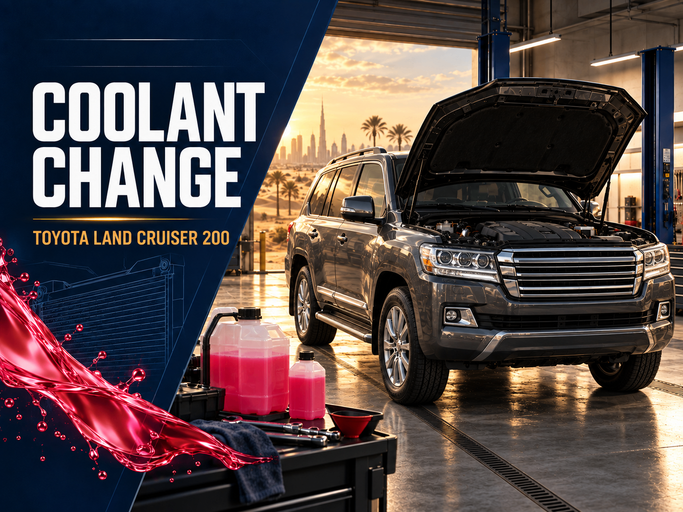
or a Toyota Land Cruiser 200 filled with genuine Toyota Super Long Life Coolant, the general reference is the first complete replacement at 160,000 km or 120 months, followed by replacement every 80,000 km or 60 months. The schedule can vary by model year and market specification, so the service booklet and VIN-specific information take priority.
Engines and specifications for later versions of the model are listed in the Toyota Land Cruiser 200 catalogue. When assessing a pre-owned vehicle, distinguish a complete coolant change from a simple top-up: useful records identify the product, date, mileage and any repairs to the radiator, water pump or hoses.
How Can You Tell When the Coolant in a Land Cruiser 200 Needs Changing?
No single visual sign provides a reliable answer. Even clear, brightly coloured coolant may be old, while slight darkening does not always indicate a fault. Base the decision on time, records, inspection results and the behaviour of the cooling system.
- The scheduled interval has been reached. If the factory SLLC has covered ten years or 160,000 km, the replacement should not be postponed. After the first service, use five years or 80,000 km as the reference unless the documentation for the specific vehicle states otherwise.
- There is no confirmed service history. A top-up entry does not prove that the system was drained and refilled. When the date and product are unknown, first check leak-tightness, concentration and contamination, then decide whether replacement and flushing are required.
- The level drops noticeably. A healthy closed system should not require regular replenishment. Damp joints, crystalline residue or traces around the water pump or reservoir point to a leak. If no external evidence is visible, the vehicle needs a pressure test and engine diagnosis.
- The coolant appearance or smell has changed. Flakes, rusty sediment, an oily film, cloudiness or an unusual smell require diagnosis. A simple change will not solve the problem if oil is entering the system, incompatible products have been mixed or corrosion continues.
- Temperature behaviour has changed. A temperature rise under load, frequent fan operation, a coolant smell, steam or an overheating warning is a reason to stop and inspect the system. Fresh coolant will help only when the fault is genuinely related to coolant condition or concentration.
Why the Level Should Be Checked Only After the Engine Cools
A hot cooling system is pressurised. Opening a cap can release steam and scalding coolant. Check the level on level ground only after the vehicle has cooled completely, using the reservoir markings and the procedure in the owner’s manual. Regular top-ups call for diagnosis and are not a normal operating characteristic.
Why Overdue Coolant Is a Risk in a Land Cruiser 200
SLLC is designed for long service, but its protective additives are gradually depleted. Once the interval is exceeded, deterioration may remain unnoticed until high load or hot weather exposes a weak point.
- Protection of metals weakens. Inhibitors help prevent corrosion of aluminium parts, pipes, the water-pump housing and internal passages. As the coolant ages, this protection reserve declines.
- Deposits reduce heat transfer. Mineral salts from unsuitable water, corrosion products and traces of incompatible coolant can settle in passages and on heat-exchanger surfaces.
- Load on the water pump and seals increases. Contamination and incorrect concentration accelerate wear of the pump seal. Even a small leak reduces the system reserve when towing, driving in sand or operating for long periods at low speed.
- Coolant loss can create air pockets. Air disrupts circulation and creates local hot spots. The temperature sensor may not immediately reveal that one part of the engine is overheating.
- Overheating can lead to expensive repairs. Continuing to drive at excessive temperature can damage gaskets, deform components and ruin the engine. A coolant change alone cannot reverse existing damage; the vehicle requires full diagnosis.
Which Coolant Should You Use in a Land Cruiser 200?
The LC 200 owner’s manual specifies Toyota Super Long Life Coolant or a comparable high-quality ethylene-glycol coolant that is non-silicate, non-amine, non-nitrite and non-borate, using long-life hybrid organic acid technology. Genuine SLLC contains 50% coolant and 50% deionised water and is supplied ready to use.
Select the appropriate document for the vehicle’s model year and specification in the Toyota manuals section. For an LC 200 using SLLC, the general schedule is 160,000 km or 120 months before the first replacement, followed by 80,000 km or 60 months between later changes. The service documentation for the specific vehicle takes priority.
Reference Cooling-System Specifications for the LC 200
For common LC 200 versions, the manual lists separate capacities for the 4.6-litre petrol 1UR-FE and 4.5-litre diesel 1VD-FTV. Total capacity depends on whether the vehicle has a rear heater; a routine drain may require less coolant than the full reference figure.
| Parameter | 1UR-FE, 4.6 V8 petrol | 1VD-FTV, 4.5 V8 diesel |
|---|---|---|
| First scheduled SLLC replacement | 160,000 km / 120 months* | 160,000 km / 120 months* |
| Subsequent replacements | 80,000 km / 60 months* | 80,000 km / 60 months* |
| With rear heater | approximately 16.5 L | approximately 17.6 L |
| Without rear heater | approximately 13.8 L | approximately 14.8 L |
| Coolant requirement | Toyota SLLC or a fully compliant equivalent | Toyota SLLC or a fully compliant equivalent |
| Checks after filling | Bleed air, warm up, cool down and recheck the level | Bleed air, warm up, cool down and recheck the level |
* Intervals are Toyota references for Toyota SLLC. Capacities are reference figures from LC 200 owner’s manual OM60Q28E and depend on the engine and rear-heater configuration. Use the service booklet and VIN-specific data for a vehicle with another specification.
Why Coolant Colour Does Not Confirm Compatibility
Pink is associated with genuine Toyota SLLC, but colour is not a specification. Products with the same colour can use different corrosion inhibitors. Check composition and full owner’s-manual compliance, not only colour, vehicle-brand wording or the phrase Long Life.
If the coolant already in the system cannot be identified, do not mix products unless compatibility has been confirmed. After an emergency top-up with water or unsuitable coolant, restore the correct mixture as soon as possible. Tap water leaves mineral deposits; coolant concentrate should be mixed only with suitable demineralised water and in the ratio permitted by its manufacturer.
Why a Land Cruiser 200 May Overheat in Hot Weather
Coolant age is only one possible factor. High ambient temperature reduces the available heat-rejection margin, while sand and insects obstruct the condenser and radiator fins. Air-conditioning use, towing, a heavily loaded vehicle and slow off-road driving add further thermal stress.
| Cause | What happens | What to inspect |
|---|---|---|
| Low level or leak | Air enters the circuit, reducing circulation and heat transfer. | Reservoir, caps, hoses, radiator, water pump, joints and dried coolant residue. |
| Dirty radiator stack | Dust, sand and insects restrict airflow through the heat exchangers. | The space between condenser and radiator; clean carefully without bending the fins. |
| Incorrect mixture | Excess water weakens protection, while incompatible additives can form deposits. | Product name, concentration and top-up history; do not adjust the mixture by guesswork. |
| Air after repairs | An air pocket disrupts flow and creates local hot spots. | Filling and bleeding procedure, heater operation and the level after complete cooling. |
| Component fault | The thermostat, cap, fan or water pump cannot maintain the intended condition. | Fault codes, pressure, fan operation, thermostat opening and actual circulation. |
| Aged or dirty coolant | Depleted additives allow corrosion and deposits to impair heat transfer. | Age, mileage, clarity, contaminants and coolant-test results. |
How to Set the Replacement Date for a Specific Vehicle
- Factory fill with a documented history. Follow the VIN-specific schedule and inspect the system at every scheduled service. Before the hottest season, check radiator cleanliness and fan operation separately.
- A vehicle with an unknown history. Check the level, concentration, leak-tightness and repair records. Preventive replacement is reasonable when the date or product cannot be confirmed, but it must not conceal a leak.
- The circuit was opened for repairs. After replacing a radiator, water pump, thermostat or hose, use the correct coolant and filling procedure. Bleed the air, warm the vehicle and recheck the level after it has cooled completely.
- The coolant is mixed or contaminated. A partial drain may be insufficient when the system contains an unknown mixture, oil, rust or flakes. Choose the flushing method after diagnosis so that the contamination source is not left in the system.
Practical Checklist Before Coolant Replacement
- Confirm the engine, model year and equipment. The 1UR-FE and 1VD-FTV have different reference capacities, and a rear heater also changes the total system capacity.
- Inspect the system before draining. Check the reservoir, caps, radiator, water pump, hoses, joints and the space between the heat exchangers. Fresh coolant can quickly escape through an existing leak.
- Verify the complete specification. Labels such as “pink” or “for Toyota” are not enough. Use Toyota SLLC or a confirmed equivalent that matches the chemical technology stated in the owner’s manual.
- Allow the system to cool completely. Begin work only when the engine is cold. Pressure in a hot circuit can eject steam and scalding coolant.
- Keep a service record. Record the date, mileage, product name, refill quantity, inspection results and any parts that were replaced.
- Verify the result after the work. After bleeding the air, confirm that there are no leaks, the heaters work and the temperature remains stable. Check the final level only after complete cooling.
What to Check Between Scheduled Coolant Changes
- Level with the engine cold. Compare it with the reservoir markings under consistent conditions. Small temperature-related variations are normal; a persistent drop is not.
- Leak traces and hose condition. Look for damp areas, white or pink residue, cracks, swelling and hoses rubbing against nearby components. A sweet smell after driving also requires inspection.
Conclusion
For a Toyota Land Cruiser 200 using SLLC, the general reference is the first replacement at 160,000 km or 120 months, followed by replacement every 80,000 km or 60 months. In a hot, dusty climate, regular checks of the level, leak-tightness, radiator stack and fans matter most; there is no need to shorten the interval arbitrarily without diagnosis.