


How Often to Change the Engine Oil in a Toyota Highlander XU70 Hybrid: Intervals, Specifications and Capacity
Toyota Highlander
Toyota Highlander•
•17 views
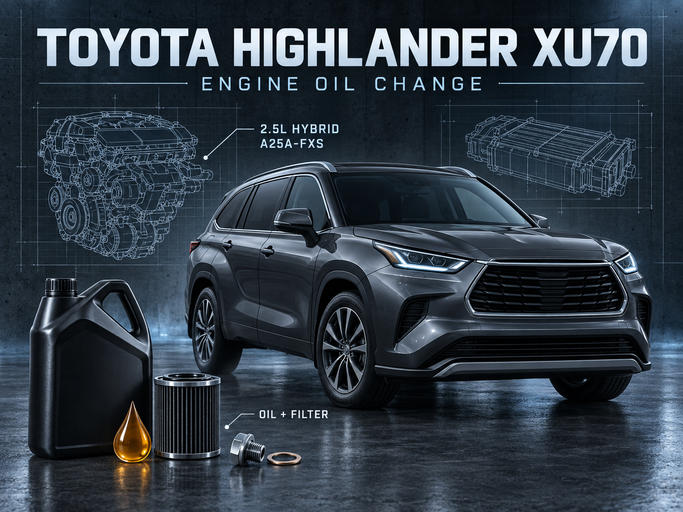
For a Toyota Highlander XU70 with the 2.5-litre hybrid powertrain and A25A-FXS petrol engine, a practical upper planning point is 10,000 km or six months, whichever comes first. Short urban journeys, frequent engine restarts, prolonged stationary climate-control use, full loads, heat, and dust justify bringing the distance closer to 5,000 km. The final interval, viscosity, and refill quantity must be matched to the VIN, model year, and original market.
5 Situations When a Highlander Should Not Wait for the Scheduled Date
A hybrid Highlander may travel part of each journey on electric power, but calendar ageing does not pause. The petrol engine can start and stop repeatedly during one trip, while family use adds passengers, luggage, air-conditioning demand, and long stationary periods. Mileage alone therefore does not describe the oil’s workload.
- The time or distance limit has arrived. Service the vehicle when the first limit is reached. Low annual mileage does not prevent oxidation, condensation, or gradual additive depletion.
- Most journeys are short and urban. The petrol engine may run briefly and then stop again under hybrid control. If the oil seldom remains at operating temperature, moisture and fuel can stay in it for longer.
- The SUV often carries a full load or climbs long grades. Seven occupants, luggage, sustained speed, and uphill operation increase heat. This use consumes the oil’s protection margin faster than relaxed driving on level roads.
- The dipstick level is rising or falling noticeably. A decrease calls for leakage and consumption checks; an increase can indicate fuel dilution. A top-up or early change does not replace diagnosis.
- The red oil-pressure warning remains on after the engine starts. Treat this as an emergency. Stop safely, switch off the hybrid system, and do not continue until the level and the cause have been checked.
Why Hybrid Mileage Is Not the Same as Engine Operation
The odometer records the entire journey, including electric-only movement, while the petrol engine runs intermittently. Fewer engine hours do not always mean easy conditions: brief starts, repeated warm-up cycles, and high-load operation create their own ageing pattern. A useful interval therefore considers distance, elapsed time, and how the vehicle is used.
What Happens to Oil After the Interval Is Exceeded
Engine oil separates moving surfaces, carries heat away, and holds contaminants until the filter captures them. Its detergent, alkaline, and anti-wear reserves decline with use. Oxidation products, moisture, fuel, and fine particles build up at the same time, making protection less consistent.
- Viscosity moves away from the intended range. Fuel dilution can thin the oil, while prolonged oxidation can thicken it. Either direction interferes with the lubrication system’s intended operation.
- Deposits become more likely. Depleted additives are less effective at keeping contamination suspended. Varnish and sludge can settle in passages, on piston rings, and around variable valve-timing hardware.
- The filter approaches its contamination limit. As captured material accumulates, resistance to flow rises. If the bypass valve opens, some oil can circulate around the filter medium.
- Thermal margin is reduced. Hot weather, heavy loads, and sustained climate-control demand raise operating temperature. Overdue oil handles these conditions with less reserve.
- Symptoms may appear late. The timing drive, bearings, camshafts, and valve-timing actuators rely on stable oil pressure. Noise or a dashboard warning requires investigation, not simply a fresh container of oil.
Reference Data for the Highlander XU70 2.5 Hybrid
The current UAE-market Highlander uses a 2.5-litre hybrid system with the A25A-FXS petrol engine. Earlier vehicles and versions from other markets may use a 3.5-litre V6 or 2.4-litre turbo engine; their capacities, filters, and viscosity requirements are not transferable to the hybrid. The table below is a service-planning reference for the 2.5 Hybrid version.
| Item | Highlander XU70 2.5 Hybrid | How to verify |
|---|---|---|
| Engine | A25A-FXS petrol engine within the hybrid system | VIN and identification data |
| Normal planning point | Up to 10,000 km or six months | Original-market schedule |
| Severe-use planning | About 5,000 km or six months | Operating conditions |
| Viscosity and quality | Exact VIN and market manual | One document revision |
| Refill with new filter | Approximately 4.3 L | Final level by dipstick |
| Post-start check | Warning out; filter and plug dry | Inspection and repeat measurement |
The year, drivetrain, and trim can first be compared with current listings. Before buying service materials, locate the manual for the exact VIN and original market. A catalogue entry or container label that merely says “Highlander” does not confirm compatibility with the A25A-FXS.
How to Use the Reference Figures
First confirm the A25A-FXS code and hybrid designation in the vehicle records. Then match the model year and original market. Information for a US-market petrol Highlander, another XU70 powertrain, or the Grand Highlander may look similar but should not automatically be treated as applicable.
Approximately 4.3 L with a new filter is a planning quantity, not an instruction to pour everything in at once. The remaining oil varies with temperature, drain time, and vehicle position. Begin below the reference figure, run the engine briefly according to the correct procedure, wait, and raise the dipstick level without exceeding MAX.
Matching the Interval to Real Highlander Use
- Long family journeys. With full warm-up, steady speed, and moderate load, the 10,000 km or six-month ceiling is a reasonable planning point unless the documentation for that version calls for earlier service.
- Short urban routes. Repeated engine starts, traffic queues, and limited warm-up amount to severe operation. A practical distance target is about 5,000 km while retaining the six-month limit.
- Full loads, mountain roads, and sustained speed. Continuous traction demand raises oil temperature. Shorten the interval and check the level before a long journey, particularly if consumption has been observed.
- Heat, sand, and long periods of storage. High temperature accelerates oxidation, dust adds filtration demand, and parking does not stop calendar ageing. Track the service date as carefully as the odometer.
Problems Made More Likely by Overdue Oil
A late oil change is rarely the only cause of a fault. Risk rises when aged lubricant combines with an incorrect level, overheating, a restricted filter, leakage, or fuel dilution. Smoke, unstable engine operation, unusual sound, or a warning message calls for diagnosis.
| Condition | Why it matters for a Highlander | What to do |
|---|---|---|
| Short journeys | The petrol engine runs briefly and may not warm the oil fully. | Plan for severe operation. |
| Full loads | Passengers, luggage, and climbs increase thermal demand. | Shorten the interval and check the level. |
| Heat and traffic | Oil temperature and oxidation rate rise. | Check the level more often. |
| Dust and sand | Intake contamination increases filtration demand. | Monitor the air filter. |
| Steady long-distance use | Full warm-up limits moisture accumulation. | Do not exceed 10,000 km or six months. |
| Low annual mileage | Oil ages by time even when the petrol engine runs rarely. | Change by calendar date. |
Checks Before the Oil Change
- Confirm the powertrain. Match the VIN, model year, original market, and A25A-FXS code. Do not use figures for the 3.5 V6, 2.4 Turbo, RAV4, or Grand Highlander merely because the names or layouts appear similar.
- Verify viscosity and oil quality. Take the SAE grade and API or ILSAC requirement from one manual version for the exact vehicle. Hot weather is not permission to move outside the approved range.
- Match the filter and drain washer by VIN. Similar-looking elements can use different threads, valves, or dimensions. Confirm the part numbers before draining the sump.
- Switch the hybrid system fully off. The READY indicator must be off and the vehicle must be protected against an unintended start. A routine oil change does not require contact with high-voltage components or orange wiring.
- Inspect the sump, plug, and undertray. Leakage, damaged threads, or a distorted washer should be corrected before refilling. Refit the lower panels with every fastener in place.
- Check the level after start-up. Confirm that the pressure warning goes out and that the filter and plug remain dry. After the required pause, use the dipstick again and record the date, mileage, viscosity, and filter number.
Four Highlander Service Mistakes
- Treating hybrid operation as a substitute for maintenance. Electric driving reduces petrol-engine running time, but oil still ages by date and undergoes repeated heat cycles.
- Transferring figures from another engine. Capacities and specifications differ among the 3.5 V6, 2.4 Turbo, and A25A-FXS. Identify the powertrain before ordering materials.
- Choosing thicker oil solely because of heat. The approved SAE range already accounts for operating conditions. Unauthorised viscosity changes can affect start-up flow and controlled lubrication systems.
- Adding the entire reference quantity without an intermediate dipstick check. Residual oil changes the real refill requirement. Overfilling can promote foaming, raise crankcase pressure, and carry oil into the intake.
Conclusion
For a Toyota Highlander XU70 2.5 Hybrid with the A25A-FXS engine, begin planning with a ceiling of 10,000 km or six months. Frequent short trips, repeated petrol-engine starts, full loads, heat, and dust bring the practical distance closer to 5,000 km. Before servicing, confirm the VIN and market, use the oil specification from the exact vehicle manual, install a new filter, switch the hybrid system fully off, and set the final level with the dipstick.


