


How Often Should You Change the Transmission Fluid in a Toyota Highlander?
Toyota Highlander
Toyota Highlander•
•10 مشاهدة
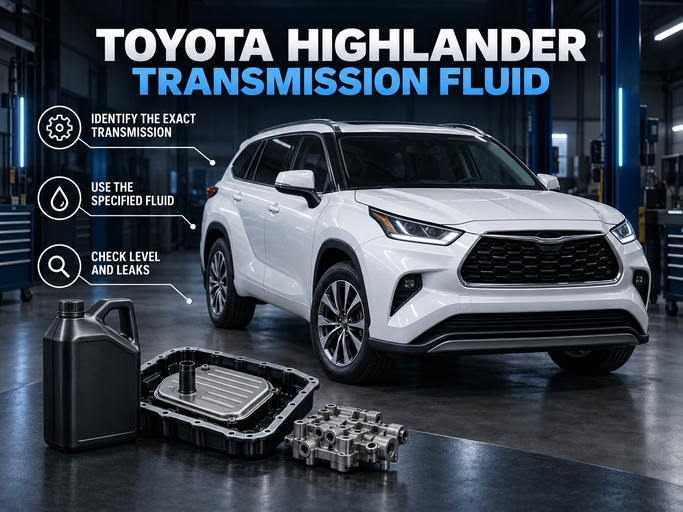
Transmission fluid removes heat, lubricates loaded surfaces, and supports hydraulic operation. In a conventional automatic, its condition affects clutch engagement and torque-converter operation. In a hybrid transaxle, it protects gears, bearings, and electrical components within the unit’s intended design.
There is no single service interval that can be assigned to every Highlander without identifying the vehicle first. Generation, destination market, engine, driveline, and transmission type affect both the required fluid and the level-check procedure. The electronically controlled continuously variable transmission in a hybrid is not a belt-type CVT and follows its own requirements.
5 Signs Your Toyota Highlander Transmission Fluid Needs Inspection
- 1. Delayed engagement of D or R. A pause after selecting a range may relate to fluid level, hydraulic pressure, temperature, or a control fault.
- 2. Harsh or inconsistent shifts. If the familiar smoothness disappears, retrieve fault codes and assess the transmission before treating a fluid change as a universal cure.
- 3. Whine, hum, or unusual vibration. Noise under load calls for checks of the transmission, axles, wheel-end components, and—on applicable AWD models—other driveline units.
- 4. Evidence of leakage. Fluid around the pan, seals, or cooler circuit should be traced and the level verified before further driving.
- 5. Overheating or a dashboard warning. Towing, long climbs, hot weather, and slow traffic raise thermal load; a warning requires prompt attention.
One Symptom Does Not Identify the Cause
Low system voltage, engine faults, worn mounts, throttle issues, and AWD problems can create similar sensations. A sound diagnosis begins with fault-code retrieval, a leak inspection, and confirmation of temperature and fluid level using the procedure for the installed transmission.
What Delayed Service Can Do
| Issue | Internal effect | What the driver may notice |
|---|---|---|
| Fluid oxidation | Thermal stability and lubricity decline | Overheated odor and rougher operation |
| Wear debris | Deposits can interfere with passages and regulating parts | Delay, harshness, or inconsistent response |
| Incorrect level | The pump may draw air or the fluid may foam | Noise, pressure fluctuation, or overheating |
| Leakage | The working fluid volume becomes insufficient | Wet areas and poorer engagement |
How to Determine the Service Interval
Begin with the VIN, model year, destination market, powertrain, and transmission code. Then consult the service information for that exact configuration to see whether it specifies replacement, periodic inspection, or separate provisions for severe use. An instruction to “inspect” should not automatically be rewritten as a mandatory replacement interval.
When Earlier Inspection Makes Sense
Earlier checks are sensible for regular towing, heavy passenger or cargo loads, repeated mountain driving, sand use, prolonged hot-weather congestion, and after water exposure. These conditions do not create one universal interval, but they increase the value of checking condition and sealing integrity.
How to Select the Correct Fluid
The specification matters more than the brand name on the bottle. Select the product from the VIN and the data for the installed unit. Fluid color does not prove compatibility: dye changes in service, and products with a similar appearance may have different friction characteristics.
Conventional Automatic and Hybrid e-CVT Are Different
A hydraulic automatic uses fluid for torque transfer and clutch control. The Highlander hybrid e-CVT uses a planetary power-split device and electric motor-generators, not a variator belt or chain. For that reason, a product labeled “CVT fluid” should never be selected merely because the vehicle description contains e-CVT.
Total Capacity Is Not the Drain Quantity
A routine drain leaves fluid in passages, cooling components, and internal assemblies. The refill amount depends on the work performed and on the specified checking temperature. Filling to the published total capacity after a partial drain can create an incorrect level; the final setting must follow the prescribed procedure.
| Item to confirm | Why it matters |
|---|---|
| VIN, year, and market | One model name spans multiple generations and configurations |
| Powertrain type | Gasoline and hybrid versions use different designs |
| Transmission code | It determines the fluid specification and checking method |
| Operating conditions | Load and heat influence inspection frequency |
| Scope of the service | A drain-and-fill and a repair require different quantities |
Why a Highlander May Shift Harshly
Fluid is not the only possible cause. Shift feel can be affected by adaptive values, temperature, software, solenoids, hydraulic pressure, powertrain mounts, and engine operation. In a hybrid, a perceived surge may also coincide with transitions between electric drive and engine operation. Record the complaint, scan for faults, and rule out mechanical problems before service.
A Practical Service Checklist
- □ Identify the vehicle. Record the VIN, year, engine, driveline, and transmission type.
- □ Inspect for leaks. Check the pan, seals, lines, and heat exchanger.
- □ Confirm the specification. Use only the fluid listed for the identified configuration.
- □ Follow the temperature procedure. Many units require level setting within a defined temperature range with the vehicle correctly positioned.
- □ Assess accessible components. When the procedure provides access, inspect the pan, magnets, and filter element.
- □ Perform a final road check. Confirm there are no leaks, warnings, or abnormal operating symptoms.
Common Mistakes
- Buying fluid by model name alone. Highlanders bearing the same badge may have different transmissions and specifications.
- Applying automatic-transmission rules to a hybrid. The designs and checking procedures are not interchangeable.
- Confusing separate driveline fluids. Transmission, transfer-unit, and rear-final-drive fluids serve different assemblies; hybrid AWD layouts also vary by version.
- Setting the level without temperature control. The correct product cannot compensate for an incorrect level.
- Using service to mask a fault. Pronounced slipping, harsh engagement, or stored faults require diagnosis first.
Conclusion
The safe approach for a Toyota Highlander is to identify the exact transmission, account for the vehicle’s real workload, and follow the procedure written for that configuration. This keeps fluid service preventive instead of turning it into an experiment on an expensive assembly.
If you are also comparing model years and trim levels, you can review current listings in the vehicle catalogue, then verify the fluid specification and service method separately against the VIN of each vehicle.


