


Toyota Highlander Coolant Replacement: Intervals, Capacities and Diagnosis
Toyota Highlander
Toyota Highlander•
•26 مشاهدة
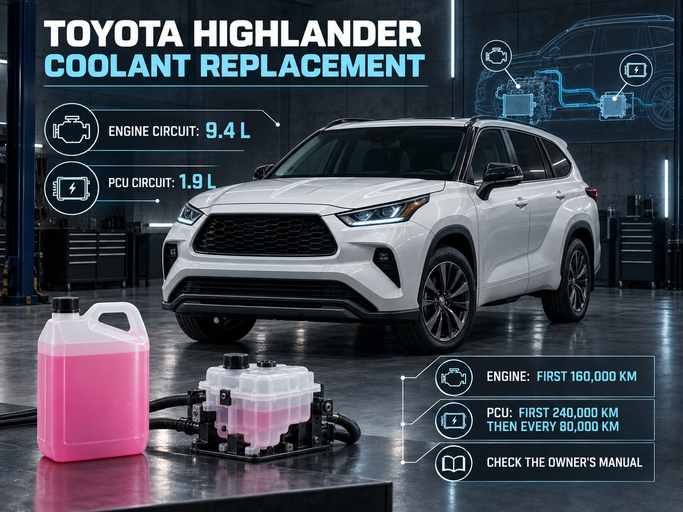
A current Toyota Highlander Hybrid has two liquid-cooling circuits: one for the engine and one for the power electronics. Their initial replacement points and capacities are different. This guide explains the official schedule, warning signs and checks that matter in high heat, dense traffic and fully loaded family travel.
When a Highlander Needs Attention Before the Scheduled Change
A long factory-coolant life does not make the system maintenance-free until the scheduled date. A large crossover often runs its air conditioning continuously, idles in traffic and carries several occupants. Compare both cold reservoir levels regularly, inspect the liquid, confirm fan operation and watch for engine-temperature or hybrid-system messages.
- The service history is incomplete. A top-up entry does not prove that the full charge was renewed, and a pink appearance does not establish compatibility. Identify the year, supply market and exact powertrain, then review the invoices. On a Highlander Hybrid, establish whether the power-control-unit circuit was serviced separately; engine work does not renew it.
- The level falls again after replenishment. A small leak may evaporate from a hot component, leave dry crystalline residue or collect on an underbody shield without staining the parking space. Inspect reservoirs, caps, hoses, joints, heat exchangers and pumps in both circuits. Recurring loss calls for pressure testing and source identification, not repeated top-ups.
- Flakes, persistent foam, cloudiness or an oily film are visible in a reservoir. This can follow mixed coolant chemistries, corrosion or an internal fault. Do not conceal it with an additive or stop-leak product. Diagnose the fluid, assess heat exchangers and seals, and choose a cleaning method only after the contamination source is understood.
- Cabin-heater output changes without a new setting. In the Highlander’s large multi-zone cabin, declining performance may not be obvious immediately. A repeatable shift from warm to cool air can indicate a low engine-circuit level, trapped air or unstable circulation after a repair. It does not directly confirm the condition of the separate electronics circuit.
- Temperature climbs in congestion or on a grade, then returns to normal on an open road. Check the heat-exchanger stack, fans, pressure cap, thermostat and pump performance. Scan data can compare measured temperature with control commands. A separate hybrid-system warning directs attention to the power-electronics cooling loop even when the engine gauge appears normal.
How to Check Both Circuits Safely
Park on level ground and allow the vehicle to cool completely. Check the engine reservoir and the power-control-unit reservoir against their FULL and LOW marks; one reading cannot substitute for the other. If a level is low, use only a compatible product and investigate the loss. Never open a hot cap because pressurised coolant can escape violently.
What Aged or Incorrect Coolant Does Inside the System
Coolant transfers heat, protects dissimilar metals against electrochemical corrosion and supports pump-seal operation. As its additive package is depleted, internal surfaces lose the intended protection. This matters twice on a hybrid Highlander: a stable thermal environment is required by the petrol engine and also by the inverter and associated power electronics.
- Corrosion usually starts beyond sight. A radiator edge, joint or heater pipe may first produce an odour and dry residue rather than a puddle. Oxide particles stay in circulation, narrow small passages and interfere with thermostat movement. A local defect can therefore raise the load on pumps and fans long before a dramatic leak appears.
- Deposits reduce heat transfer even in a sealed system. Hard water, incorrectly mixed concentrate or an unsuitable sealing product can create an insulating layer internally, while dust on the fins limits airflow outside. High ambient temperature exposes this combined restriction earlier because there is less thermal reserve for slow traffic and air-conditioning load.
- Pumps are sensitive to trapped air, abrasive material and incorrect chemistry. Cavitation damages working surfaces, while poor lubrication accelerates seal wear. Weak circulation in the engine loop tends to appear under load; in the electronics loop it may trigger a warning or power limitation. Neither symptom is corrected by using a thicker coolant mixture.
- An air pocket left after repair prevents stable flow. A reservoir can look correct immediately after filling, then fall after the first complete warm-up and cool-down. Each Highlander Hybrid circuit requires its own air-removal procedure. The technician must also confirm that the corresponding electric pump is circulating coolant rather than assuming a full tank proves success.
- Continuing after a red warning is hazardous. Engine overheating can damage the head gasket and distort components, while excessive power-electronics temperature may place the hybrid system in a protective mode. Stop safely, switch the vehicle off and let it cool. Never remove a hot cap or shock heat-soaked parts with cold water.
Toyota-Recommended Coolant for a Highlander
The manual specifies Toyota Super Long Life Coolant or a similar high-quality ethylene-glycol coolant that is non-silicate, non-amine, non-nitrite and non-borate, using long-life hybrid organic acid technology. Factory SLLC is a 50% coolant and 50% deionised-water premix. Do not dilute the premix or judge chemical compatibility from colour alone.
Select the document for the exact year, equipment and supply market from Toyota’s official catalogue of manuals. The vehicle specification takes precedence over a universal statement on a container: different Highlander generations include petrol and hybrid powertrains with distinct circuits, capacities and filling procedures.
Official Toyota Highlander Coolant Intervals and Capacities
The UAE-market 2026 Highlander Hybrid manual gives two independent capacities: 9.4 litres for the petrol-engine circuit and 1.9 litres for the power control unit. The first scheduled point differs as well—160,000 km for engine coolant and 240,000 km for PCU coolant. After the initial replacement, each circuit follows an 80,000 km interval.
| Parameter | Engine circuit | Power-electronics circuit |
|---|---|---|
| Component | 2.5-litre petrol engine | Power control unit (PCU) |
| First replacement | 160,000 km* | 240,000 km* |
| Later replacements | Every 80,000 km* | Every 80,000 km* |
| System capacity | 9.4 L* | 1.9 L* |
| Factory coolant | Toyota SLLC, 50/50 premix | Toyota SLLC, 50/50 premix |
| Post-service check | Temperature, heater, level, leaks | Pump circulation, messages, level, leaks |
* These intervals and capacities apply to the 2026 Highlander Hybrid in the cited regional manual. Capacity describes the complete circuit, so a routine drain may release less because coolant remains in passages and heat exchangers. Verify another year, generation, market or non-hybrid version separately by VIN and model code.
Why the Two Circuits Must Remain Separate
The engine and power electronics handle different thermal loads and have their own reservoirs, pumps and passages. A correct engine-reservoir level says nothing about the inverter loop. The 9.4- and 1.9-litre figures must not be combined into one fill quantity: each circuit is serviced, bled and checked independently.
Nominal capacity helps estimate the supply but is not an instruction to force that amount into a partially drained circuit. Measure what leaves, use the specified filling sequence and remove trapped air. Establish the final level only after operation and complete cool-down. Overfilling does not compensate for poor bleeding and cannot improve heat transfer.
Why a Highlander May Overheat in UAE Conditions
High ambient temperature, slow traffic and continuous air-conditioning reduce the cooling margin. A full complement of passengers and luggage, an extended climb or towing increases the thermal load. Sand and fine dust can collect between the condenser and radiator even when the grille looks clean. Aged coolant is seldom the only cause, so inspect airflow, fans, caps, pumps and thermostat as well. On the hybrid version, read fault codes and power-electronics temperature because its separate circuit can develop a problem without engine overheating.
| Problem | Change inside the system | Possible consequence |
|---|---|---|
| Depleted additives | Protection of metals and seals weakens | Corrosion in passages and joints |
| Incompatible mixture | Flakes, sediment or thickening may develop | Restricted heat-exchanger flow |
| Air after filling | The pump receives an unstable flow | Local overheating or a warning |
| Dust between radiators | Airflow through the stack decreases | Overheating in traffic with A/C |
| Pump wear | Circulation performance declines | Temperature rise under load |
| Undetected leak | Level gradually falls below normal | Air entry and loss of heat removal |
How to Establish the Next Service Point
- A repair order confirms a complete replacement. Keep a separate record for each circuit, including date, odometer, product and procedure. Count the next interval from the actual replacement while respecting the different initial schedules. Note whether flushing was performed, a leak was repaired and the specified air-removal process was completed.
- There is no record, or the invoice merely says “coolant”. Determine which circuit the work covered instead of applying the date to both. Record cold levels, clarity and concentration, then inspect for evidence of repair. A handheld tester can indicate density or freeze protection, but it cannot measure the condition of every corrosion inhibitor.
- A radiator, pump, hose or hybrid-cooling component was replaced recently. Ask how much fluid was removed and which product restored the level. A limited refill after local work does not equal a full replacement. After intervention, the priority is to confirm sealing, circulation and complete air removal in the affected circuit.
- An unknown blend, oil or heavy sediment is present. Find the source and assess gaskets, heat exchangers and passages before cleaning. An aggressive flush without diagnosis can dislodge material and block a narrow channel. Both circuits may need inspection, but their fluids must never be joined or treated as a shared drain path.
Checks Before Coolant Replacement
- Record the VIN, model year, supply market, model code and powertrain type. “Highlander Hybrid” is not precise enough if the vehicle came from another region or belongs to a different model year. Match those identifiers to the correct document before purchasing coolant, parts or special tools.
- Divide the job by system. Identify the engine reservoir and power-control-unit reservoir, then locate the specified drain and inspection points. Track the volume removed from each loop separately. Never infer the condition of one circuit from the colour or level of the other, even when both contain Toyota SLLC.
- Inspect before washing or draining. Photograph both cold levels and examine reservoir seams, caps, clamps, pumps, the lower shield and the heat-exchanger stack. A dry stain, damp joint or characteristic odour can disappear after cleaning even though it may be the most useful evidence of a slow leak.
- Verify the complete coolant specification. Do not select antifreeze by its pink shade, and do not mix an unidentified technology with SLLC. A premixed product should not be diluted. When the history is uncertain, identify the existing fluid and system condition before trying to correct concentration with an arbitrary top-up.
- Work only after both circuits have cooled. Collect used coolant in a sealed container and protect animals from exposure because ethylene glycol is toxic. Follow the manufacturer’s precautions around power electronics: a familiar coolant procedure does not remove the electrical hazards associated with a high-voltage hybrid system.
- After filling, carry out the specified circulation and bleeding routine independently for the engine and PCU loops. Confirm stable temperature, consistent heater output, leak-free operation and no warning messages. Set the final level after complete cool-down. A renewed drop indicates a fault rather than normal coolant consumption.
Monitoring Between Replacements
- Compare both levels in the morning on the same level surface. Photographs taken immediately after service provide useful baselines. A small change caused by temperature or vehicle angle is possible, but a persistent downward trend requires inspection and pressure testing. Do not keep topping up without recording the quantity and circuit.
- Keep the heat-exchanger stack clean and monitor hoses, caps and fan operation. Remove dust after severe use without bending the fins. Stop driving after a red warning, visible steam, a strong coolant smell, suddenly cold heater output or a hybrid-system alert, then allow the vehicle to cool before diagnosis.
Conclusion
For a Highlander Hybrid, first service the engine circuit at 160,000 km and the PCU circuit at 240,000 km; both then follow 80,000 km intervals. Before buying, compare the VIN and history with current listings.


