


How Often Should You Change the Brake Fluid in a Toyota Hiace?
Toyota HiAce
Toyota HiAce•
•31 مشاهدة
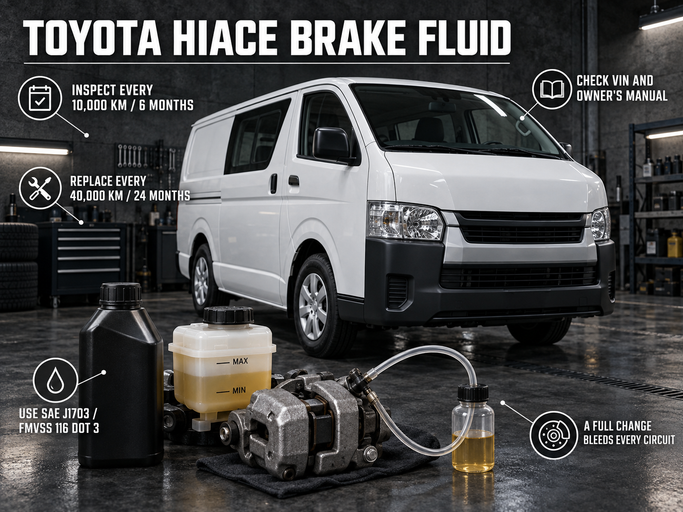
In the published Toyota Hiace maintenance schedule, brake fluid is inspected every 10,000 km or 6 months and completely replaced every 40,000 km or 24 months, whichever comes first. These figures apply only to vehicles covered by that schedule. Requirements may differ between Hiace model years, generations and markets.
When Should Hiace Brake Fluid Be Checked Ahead of Schedule?
The scheduled interval assumes that the system is in good working order. A new symptom, a recurring drop in the reservoir level or an unknown service history calls for diagnosis regardless of mileage.
- There is no evidence of a complete replacement during the past 24 months. Low annual mileage does not cancel the time limit.
- With the same pedal force, the pedal travels farther before the van slows confidently, or firm resistance appears later. Avoid high speed and a full load until the system has been inspected.
- The red brake warning light remains on after startup with the parking brake released. Stop in a safe place and check the fluid level and system for leaks.
- The reservoir level drops again after a top-up. Pad wear can gradually affect the level, but repeated fluid loss requires a leak inspection.
- Pedal travel increases after a long descent or repeated stops. Even if it returns to normal after cooling, check the system for moisture, air and overheating.
- The reservoir contains flakes, cloudiness or traces of an unknown fluid. Colour alone does not reveal boiling performance, but visible contamination must be investigated.
Why Does Brake Fluid Deteriorate?
Glycol-based brake fluid gradually absorbs moisture through the reservoir vent, seals and flexible hydraulic components. The change is difficult to notice in normal driving, but heat reduces the margin before vapour can form.
- Water content rises over time, even when the van is used infrequently.
- Moisture-contaminated fluid boils sooner in the hottest areas near the wheel brakes.
- Vapour compresses under pressure, increasing pedal travel and making brake response less predictable.
- Moisture and contaminants promote oxidation inside cylinders, pipes, ABS valves and hydraulic passages.
- A top-up restores only the reservoir level: old fluid stays in the lines, and the reason for the loss remains unresolved.
Toyota Hiace Maintenance Schedule and Fluid Specification
For a Hiace covered by this schedule, use 10,000 km or 6 months as the inspection reference and 40,000 km or 24 months as the complete replacement reference. Start the interval again after the system has been fully bled. Adding fluid to the reservoir does not count as replacement.
Select the required specification from the manual for the exact model year and market, then confirm it against the reservoir-cap marking. Many Hiace versions specify SAE J1703 / FMVSS No. 116 DOT 3, but it must not be applied to another variant without verification.
| Item | Reference interval | What to verify |
|---|---|---|
| Fluid inspection | 10,000 km or 6 months | Check the level, leaks and brake operation. |
| Complete replacement | 40,000 km or 24 months | Count from a complete bleed, not from a top-up. |
| Fluid specification | Manual and reservoir cap | Many Hiace versions specify SAE J1703 / FMVSS No. 116 DOT 3. |
| Different year or market | VIN and documentation | Do not transfer intervals or specifications between H200, H300 and imported versions. |
| Quantity | No universal volume | Use enough new fluid to displace the old fluid from every circuit. |
How to Select Brake Fluid for a Hiace
The main criterion is an exact specification match, not colour, price or a claim of a higher boiling point. Read the DOT designation together with the relevant SAE and FMVSS markings.
- Use fresh fluid from a sealed factory container with a clearly readable label.
- Confirm the permitted grade by VIN, the vehicle manual and the reservoir cap, especially on an imported van.
- Do not use silicone-based DOT 5; its chemistry differs from the glycol-based fluids used in these systems.
- Do not change to DOT 4 or DOT 5.1 solely for a higher advertised boiling point unless the vehicle documentation permits it.
- Open the container immediately before service and do not store the remainder until the next scheduled replacement.
- Protect painted surfaces and rinse any spilled brake fluid away immediately with clean water.
Which Operating Conditions Heat Hiace Brakes Most?
For a commercial van, thermal load depends not only on speed but also on actual mass, cargo distribution and stop frequency. The same Hiace may work as a lightly loaded delivery vehicle, a route bus or a fully loaded cargo van.
High-Heat Operating Scenarios
- A long descent with passengers, equipment or cargo. The greater the actual mass, the more energy the discs, drums and pads must dissipate.
- A delivery route with short stages and frequent stops. Discs, drums and calipers have little time to cool between brake applications.
- Regular passenger Commuter operation in dense traffic. The number of braking cycles matters more than one daily-mileage figure.
- Driving on sand, gravel or uneven surfaces. ABS and stability control may repeatedly alter pressure in individual circuits.
- Towing where it is approved for the exact version. Consider trailer and cargo mass together, select a suitable gear on descents and do not control speed with the brake pedal alone.
Heat, Dust and Humidity
High ambient temperature does not create a separate official interval, but it reduces cooling reserve after hard braking. The calendar limit deserves particular attention in humid conditions, while dusty environments require protection against particles entering the reservoir.
Clean the cap and reservoir neck before opening them. Grit can damage precision valves, so tools, funnels and bleeding containers must be clean and reserved for brake-fluid work.
What Does a Complete Hiace Brake-Fluid Replacement Involve?
A complete replacement progressively displaces the old fluid through the specified bleed points. Extracting fluid only from the reservoir renews a small portion of the total volume and leaves old fluid in the wheel circuits.
- Identify the vehicle. Confirm the VIN, generation, year, engine, body, original market and reservoir-cap specification.
- Inspect the system. Check the reservoir, master cylinder, pipes, hoses, joints, calipers or wheel cylinders, discs, drums and pads.
- Repair faults first. Correct leaks, damaged lines or sticking mechanisms before bleeding the system.
- Follow the procedure for the exact version. Bleed-point order and any ABS or load-sensing regulator steps cannot be chosen from a universal sequence.
- Bleed every specified circuit without allowing the reservoir to run empty or air to enter.
- Verify the result. After several pedal applications, confirm a stable level, dry connections and consistent pedal travel.
Can You Replace the Fluid Yourself?
Hiace brake layouts vary by generation and market. A vehicle may have ABS, a load-sensing regulator, rear drum brakes or a hydraulic clutch circuit. An incorrect sequence can leave air in the system. Without the exact procedure, do not open bleed screws at random, empty the reservoir or activate service modes; assign the work to a specialist if there is any doubt.
What Should You Check on a Used Toyota Hiace?
Equal mileage does not mean equal brake load. A Hiace may have covered long highway routes, delivered cargo through city traffic or carried passengers with frequent stops. Its operating history and the system's actual condition therefore matter together.
- There is no record of a complete replacement during the past 40,000 km or 24 months. Once leaks have been ruled out, include fresh fluid in the initial service.
- The invoice records only a top-up or a general brake inspection. This does not prove that every circuit was bled.
- The level is below MIN. Before adding fluid, measure pad wear and inspect joints, hoses, calipers and rear mechanisms for moisture traces.
- The vehicle has been converted for passengers, medical equipment or heavy cargo. The braking system must suit its actual mass and conversion documents.
- After several brake applications, the pedal begins to travel farther. End the test and arrange diagnosis before purchase.
- Hydraulic components or the ABS unit were recently replaced. Confirm that the system was bled correctly and contains no trapped air.
Common Service Mistakes
- Replacing only the reservoir fluid and leaving the old fluid in the pipes and wheel mechanisms.
- Judging fluid condition only by colour and forgetting the time since the last complete replacement.
- Filling to MAX with heavily worn pads without considering the future level after new parts are installed.
- Copying the DOT specification or bleeding order from another Hiace generation or a related variant.
- Mixing remnants from containers that have been open for a long time, even when the labels show the same grade.
- Attributing increased pedal travel to van loading and postponing a leak inspection.
Conclusion
For a Toyota Hiace covered by this schedule, inspect the fluid every 10,000 km or 6 months and replace it every 40,000 km or 24 months. Confirm the specification by VIN, the vehicle manual and the reservoir cap. Increased pedal travel, a red warning or a falling level requires diagnosis.
Current listings for the Toyota Hiace help compare model years and body styles; inspect the hydraulic system on the specific vehicle and review its service history.


