


Toyota Fortuner Weak Points
Toyota Fortuner
Toyota Fortuner•
•17 views
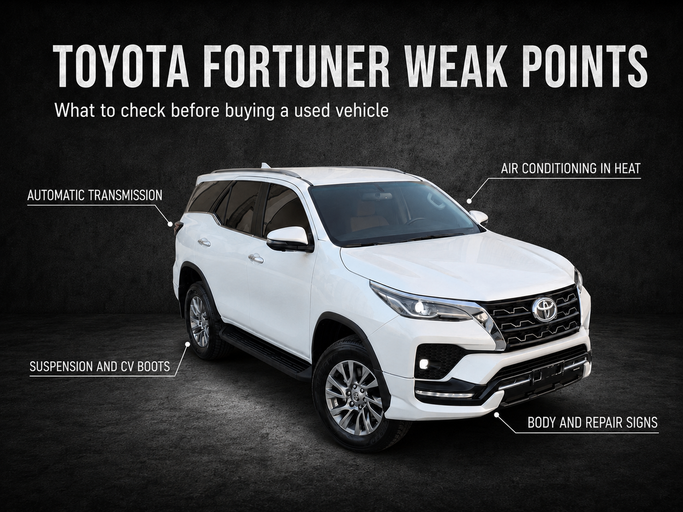
What to check before buying: from the transmission and air conditioning to the suspension, body and signs of hard use.
The Toyota Fortuner has earned a reputation as a durable body-on-frame SUV, but a robust design does not eliminate the effects of age, mileage and maintenance quality. In the UAE, normal wear is compounded by heat, sand, prolonged air-conditioner use and possible dune driving. Before buying, it is therefore important to assess not only the model year but also the condition of the specific vehicle.
Below is a practical review of the weak points found in Fortuner models from different years. It will help you understand which symptoms to look for, what to check during a test drive and when you should avoid making a decision without an inspection on a lift.
What are the weak points of a 2015 Fortuner?
There is no single fault that affects every 2015 Toyota Fortuner. The main risk is accumulated wear: most examples are now more than ten years old, and their condition depends on mileage, maintenance and previous use. Check the automatic transmission, front suspension, cooling and air-conditioning systems, steering and rear axle first.
Automatic transmission: jerks and delays
During the test drive, the transmission should shift progressively, without a heavy thump between first and second gear, a long delay after selecting D or R, or slipping under acceleration. A single jolt does not necessarily indicate a serious fault: old fluid, powertrain mounts or transmission adaptations may be responsible. Repeated harsh shifts require diagnosis.
- Check the vehicle when cold and at normal operating temperature.
- Accelerate and stop smoothly several times, then repeat with firmer throttle input.
- Check the fluid for a burnt smell and ask about its replacement history; the level-checking procedure depends on the specific transmission.
Suspension and steering
Knocking over small bumps, continued body movement after a speed hump, pulling under braking and uneven tyre wear indicate that the shock absorbers, anti-roll-bar bushes, suspension bushes, ball joints and wheel alignment should be checked. A small amount of steering free play may be acceptable, but a pronounced delay in wheel response, clicking or looseness calls for inspection of the steering links and mechanism.
Air conditioning and cooling system
The air conditioner should cool the cabin consistently both while driving and at idle. If the air becomes noticeably warmer in traffic, check the fans, condenser condition, refrigerant pressure and cleanliness of the radiator stack. A lack of cold air alone does not identify the failed component: proper diagnosis is required rather than automatic compressor replacement.
Rear axle
On a smooth road, listen for a steady hum from the rear that grows with speed and changes under load. The source may be the tyres, wheel bearings or differential. It is difficult to identify the cause by sound without a lift, so this symptom warrants a separate drivetrain inspection.
| Component | Issue | Mileage | Estimated repair, AED |
|---|---|---|---|
| Automatic transmission | Jerks during shifts | 120,000–150,000 km | 3,000–5,000 |
| Front suspension | Knocks, worn bushes | 100,000–120,000 km | 1,500–2,500 |
| Air conditioning | Radiator fan | 80,000–100,000 km | 800–1,200 |
| Steering mechanism | Excessive play | 150,000+ km | 1,000–2,000 |
| Rear axle | Hum at speed | 150,000+ km | 2,000–3,000 |

Even body gaps and rear-end symmetry matter more than shiny paintwork: compare the edges of the tailgate, lights and bumper.
What problems can appear on a 2018 Fortuner after 100,000+ km?
After 100,000 km, a 2018 Fortuner is more likely to show ordinary wear than one universal factory defect. The most probable areas of concern are the brakes, shock absorbers and rubber suspension parts, CV-joint boots, multimedia system and interior trim.
| Component | Issue | Mileage | Estimated repair, AED |
|---|---|---|---|
| Interior | Plastic creaks | 80,000+ km | 500–1,000 |
| Multimedia | Freezing and restarts | 60,000+ km | 200–500, software update |
| Brake discs | Vibration under braking | 80,000–100,000 km | 1,200–1,800 |
| Shock absorbers | Leaks | 100,000+ km | 1,500–2,500 |
| CV-joint boots | Cracks | 80,000–100,000 km | 500–1,000 |

The interior helps verify whether the mileage is plausible: assess the steering wheel, driver-seat bolster, pedals, buttons and operation of all electronics together.
Should you buy a 2007 Fortuner in Dubai?
Yes, but only after an in-depth inspection and with funds reserved for repairs. In 2026, such a Fortuner is about 19 years old, so age matters more than the model’s reputation. Even a healthy engine cannot compensate for a tired body, worn suspension, overheated transmission or weak air conditioner.
| Advantages | Disadvantages |
|---|---|
| Low price: AED 20,000–35,000 | Body corrosion |
| Straightforward design | Full suspension overhaul: AED 4,000–6,000 |
| Durable 4.0 V6 engine | Transmission overhaul: AED 5,000–8,000 |
| Limited electronics | Possible oil consumption |
| Parts are easy to find | Air conditioning often needs repairs |
Buying such a vehicle is reasonable if an independent inspection shows that the essential work fits the budget. A rule such as “30–50% of the purchase price for repairs” cannot be applied to every example: scheduled maintenance may be enough in one case, while restoration may make no economic sense in another.
What fails most often on a Fortuner?
There is no single public dataset from UAE workshops that would allow an accurate and honest ranking of Fortuner failures. In practice, inspectors focus on components that are particularly sensitive to age, heat, sand and hard use.
| Rank | Component | Cause | Estimated repair, AED | Symptoms |
|---|---|---|---|---|
| 1 | Radiator fan | Heat-related overload | 800–1,200 | A/C weak in traffic |
| 2 | CV-joint boots | Sand and heat cracking | 500–1,000 | Clicking while turning |
| 3 | Bushes and shocks | Load-related wear | 1,500–2,500 | Knocks over bumps |
| 4 | Rear-axle bearings | Heavy loads | 2,000–3,000 | Rear hum at speed |
| 5 | Belts and pulleys | Heat accelerates wear | 500–800 | Squeal at start-up |
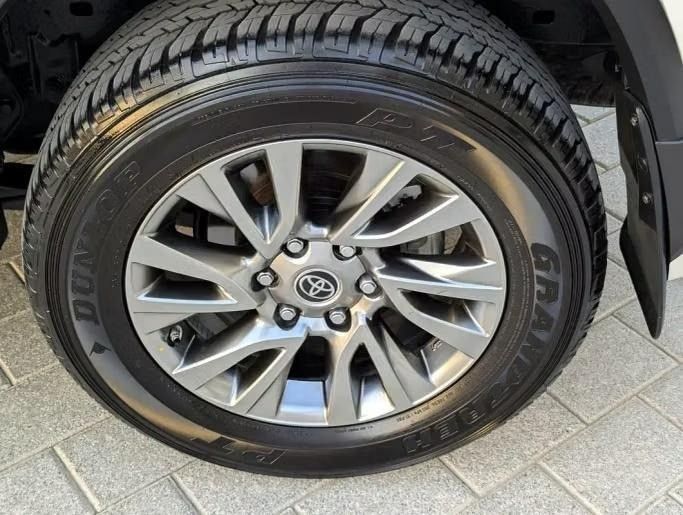
A tyre reveals more than its remaining tread: cracks, age according to the DOT code and uneven wear help assess storage conditions, wheel alignment and suspension condition.
How much can it cost to repair the weak points?
Indicative ranges from local workshop offers can be used for preliminary budgeting, but an exact estimate is possible only after diagnosis. The price depends especially on whether genuine or alternative parts are selected.
- Diagnosis and minor climate-system repairs: approximately AED 800–1,500; replacing major components can cost considerably more.
- Repair of individual front-suspension components: approximately AED 1,500–3,000; a complete overhaul of an older vehicle exceeds this range.
- Drive-shaft boot: approximately AED 500–1,000 including labour; a damaged joint or complete drive shaft costs more.
- Rear-axle or bearing work: approximately AED 2,000–4,000 depending on the cause and parts required.
- Major automatic-transmission repair: several thousand dirhams; quoting an exact amount before dismantling and inspection would be misleading.
Short pre-purchase checklist
| Component | What to check | Assessment |
|---|---|---|
| Engine | Cold start, noises, leaks | ☐ OK / ☐ NOT OK |
| Automatic transmission | Jerks, delays, shift smoothness | ☐ OK / ☐ NOT OK |
| Air conditioning | Cooling while driving and at idle, fan | ☐ OK / ☐ NOT OK |
| Suspension | Knocks, body movement, rear hum | ☐ OK / ☐ NOT OK |
| CV-joint boots | Condition and grease traces | ☐ OK / ☐ NOT OK |
| Body | Corrosion and accident repairs | ☐ OK / ☐ NOT OK |
| Interior | Steering wheel, seat and pedal wear | ☐ OK / ☐ NOT OK |
| Electronics | Multimedia, buttons and power windows | ☐ OK / ☐ NOT OK |
How to reduce the purchase risk
Start by checking the documents and history. The official Technical Vehicle Status Report from the RTA may contain information about a vehicle registered in Dubai, including ownership history and insurance status. Then arrange an independent pre-purchase inspection: a standard registration test does not replace assessment of the engine, transmission, body and suspension.
For vehicles with a preserved dealer history, it is useful to verify the documents and maintenance through Al-Futtaim Toyota. Toyota UAE also recommends checking tyre condition: cracks, bulges, vibration and uneven wear require attention regardless of tread depth.
Which Fortuner should you choose?
- A 2007–2010 Fortuner suits a buyer who accepts age-related risks and is prepared for restoration work.
- A 2015 Fortuner can be a sensible choice if the automatic transmission, cooling system, suspension and body pass inspection.
- A 2018 Fortuner with more than 100,000 km should be judged by its service history and actual wear, not automatically treated as problematic.
- A 2020+ Fortuner usually needs fewer age-related repairs, but a high price does not guarantee the absence of accident damage, mileage tampering or hard use.
The Fortuner remains a dependable vehicle if the previous owner did not cut corners on maintenance. First compare several current Toyota Fortuner listings, then assess the best options against the same checklist. The right purchase is not the shiniest or cheapest example, but the vehicle with a clear history and the shortest list of essential work.


