


How to Inspect a Toyota Fortuner Before Buying?
Toyota Fortuner
Toyota Fortuner•
•55 views

Buying a used Toyota Fortuner is a serious decision: a clean interior and shiny body do not prove that the vehicle is mechanically sound. It may have been subjected to demanding off-road use, repaired after an accident, overheated, or serviced irregularly. This checklist will help you inspect it systematically—from the documents and bodywork to a cold start, test drive, and professional diagnostics.
Where Should You Start When Inspecting a Toyota Fortuner?
Arrange the inspection during daylight, but avoid harsh midday sun: diffused light makes mismatched paint shades, dents, and repair marks easier to spot. Ask the seller to leave the engine cold for at least several hours and prepare the registration card, service documents, and VIN. Do not agree to inspect the vehicle only in a dark parking garage or immediately after it has been washed and polished.
Five Stages of the Inspection
- Documents and history: match the VIN on the body, registration card, and reports; compare dates and mileage.
- Body and interior: check panel gaps, fasteners, paintwork, glass, signs of water ingress, and whether wear is consistent with the stated mileage.
- Engine bay: assess the cold start, fluids, leaks, belts, hoses, and cooling-system operation.
- Suspension and underbody: inspect boots, bushings, shock absorbers, tyres, impact marks, and leaks—preferably on a lift.
- Test drive and diagnostics: check the automatic transmission, brakes, steering, air conditioning, and scan the vehicle for fault codes.
What Should You Check on the Body and in the Documents?
- Check the VIN in every available location. Welding marks, damaged rivets, irregular characters, or mismatched numbers are reasons to stop the inspection.
- View the vehicle along the length of its panels. Ripples, mismatched shades, and inconsistent paint texture often reveal body repairs.
- Compare the gaps around the bonnet, doors, and tailgate. Factory panel gaps should be even on both sides.
- Inspect the bolts on the wings, bonnet, and doors. Chipped paint on their edges shows that a panel has been removed or adjusted.
- Check the dates on the glass and seat belts. One different date does not prove that the vehicle was in an accident, but it requires an explanation.
- There should be no damp smell, sandy silt, rust, or fresh localised paint beneath the floor mats or in the spare-wheel well.

An overall view of the vehicle helps assess body geometry, panel gaps, and differences in paint shade.
For a vehicle registered in Dubai, ask the seller for permission to obtain an RTA* Technical Vehicle Status Report*.
How Can You Verify a Fortuner's Actual Mileage?
Mileage cannot be assessed from a single sign. Compare the odometer reading with inspection records, workshop orders, service dates, and wear across several interior components. A new steering wheel or reupholstered seat may simply be a repair, but the seller should explain the replacement and support it with documents.
| Component | Expected sign | Reason for further checks |
|---|---|---|
| Steering wheel | Even sheen and light wear | A new cover without supporting documents, or heavy wear at low stated mileage |
| Driver's seat | Creasing on the side bolster | Fresh reupholstery on only one section |
| Pedals | Wear consistent with the steering wheel and seat | New pedal covers in an otherwise visibly worn interior |
| Buttons and handles | Gradual, even wear | Worn-off symbols despite very low stated mileage |
| Service history | Entries progress consistently by date and mileage | Gaps, sudden jumps, or higher mileage in earlier records |
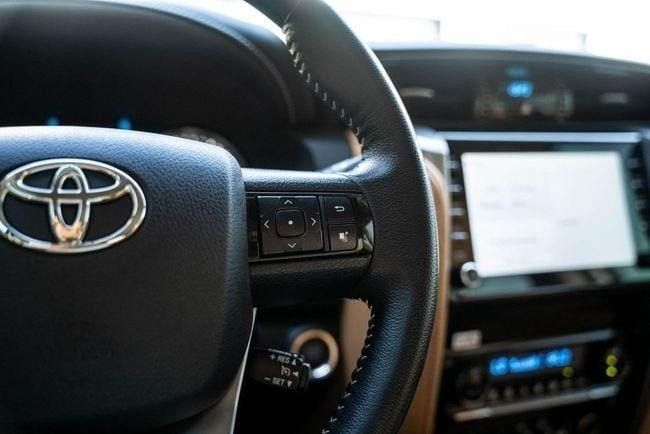
The condition of the steering-wheel rim and buttons should be compared with the stated mileage and wear on other interior components.
Step-by-Step Mileage Check
- Photograph the VIN and compare it with the registration card.
- Compare the odometer reading with vehicle-inspection records and workshop orders.
- Check the dates and mileage in the service book; call the listed workshop if the seller permits you to verify the history.
- Run computer diagnostics. Some control units may retain indirect data about operating time and events, but whether the mileage can be confirmed depends on the vehicle version and diagnostic equipment.
- Assess the evidence as a whole. Neither a worn steering wheel nor a single report provides an absolute guarantee on its own.
How Should You Inspect the Fortuner 4.0 V6 Engine?
The listing for the vehicle selected for the illustrations specifies a 4.0-litre 1GR-FE V6 petrol engine producing 238 hp. This naturally aspirated engine is known for its simple and durable design, but its condition depends on maintenance and operating conditions. The words “GCC Specs” also do not prove that a particular vehicle is mechanically sound.
Cold Start
- Before starting, touch the upper part of the engine only with the ignition switched off: it should be cold or close to the ambient temperature.
- Switch on the ignition and make sure the warning lights illuminate and then go out normally after the engine starts. Do not mistake a removed warning bulb or cleared fault codes for the absence of problems.
- The engine should start without prolonged cranking. Persistent metallic knocking, whistling, uneven running, or strong vibration requires diagnostics.
- A small amount of water vapour on a cold start may be caused by condensation. Persistent blue smoke indicates oil burning; thick white smoke after warm-up may be related to coolant.
Under the Bonnet
- Check the oil level on level ground according to the manufacturer's instructions. Oil below MIN, a fuel smell, emulsion, or metallic particles are serious warning signs.
- Look for fresh leaks around the valve covers, front of the engine, sump, hoses, and radiator. Reinspect an engine that has been cleaned until spotless after the test drive.
- Inspect the expansion tank when the engine is cold. The fluid should be clean, with no oil or rusty sediment. Never open the cap of a hot cooling system.
- Belts and hoses should have no cracks, delamination, swelling, or signs of contact with oil.
Engine and Automatic Transmission Operation
After warm-up, the engine speed should stabilise without noticeable dips. When D or R is selected, a brief transmission response is acceptable, but a hard jolt, long delay, or vibration requires investigation. During the test drive, accelerate smoothly and remain within traffic rules: the transmission should shift predictably, without slipping, jerking, or entering fail-safe mode. Do not accelerate hard with a cold engine or attempt to reproduce extreme loads on public roads.
How Should You Check the Air Conditioning in a Fortuner?
In Dubai, air conditioning is a critical system. It should be tested not only while driving but also at idle, when cooling performance is under particularly noticeable strain.
Start the engine and select MAX A/C, recirculation, and a high fan speed. After several minutes, the air from the central vents should become noticeably colder.
Check every fan speed, airflow direction, and the front and rear systems, if fitted.
Listen as the compressor and fans engage. Grinding, frequent cycling, weak airflow, or cooling only while driving are reasons to arrange diagnostics.
Compare the temperature on the left and right. A noticeable difference may indicate low refrigerant, a blend-door problem, or contamination in the system.
Assess the smell. Damp or mouldy odours are often linked to contamination of the evaporator or drain; a burning smell requires an immediate electrical inspection.
After 10–15 minutes of operation, inspect the ground beneath the vehicle: water from the air-conditioning drain is usually normal, whereas coloured or oily fluid is not.
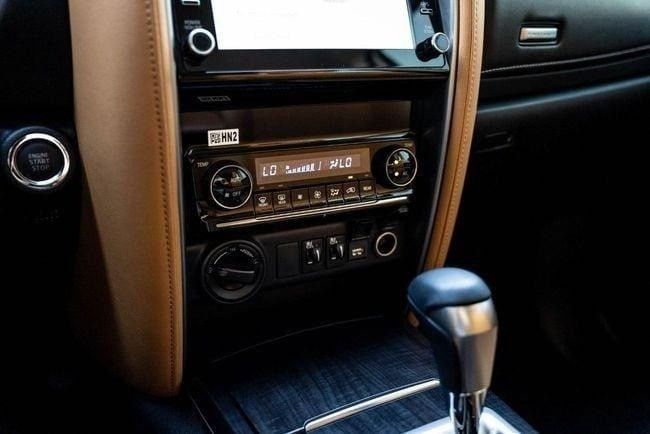
Check the climate-control panel and automatic-transmission selector in every mode during the inspection and test drive.
Vent temperature depends on the outside temperature, humidity, fan setting, and cabin condition. A single reading is therefore not a universal standard: what matters is stable cooling, the absence of unusual noises, and the system's ability to maintain comfort both at idle and while driving.
How Should You Inspect a Fortuner's Suspension and Running Gear?
The Fortuner has independent front suspension and a dependent rear coil-spring setup. This design is built to carry loads, but sand, kerbs, demanding off-road use, and overloading accelerate wear on rubber components, shock absorbers, and bearings.
Inspection on the Ground and on a Lift
- Compare wear across all four tyres. Wear along one edge, feathering, or mismatched tyre models may indicate incorrect alignment, play in suspension components, or cost-cutting on maintenance.
- Inspect the shock absorbers: their bodies should not be wet with oil, the rods should be undamaged, and the springs should not be cracked.
- Check the control-arm bushings, ball joints, tie-rod ends, and anti-roll-bar bushes. Deep cracks, separating rubber, and noticeable play require repair.
- On a four-wheel-drive version, inspect the drive-shaft and CV-joint boots. Cracks and scattered grease indicate a loss of sealing.
- Inspect the engine guard, frame, crossmembers, axle housings, and transfer case. Major dents, fresh paint, and leaks may indicate off-road impacts.
Safe Test Drive
- Drive over ordinary uneven surfaces at low speed. Dull impacts, metallic knocking, and rattling should be traced on a lift.
- On a straight, level road, briefly relax your grip without letting go of the steering wheel. The vehicle should not pull noticeably to either side.
- Make several smooth turns at a safe speed. The steering should self-centre without binding, and the body should respond predictably.
- Brake smoothly on a clear stretch of road. Pulsation through the pedal or steering wheel, pulling, and grinding indicate brake or running-gear problems.
- At a constant speed, listen for a humming sound that changes under acceleration or when you lift off the throttle. It may come from the tyres, wheel bearings, propeller shaft, or rear axle—the exact cause should be diagnosed at a workshop.
Toyota Fortuner Inspection Checklist
☐ Documents. The VIN matches; history and service records have been checked
☐ Body. Panel gaps and paintwork are even; there are no signs of major repairs
☐ Interior. Wear is consistent with the mileage; all electrical equipment works
☐ Engine. Cold start is smooth; there is no smoke, leakage, or persistent knocking
☐ Automatic transmission. D/R engage without a hard jolt; shifts are smooth
☐ Cooling system. Coolant is clean; there is no overheating or evidence of leaks
☐ Air conditioning. Cooling remains stable at idle and while driving
☐ Suspension. There are no leaks, critical play, or damaged boots
☐ Tyres and brakes. Wear is even; there is no vibration, pulling, or unusual noise
☐ Diagnostics. Lift inspection and diagnostic scan completed before paying a deposit
How Should You Make the Final Decision?
A good Fortuner does not have to look new, but its history, mileage, and actual wear should form a consistent picture. Minor cosmetic defects can be considered during negotiations, whereas a VIN mismatch, evidence of major body repairs, overheating, persistent smoke, transmission faults, or a seller's refusal to allow independent diagnostics are reasons to walk away from the deal.
For initial screening, compare several Toyota Fortuner vehicles in Dubai by year, mileage, engine, and regional specification, then apply the same checklist to every candidate. This way, the decision will be based on comparable facts rather than an impression formed from a single listing.


