When should brake pads and rotors be replaced on a Toyota Land Cruiser 200?
Toyota Land Cruiser 200 Series 200 Series Facelift 2
Toyota Land Cruiser 200 Series 200 Series Facelift 2•
•110 مشاهدة
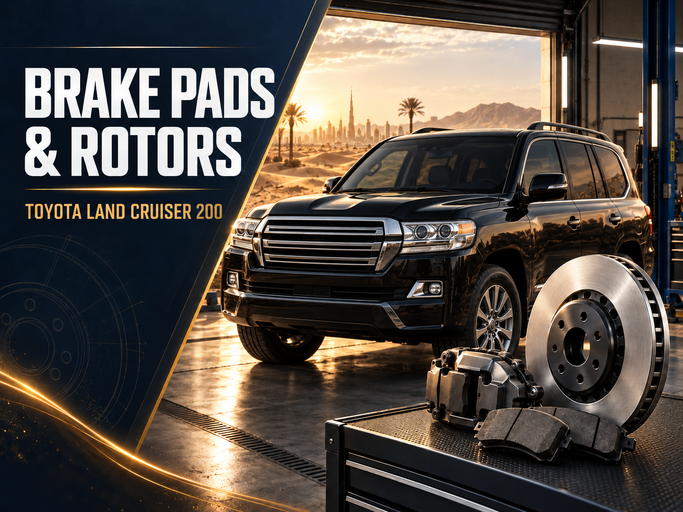
For the Land Cruiser 200, the maintenance schedule sets inspection intervals rather than mandatory replacement mileage for brake pads and rotors. Toyota recommends regular brake-system checks as part of scheduled maintenance, with more frequent inspections on dusty roads, under heavy loads, while towing or during prolonged low-speed driving. Replacement is decided from measurements and the parts' actual condition.
4 signs of worn brake pads and rotors on a Land Cruiser 200
A sound or sensation does not identify one faulty component with certainty. A squeal may come from the built-in wear indicator, a trapped grain of sand or a vibrating shim, while judder may originate at the hub, wheel or suspension rather than the rotor. Treat every repeatable symptom as a reason to inspect the complete system, not as a reason to replace parts at random.
- Metallic squeal or grinding. A steady high-pitched squeal during braking may occur when the wear-limit indicator contacts the rotor. Harsh grinding points to a more serious stage: the friction material may be gone. Continued driving can then ruin the rotor quickly, so the vehicle should be inspected without delay.
- Pedal pulsation or steering-wheel judder. If vibration returns during normal braking and changes with speed, measure rotor runout and thickness variation, then inspect the hub, wheel fastening and suspension. Pulsation during an emergency stop may simply be normal ABS operation, which is why the conditions matter.
- Pulling to one side or uneven braking. Possible causes include a sticking piston or slide pin, different inner and outer pad wear, friction-surface contamination, or a tyre or suspension fault. Replacing only the most worn item will not restore balance or correct the root cause.
- Longer pedal travel or stopping distance. Delayed bite, a soft pedal, an overheated-brake smell or noticeably weaker deceleration requires urgent inspection. In addition to the pads and rotors, check fluid level and condition, hydraulic integrity, calipers, the brake booster and the electronic systems.
Why delaying brake-pad and rotor replacement is dangerous
The LC200 is a heavy body-on-frame SUV, so its brakes must dissipate substantial energy whenever the vehicle slows. Deterioration may be difficult to notice while the friction material still has usable thickness. Once the service limit is reached, however, rotor damage and heat transfer to neighbouring components can develop quickly.
- Repeated stops become less consistent. A thin pad transfers heat to the caliper more quickly and copes less effectively with a series of hard stops. Pedal effort may rise after repeated braking while the vehicle's response becomes less predictable.
- The rotor develops deep scoring. When the usable pad material is gone, the metal backing plate cuts grooves into the working surface. A rotor that could have remained serviceable with timely maintenance may then need replacement together with the new pads.
- Thermal stress increases. A dragging caliper or patchy contact creates local hot spots. This accelerates ageing of the dust boots and grease, heats the hub and brake fluid, and increases the likelihood of vibration.
- The fault affects neighbouring components. A binding brake continually loads the wheel, tyre and bearing, raises rolling resistance and can increase fuel consumption. Installing pads without repairing the mechanism offers only a temporary result.
- The safety margin shrinks. The vehicle may slow acceptably in gentle driving yet perform poorly on a descent, with a trailer or during an emergency stop once the brakes are hot or worn. Do not wait for grinding to become constant.
Toyota's maintenance guidance for the LC200 brake system
Toyota's manual directly links persistent squealing or grinding with possible pad wear and advises having the pads checked as soon as possible. Continuing to drive after the friction material is worn away allows the metal backing plate to damage the rotor. For the front brakes, Toyota also recommends measuring rotor thickness whenever the pads are replaced and warns that operating beyond the wear limits is unsafe.
Source: English-language Land Cruiser manuals and warranty information at Toyota Owners. Before service, select the manual for the vehicle's model year and confirm the applicable wear limits by VIN. Rotor dimensions and part numbers must not be carried over from another version without verification.
| Component | What to inspect | When action is required |
|---|---|---|
| Brake pads | Remaining friction material on the inner and outer pad at every wheel, wear uniformity, cracks, contamination and wear-indicator operation. | Replace at the service limit, with persistent indicator noise, separation, contamination or pronounced uneven wear. |
| Rotors | Thickness at several points, thickness variation, lateral runout, scoring, cracks, corrosion and local heat marks. | Replace when below the limit, physically damaged, or when runout and friction variation cannot be corrected by an approved procedure. |
| Calipers and hydraulics | Free piston and slide-pin movement, dust boots, hoses, leaks, and normal pedal effort and travel. | Correct binding, leakage, a damaged boot or another fault before new wear parts are installed. |
| Parking brake | Shoes inside the rear rotor, drum surface, springs, cable or linkage, adjustment and vehicle-holding performance. | After shoe or drum replacement, perform the Toyota bedding-in procedure; replace worn or damaged components. |
How to choose brake pads and rotors for a Land Cruiser 200
The LC200 received several updates during its production life, and brake equipment can vary by year, supply market and version. Safe selection therefore starts with the VIN. A matching model name, engine or pad outline does not prove that the shape, thickness and operating characteristics suit the individual vehicle.
- Exact part number. Confirm it by VIN in a current catalogue. The front and rear axles use different components, and differences can also exist between early vehicles and later facelifts.
- Friction-material specification. The pad must retain the intended friction when hot, remain compatible with the rotor and deliver predictable response. An unknown, excessively hard compound can increase noise and accelerate rotor wear.
- Rotor geometry. Check diameter, nominal thickness, overall height, ventilation, mounting holes and any required installation direction. A visual resemblance is not enough to establish safe compatibility.
- Complete axle repair. Replace the left- and right-hand pads together. Measure and compare both rotors; when replacement is required, they are normally installed as a pair to keep braking force symmetrical.
- Parking brake and fitting hardware. The LC200 uses a drum-in-disc parking brake. When the rear axle is serviced, inspect its shoes, the internal drum surface, springs and adjustment, as well as the shims, indicators, dust boots and slide pins of the service brake.
The generation and facelift can be checked initially in the Toyota Land Cruiser 200 catalogue. This page helps identify 2015–2021 vehicles, but final selection of pads, rotors and fitting hardware must still be completed by VIN.
Why does an LC200 squeal, vibrate or brake unevenly?
Noise or vibration after a repair does not automatically mean that the new parts are defective. The cause may be corrosion or debris on the hub face, lateral runout, sticking slide pins, incorrectly fitted shims or uneven friction-material transfer. Identify the source of the symptom before choosing the repair.
| Symptom | Possible causes | What to check |
|---|---|---|
| Squeal under light braking | Wear indicator, sand, glazing or shim vibration | Measure the pads; inspect the surfaces, shims and installation |
| Harsh grinding | Friction material is gone or a hard object is trapped | Stop using the vehicle; inspect the rotor, pads and caliper |
| Pedal pulsation | Thickness variation, runout or hub debris; ABS during an emergency stop | Measure the rotor and hub before deciding on replacement |
| Steering-wheel judder | Front rotors, wheel, hub or suspension | Inspect the brakes together with the wheels and suspension |
| Pulling to one side | Binding caliper, different friction, tyre or suspension fault | Compare left/right wear and temperature; correct the cause |
| Hot-brake smell or smoke | Dragging brake, heavy load or prolonged braking | Stop safely, do not cool with water, and arrange diagnosis |
How heat, sand and heavy use affect the brakes
A hot climate does not create one universal replacement mileage, but it increases the importance of temperature control. Dusty roads, congested traffic, dune driving, towing and long descents are especially relevant in the region. Under these conditions, the brake system should be inspected more frequently than in gentle use on clean roads.
- Congested traffic. Frequent stops in a heavy vehicle heat the front brakes more than steady-speed driving. Adequate following distance and smooth, anticipatory deceleration reduce unnecessary heat cycles.
- Sand and off-road driving. Abrasive particles can reach the working surfaces, while stability systems may brake individual wheels. After a demanding route, check for abnormal noise, damaged boots and a large temperature difference between wheels.
- Towing and full loads. Additional mass sharply increases the energy that the brakes must absorb. Select an appropriate speed before a descent, use engine braking and avoid holding the pedal continuously.
- Water after heavy braking. Do not direct cold water at a very hot rotor immediately after an intensive drive. The sudden temperature change places unnecessary stress on the metal; allow the assembly to cool naturally.
- Humidity and long-term parking. A thin film of surface rust often clears after a few gentle stops. Deep corrosion, continuing noise or new pulsation needs an inspection.
Practical inspection and replacement checklist
- Record when the symptom appears. Note road speed, brake temperature, pedal effort, vehicle load and the exact moment when noise or vibration begins. This helps separate a fault from ABS operation and shortens diagnosis.
- Inspect the inner and outer pads. A view through the wheel spokes is insufficient. The inner pad can wear much faster because of a sticking piston or slide pin even while the outer pad still looks healthy.
- Obtain the actual measurements. A useful repair order records remaining friction material, each rotor's thickness, lateral runout and the limits for the exact version. 'They still have some life left' is not a measurement.
- Correct the cause of unequal wear. Before fitting new parts, check caliper movement, the hub face, dust boots, shims and mounting surfaces. Otherwise, the new set can quickly repeat the same fault.
- Service the parking brake correctly. Toyota states that the drum-in-disc system requires periodic bedding-in and must also be bedded in after its shoes or drum are replaced. Carry out this work using the specified Toyota procedure.
- Bed in the service brakes correctly. After repair, avoid a series of unnecessary emergency-level stops and prolonged clamping of hot pads while stationary. Follow the parts manufacturer's procedure without compromising road safety.
- Inspect a pre-owned vehicle. Photographs in the Land Cruiser listings may reveal only major scoring or corrosion. Before purchase, obtain measurements, a safe road test and an inspection of the calipers and parking brake.
Common maintenance mistakes
- Replacing parts by mileage alone. The same 40,000 km can mean relaxed motorway use or daily stop-and-go driving with a full load. The schedule determines when to inspect; condition determines when to replace.
- Fitting new pads to an unmeasured rotor. Deep scoring, runout or thickness below the limit will not disappear with new friction material. The replacement pads may develop uneven contact and vibration very quickly.
- Replacing only one side. Different thicknesses and friction characteristics on the same axle produce unequal braking force. Install pads as a complete axle set and service the rotors symmetrically.
- Forgetting the parking-brake shoes. The rear disc brake and the parking-brake mechanism perform different tasks. Replacing the rear service pads does not remove the need to inspect the shoes and drum surface inside the rotor.
- Blaming a soft pedal only on pad wear. Longer travel may be caused by air, a leak, overheated fluid or another component fault. This symptom requires urgent inspection of the whole system.
Conclusion
Land Cruiser 200 brake pads and rotors should be replaced according to their measured condition and inspected on a schedule that reflects how the vehicle is used. Dusty roads, heavy loading, towing and prolonged low-speed driving call for more frequent checks. Wear-indicator noise, grinding, vibration, pulling or weaker braking requires an unscheduled diagnosis. Select parts by VIN and fit them as a complete axle set.