


How Often Should You Change Toyota Highlander Brake Fluid?
Toyota Highlander
Toyota Highlander•
•10 مشاهدة
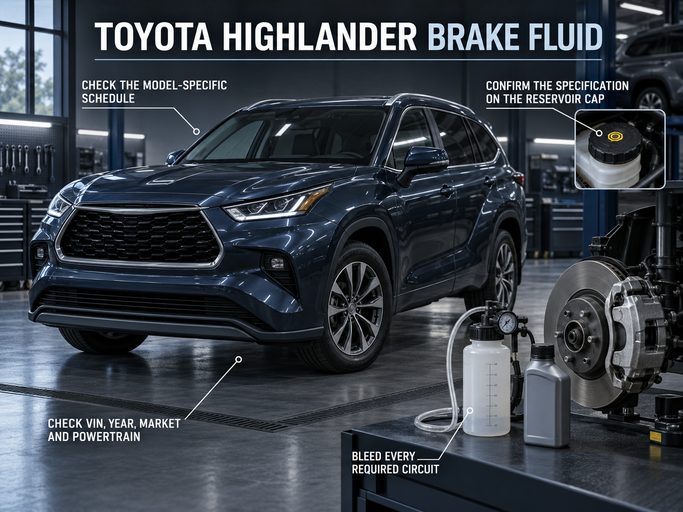
There is no single replacement interval for every Toyota Highlander. Some regional schedules use 40,000 km or 24 months, but that reference applies only where the exact version specifies it. Inspect the hydraulic system at every scheduled service and confirm the interval by VIN, model year and source market.
When Should the Brake System Be Checked Early?
Mileage and date do not override a new symptom. On a heavy family SUV, compare pedal behaviour under similar loads and familiar driving conditions.
- The pedal moves farther before decisive braking begins, or its usual resistance develops later than before.
- The first application feels soft but two or three quick presses make the pedal firmer. Air or another hydraulic fault may be present.
- With steady pressure while stationary, the pedal slowly sinks. The system and master cylinder require inspection.
- The red brake warning remains on after the parking brake is released, or a brake-system message appears.
- The level falls again after a top-up. Pad wear may lower it gradually, but repeated topping up without finding the cause is unsafe.
- Pedal travel grows on a long descent and shortens after cooling. Check for overheating, moisture and trapped air.
Why Does Brake Fluid Age at Low Mileage?
Glycol-based brake fluid gradually absorbs moisture through reservoir ventilation, seals and flexible components. The change may be invisible during gentle driving, while the margin before vapour formation under heavy heat becomes smaller.
- Calendar ageing continues while the vehicle is parked, so occasional use does not reset the clock.
- Moisture lowers the boiling margin in the hottest areas near the wheel brakes.
- Vapour compresses under pressure, forcing the pedal to travel farther for the same deceleration.
- Water and wear products encourage corrosion in internal passages, cylinders and ABS valves.
- A top-up changes the reservoir mark but barely renews the fluid in the lines or removes the cause of the loss.
Toyota Highlander Interval and Specification
If the exact Highlander service schedule states 40,000 km or 24 months, use whichever limit comes first. A vehicle from another market or generation may follow a different schedule, so the figure is not universal across the model line.
Find the required grade in the owner’s manual for the individual vehicle and confirm it on the reservoir cap. DOT 3 and DOT 4 appear on different vehicles, but a shared Highlander name does not establish compatibility.
| Item | Reference | Required check |
|---|---|---|
| Inspection | At every scheduled service | Level, dry unions, warning messages and consistent pedal response. |
| Full change | 40,000 km or 24 months only where that schedule specifies it | The interval by VIN, model year, source market and powertrain. |
| Specification | Reservoir cap and owner’s manual | Do not select a DOT grade from another Highlander or by colour alone. |
| Hybrid | A separate bleeding procedure | Whether the electronically controlled brake system requires a service mode. |
| Quantity | No universal volume | Enough fluid to displace the old fluid from every required circuit. |
How Do You Select the Correct Fluid?
The factory specification matters more than colour, price or a headline boiling-point claim. The container should be sealed and its markings easy to read.
- Matching the grade to the VIN, owner’s manual and reservoir cap.
- Avoiding compatibility decisions based on fluid colour.
- Keeping silicone DOT 5 out of a system designed for glycol-based fluid.
- Avoiding the assumption that a higher DOT number is automatically better for this vehicle.
- Opening the container immediately before bleeding and discarding fluid stored after long exposure to air.
- Rinsing accidental drops from painted surfaces with clean water immediately.
Which Uses Put More Heat into Highlander Brakes?
Actual vehicle mass has a direct effect on brake heat. Seven occupants, luggage and frequent stops increase the energy absorbed by the discs and pads even when the route is short.
Full Loads, Descents and Towing
- Descending with passengers and luggage increasing heat load; use an appropriate gear and allow cooling pauses.
- Towing adding system mass; tow only where the exact version permits it and account for the trailer’s own braking system.
- Repeated stops in dense traffic leaving less time for calipers and discs to release heat.
- High ambient temperature reducing cooling reserve without creating a separate official interval by itself.
- Cleaning dust from the reservoir neck and cap before opening so particles cannot reach hydraulic valves.
Petrol, Hybrid and All-Wheel-Drive Versions
A Highlander Hybrid recovers part of its deceleration through regeneration, but the hydraulic circuit remains a safety system and still needs service. Some electronically controlled brake systems require a service mode during bleeding. Drivetrain alone does not set the fluid grade, yet equipment and market can change the hardware, so a petrol front-wheel-drive procedure must not be assumed to suit a hybrid AWD version.
What Is Included in a Full Change?
A complete operation pushes the old fluid through every specified bleed point. Replacing only the reservoir contents leaves most of the aged fluid inside the pipes, actuator and wheel circuits.
- Confirm the VIN, generation, model year, market, powertrain and drivetrain.
- Inspect the reservoir, master cylinder, pipes, hoses, unions, calipers, wheel cylinders, discs, drums and pads.
- Repair leaks, damage and sticking components before bleeding.
- Use the bleed order and service mode specified for that ABS or electronically controlled brake system.
- Displace old fluid from every required circuit while maintaining the reservoir level and preventing air entry.
- Finish by checking level stability, dry unions, no warnings and consistent pedal travel.
Can You Change It Yourself?
Highlander bleeding procedures vary with generation, ABS design, electronic parking brake and hybrid system. The wrong sequence can trap air inside the actuator. Without instructions for the exact VIN and suitable diagnostic equipment, do not open bleed screws, empty the reservoir or start service modes.
What Should You Check on a Used Toyota Highlander?
Evaluate brake-fluid history separately from total mileage. A Highlander may have covered little distance but spent years parked, or routinely carried passengers and luggage on steep routes.
- Requesting a record with the date, mileage and confirmation that every required circuit was bled.
- Checking whether “brake service” meant a top-up or pad replacement rather than a full fluid change.
- Inspecting the reservoir and unions for damp traces, then confirming that the level stays stable after driving.
- Comparing pedal travel on the first and repeated applications while stationary and during a short, safe road check.
- Checking hybrid brake-system messages and evidence that the correct service mode was used.
- Requesting proof of bleeding after replacement of an actuator, master cylinder, hose or caliper.
Common Service Mistakes
- Renewing only the reservoir contents while leaving old fluid in the circuits.
- Judging condition only by clarity and ignoring calendar age.
- Filling above MAX without considering pad wear and piston retraction during pad replacement.
- Copying a fluid grade or bleed sequence from a Grand Highlander or another Highlander generation.
- Mixing leftovers from containers opened long before the service.
- Blaming increased pedal travel on vehicle weight and postponing hydraulic diagnosis.
Conclusion
Set the Toyota Highlander brake-fluid interval from the schedule for the exact VIN. Use 40,000 km or 24 months only where it is specified, and inspect the system at every service. Confirm the grade in the owner’s manual and on the reservoir cap, then complete a full change by bleeding every required circuit.
Current listings for Toyota Highlander help compare generations, source markets and powertrains; brake-system condition must still be judged from the individual vehicle, its records and a proper inspection.


