


How Often to Change Differential Oil in a Toyota RAV4
Toyota RAV4
Toyota RAV4•
•17 views
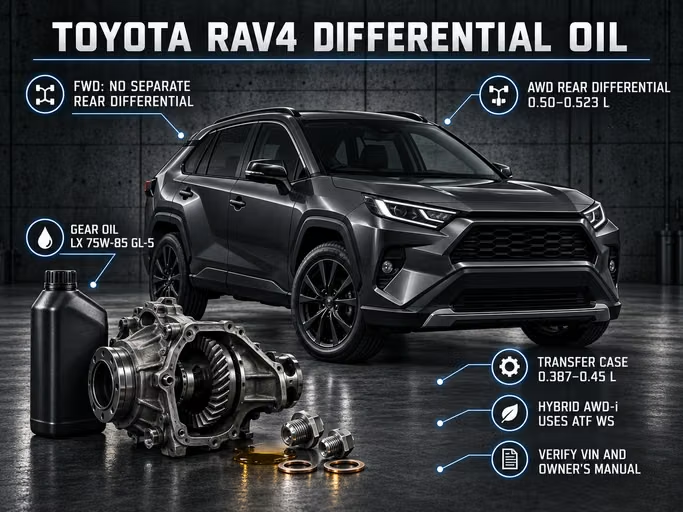
For a Toyota RAV4, the answer depends on the driveline as much as the mileage. A front-wheel-drive model has no separate rear differential or transfer case. A petrol AWD model has a transfer unit and rear differential filled with dedicated gear oil, while a hybrid AWD-i uses ATF in its rear electric motor and reduction gear assembly. Identify the generation, year, market, engine and transmission from the VIN before selecting either a fluid or an interval.
When service should no longer wait
Mileage alone does not reveal the condition of the lubricant. Arrange an additional inspection if any of these signs appears:
- The maintenance deadline has arrived. Even a low-mileage vehicle sees oxidation, moisture and repeated heat cycles, so the calendar limit matters as much as the odometer.
- A whine changes between acceleration and overrun. Tyres and wheel bearings can sound similar, but the final drive, differential bearings or an incorrect fluid level may also be responsible.
- Fresh oil is visible around a housing, plug or oil seal. Clean light staining and recheck it; repair an active leak before a longer journey can lower the level far enough to damage the unit.
- The lubricant looks cloudy or milky after deep-water driving. Water greatly reduces lubricating performance, so the next scheduled visit is no longer an appropriate deadline.
- The drain-plug magnet carries obvious chips. A soft metallic paste after long service may be normal, whereas larger fragments call for investigation before the unit is refilled and returned to use.
When a shorter interval makes sense
Toyota classifies towing, heavy loading, prolonged high-speed operation and some extended low-speed use as severe conditions. For the petrol AWD transfer and rear differential, the severe replacement interval is 20,000 km or 24 months, whichever comes first.
An unscheduled check is also sensible after water crossings, a substantial underbody impact, driveline repairs or any leak. On a vehicle that regularly works in heat, sand, mountains or with a trailer, inspect the fluid at each routine service even when the formal replacement limit has not arrived.
What old or unsuitable lubricant can cause
Gear oil maintains a strong film on teeth and bearings, carries heat away and suspends wear debris. ATF and CVTF must also support hydraulic control and friction elements. Those jobs are not interchangeable, so one supposedly universal product must not be poured into every RAV4 driveline housing.
- Film strength falls. Under high load, tooth surfaces run with less protection and both temperature and noise begin to rise.
- Oxidation promotes deposits. The fluid darkens, loses stability and performs less consistently after long motorway runs or towing.
- Contamination attacks bearings and working surfaces. Circulating metal becomes an abrasive and accelerates the next stage of wear.
- The wrong viscosity or specification can produce whine, vibration or poor AWD coupling behaviour. Substituting GL-5 axle oil for ATF in a hybrid rear motor assembly is a particularly serious mistake.
- Skipping diagnosis can turn routine service into a major repair. As a broad UAE guide, servicing a rear differential and transfer unit may cost AED 450–900, correcting a leak AED 700–2,000, and repairing a damaged differential or transaxle assembly can exceed AED 3,500–15,000 depending on the fault and labour involved.
Fluids and reference capacities
The figures below apply to current XA50 references. Several transmissions and AWD systems exist within the same model line, so use the table as an identification aid rather than a substitute for checking the VIN and build specification.
| Unit and configuration | Specified fluid | Reference capacity |
|---|---|---|
| Transfer, Dynamic Torque Control 4WD | Toyota Genuine Differential Gear Oil LX 75W-85 GL-5 or equivalent | 0.45 L |
| Rear differential, Dynamic Torque Control 4WD | Toyota Genuine Differential Gear Oil LX 75W-85 GL-5 or equivalent | 0.50 L |
| Transfer, Dynamic Torque Vectoring AWD | Toyota Genuine Differential Gear Oil LX | 0.387 L |
| Rear differential, Dynamic Torque Vectoring AWD | Toyota Genuine Differential Gear Oil LX | 0.523 L |
| Hybrid transmission, 2025 reference | Toyota Genuine ATF WS | 3.9 L |
| AWD-i rear motor-reduction unit, 2025 reference | Toyota Genuine ATF WS | 1.7 L |
Toyota’s official manual contains the exact product descriptions, level-setting procedure and cautions. Verify the entry for the vehicle’s model year and destination market before buying fluid.
Schedule for normal and severe use
For a petrol RAV4 AWD in normal service, Toyota calls for transfer and rear differential oil inspection at 20,000 km or 12 months and replacement at 40,000 km or 48 months. Automatic transmission or CVT fluid, which also lubricates the integrated front final drive, appears on its own maintenance line.
| Conditions and unit | Action | Distance | Time |
|---|---|---|---|
| Normal: transfer and rear differential | Inspect | 20,000 km | 12 months |
| Normal: transfer and rear differential | Replace | 40,000 km | 48 months |
| Severe: transfer and rear differential | Replace | 20,000 km | 24 months |
| Severe: AT/CVT with front final drive | Inspect / replace | 40,000 / 80,000 km | 24 / 48 months |
| Water entry, leak or low level | Inspect and correct the cause | Immediately | Immediately |
Under severe loading, the manual lists inspection of AT/CVT fluid including the front differential at 40,000 km or 24 months and replacement at 80,000 km or 48 months. The transfer and rear differential interval is shorter: 20,000 km or 24 months. Water entry or a loss of level requires immediate diagnosis regardless of mileage.
How to service the units safely
- Identify the vehicle first. Record the VIN, model year, market, engine code, transmission type and AWD system; the description “RAV4 AWD” is not precise enough to order the correct lubricant.
- Confirm that the fill plug can be opened before draining. A seized or damaged plug must not leave the vehicle with an empty housing and no practical way to restore the level.
- Use only the specified fluid and new sealing washers. Gear Oil LX 75W-85 GL-5 belongs in the applicable transfer and rear differential units, ATF WS in the Toyota transmission and hybrid assemblies that specify it, and CVT Fluid FE in the relevant continuously variable transmissions.
- Set the level with the vehicle horizontal and follow the temperature procedure. AT/CVT level adjustment is more involved than filling a housing to the lower edge of a plug, so specialist equipment is the safer choice when the procedure cannot be followed accurately.
- Clean the housings after service, complete a road test and inspect the plugs and seals again. Keep the product name, specification, quantity, mileage and date on the invoice for the next inspection.
If purchase price and future maintenance are being assessed together, current listings provide a useful comparison between RAV4 vehicles of the same generation, driveline and model year.
Why a whine may appear after service
A new noise does not automatically mean fresh fluid has damaged the unit. Service more often exposes existing wear or a mistake in product selection, level or procedure. Work through the likely causes in order:
- Incorrect specification. A lubricant may have the expected viscosity yet the wrong approval, changing coupling behaviour or noise; packaging and the word “synthetic” do not establish compatibility.
- Incorrect level. Too little fluid reduces lubrication, while too much may foam and overheat. Recheck the level on a flat surface using the procedure for that exact assembly.
- Mixed products. A residue of unknown fluid can alter viscosity and additive balance. Gear oil must never be treated as interchangeable with ATF or CVTF.
- Worn bearings or gear teeth. New lubricant cannot rebuild mechanically damaged surfaces, so a whine that existed before service may remain afterwards.
- A different source. Tyre tread, a wheel bearing, propeller shaft, underbody shield or the hybrid electric motor can imitate differential noise.
Checks to complete before authorising repairs
First confirm the fluid against its product number and invoice, measure the actual level, inspect the drained lubricant for water and particles, and then reproduce the noise on the road. Comparing acceleration, overrun and cornering helps separate final-drive noise from tyres or wheel hubs.
After correcting the level or repairing a leak, repeat the road test and inspect for seepage. Dismantling becomes reasonable only after simple causes have been excluded and the symptom documented; that order reduces the risk of replacing sound components.
Conclusion
There is no single “differential oil” for every Toyota RAV4. A front-wheel-drive model has no separate rear unit, a petrol AWD uses Gear Oil LX in its transfer and rear differential, and a hybrid AWD-i uses ATF WS in the rear motor-reduction assembly. Follow the VIN and the official manual: in normal use, inspect the separate petrol AWD units at 20,000 km or 12 months and replace their oil at 40,000 km or 48 months; under severe use, bring replacement forward to 20,000 km or 24 months.


