


Toyota RAV4 Coolant Replacement: Intervals, Capacities and Diagnosis
Toyota RAV4
Toyota RAV4•
•45 مشاهدة
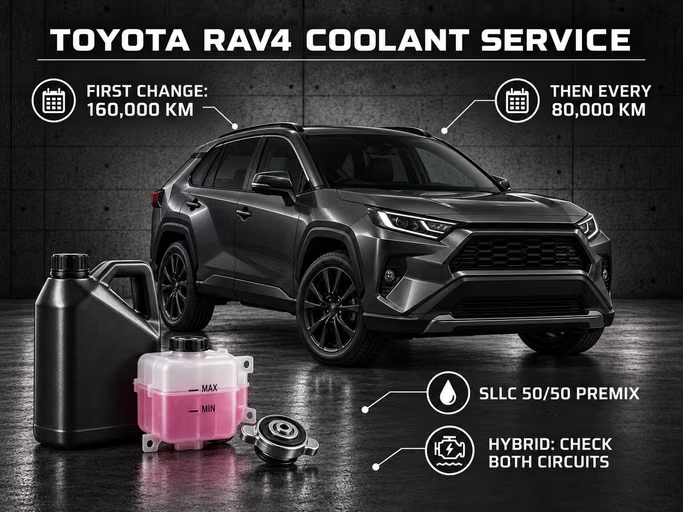
For a petrol Toyota RAV4, the manual schedules the first Toyota Super Long Life Coolant replacement at 160,000 km and later changes every 80,000 km. A leak, contamination or cooling-system repair requires earlier attention. Exact capacity depends on the engine, transmission and equipment, while a hybrid adds a separate power-electronics circuit.
When a RAV4 Needs Attention Before the Scheduled Change
A service interval does not replace routine observation. Track the cold level, fluid clarity, heater output and temperature behaviour under load. One isolated reading reveals little; comparisons made several times under the same conditions are much more useful.
- There is no verified service history. A top-up is not a complete renewal because aged fluid and wear products remain in the passages. Identify the engine and destination market before checking chemistry, concentration and leak tightness. If the existing product is unknown, mixing it with another coolant merely because the colour matches is risky.
- The level falls again after replenishment. Dried pink crystals on a hose, pump, cap or lower splash shield can guide the leak search even when the parking space remains dry. A small seep may evaporate on hot components, so the absence of a puddle does not prove that the system is sealed.
- The fluid no longer looks uniform. Sediment, flakes, foam, an oily film or a brown cast require diagnosis rather than another addition of fresh coolant. Colour change alone does not measure remaining life, but visible contamination justifies a chemistry and circuit-condition check.
- Heater temperature changes without a driver input. Inconsistent cabin heat may indicate trapped air, insufficient fluid or restricted circulation. When the symptom begins after cooling-system work, verify the filling and bleeding process first.
- Temperature climbs on a long grade, in congestion or during slow off-road travel. Check the fans, heat-exchanger stack, pressure cap, thermostat and water pump instead of blaming coolant alone. Scan data can help relate actual coolant temperature to fan commands and sensor readings.
A Safe Level Check
Leave the vehicle on level ground until it is completely cold. The reservoir should read between FULL and LOW. At LOW or below, add the specified fluid and investigate the loss. Never remove a hot cap: pressurised steam and coolant can cause serious burns.
How Aged or Mixed Coolant Causes Damage
Coolant carries heat while protecting aluminium, steel, seals and the pump. Once its additives are depleted—or incompatible chemistries are combined—deterioration may begin inside the passages without an obvious external clue. The process is progressive, which makes an early change in level or circulation more useful than waiting for an emergency warning.
- Internal corrosion attacks narrow passages and joints. A faint stain or damp area may appear long before a substantial leak. Corrosion products then circulate through the system and can accelerate wear elsewhere.
- Deposits impair heat transfer. Mineral-bearing water and incompatible additives can coat the radiator and engine water jacket. Under the same ambient conditions, a contaminated system may need the fans to work harder.
- The pump and thermostat work in harsher conditions. Incorrect concentration, cavitation and abrasive contamination shorten the life of seals and moving parts. A sticking thermostat or weak pump may become obvious only during sustained load.
- An air pocket creates a local hot spot. After careless filling, the bottle may appear full while part of the engine—or a hybrid circuit—still lacks reliable flow. Rechecking after complete cool-down can reveal a lower level once trapped air has left the passages.
- Ignoring a red temperature warning increases the repair bill. At independent UAE workshops, straightforward cooling-system work may start at about AED 300, while head-gasket work can reach roughly AED 1,900–3,000; extensive engine damage costs more. These are market indications, not fixed quotations, and diagnosis determines the final amount. Stop safely and allow the system to cool instead of continuing with an overheated engine.
Toyota Recommended Coolant for a RAV4
The default choice is premixed Toyota Super Long Life Coolant: 50% coolant and 50% deionised water. An alternative must be a high-quality ethylene-glycol coolant that is non-silicate, non-amine, non-nitrite and non-borate, using long-life hybrid organic acid technology. Colour is not a complete specification: two pink products can contain different additive systems. Plain water is not an acceptable substitute, and premix should not be diluted further.
Choose the document for the relevant year, engine and market from Toyota’s catalogue of manuals. The vehicle specification governs the chemistry and filling sequence; a general claim on the container does not replace it.
Official Toyota Coolant Schedule for a RAV4
The petrol figures below come from the 2026 RAV4 manual; the hybrid quantities are a separate 2025 example. Capacity helps plan the job, but the VIN-specific specification remains the deciding reference. After filling, establish the final level from the correct procedure and reservoir marks rather than the nominal litre figure alone.
| Parameter | Petrol version | Hybrid reference example |
|---|---|---|
| First SLLC replacement | 160,000 km* | Check the variant schedule* |
| Subsequent replacements | every 80,000 km* | Check the variant schedule* |
| Engine circuit | M20A-FKS: 6.9 L (CVT) or 6.4 L (manual); A25A-FKS: 6.9–7.0 L | A25A-FXS, 2025: 6.1 L |
| Second liquid circuit | No separate PCU circuit | Power control unit: 1.6 L |
| Factory chemistry | SLLC 50/50 premix | SLLC 50/50 premix |
| Permitted alternative | A full chemical equivalent to Toyota requirements | A full chemical equivalent to Toyota requirements |
* The 160,000 and 80,000 km intervals apply to a petrol RAV4 using SLLC in the cited regional manual. Hybrid capacities are 2025 reference values and its maintenance schedule must be checked separately. Generation, market, engine, transmission and equipment can alter the figures.
Why a Hybrid RAV4 Requires Two Calculations
A hybrid contains two independent liquid systems: one removes heat from the engine and the other cools the power control unit. Each has a separate capacity and reservoir. Their quantities cannot be combined into one fill figure because the circuits are serviced independently.
Fill and bleed each circuit according to the matching manual procedure. A correct engine-reservoir reading does not confirm the condition of the power-electronics circuit, so both must be checked individually. After work, also watch for hybrid-system warnings and unfamiliar pump operation.
Aged Coolant and Toyota RAV4 Overheating Risk in the UAE
In the UAE, the cooling system regularly operates in high ambient temperatures, with the air conditioning running and the vehicle moving slowly. Ram air assists the heat exchangers on the highway, while congestion or a sandy trail makes the electric fans more important. Fine dust and debris can accumulate between the condenser and radiator although the grille looks clean. Aged coolant is not the only cause of overheating, but deposits, incorrect concentration and weakened corrosion protection reduce the available cooling margin. Towing, a long climb or slow sand driving can expose a developing fault sooner.
| Problem | What happens in the system | Possible consequence |
|---|---|---|
| Depleted additives | Protection of aluminium, steel and seals weakens | Corrosion in passages and joints |
| Deposits | A contamination layer impairs heat transfer | Temperature rises under load |
| Incorrect concentration | Boiling and freezing margins are reduced | Unstable operation in high heat |
| Incompatible chemistries | Additives can form sediment or gel | Restricted flow and radiator contamination |
| Cavitation and abrasive debris | Pump seals and working surfaces deteriorate | Leakage or weak circulation |
| Air after filling | Some passages lack continuous flow | Local overheating in the engine or PCU circuit |
Setting the Next Service Point
- A complete-change invoice is available. Count forward from its recorded mileage, keeping the product name, job scope and date with the vehicle file. On a hybrid, record whether the engine circuit alone or both circuits were serviced.
- No records remain. Note the engine code and powertrain, test concentration, assess clarity and inspect the circuit before deciding on a preventive replacement. A quick test does not measure every depleted additive, so interpret it alongside history and visible evidence.
- A pump, radiator or hose was replaced recently. Confirm how much fluid was removed, what product was installed and whether the specified bleeding routine was completed. A partial refill after a repair does not necessarily renew the full system capacity.
- Oil or mixed products are visible in the coolant. Locate the contamination source first; diagnostic findings should determine the flushing method and parts list. Repeated flushing without correcting the fault only changes the fluid’s appearance temporarily.
Checks Before Replacement
- Identify the generation, engine, transmission and equipment. “RAV4 2.0” or “RAV4 2.5” does not define an exact fill quantity: even within one engine family, the gearbox and auxiliary equipment can alter the figure.
- Locate both reservoirs on a hybrid. Do not combine their readings or apply one circuit’s procedure to the other.
- Inspect before draining. Photograph the cold level and note dried pink residue around joints, the cap, pump and lower underbody shield.
- Verify the complete product specification. Do not dilute premixed SLLC further or supplement it with aftermarket additives. If an approved concentrate is used, calculate the mixture from its instructions and the vehicle requirement.
- Work only on a cold system. Use the drain points and filling sequence prescribed for the exact variant.
- After warm-up, confirm stable temperature, consistent heater output and leak-free operation. Make the final level check only after complete cool-down.
Monitoring Between Services
- Compare the level in the morning on the same level surface. This makes a slow loss easier to see and prevents thermal expansion from being mistaken for a fault. A photograph after service provides a useful baseline for checks after several journeys.
- Periodically inspect the heat-exchanger fins, hoses, caps and fan operation. A hybrid needs the same attention at both liquid circuits. After dusty-road use, check the exchanger stack, but clean it without bending the thin fins or damaging electrical components.
Conclusion
For a petrol RAV4, use 160,000 km for the first SLLC change and 80,000 km thereafter. When buying an example, check both hybrid circuits where fitted and compare its service history with current listings for Toyota RAV4 models.


