


How Often to Change the Engine Oil in a Toyota Hiace H300: Intervals, Specifications and Capacity
Toyota HiAce
Toyota HiAce•
•45 مشاهدة
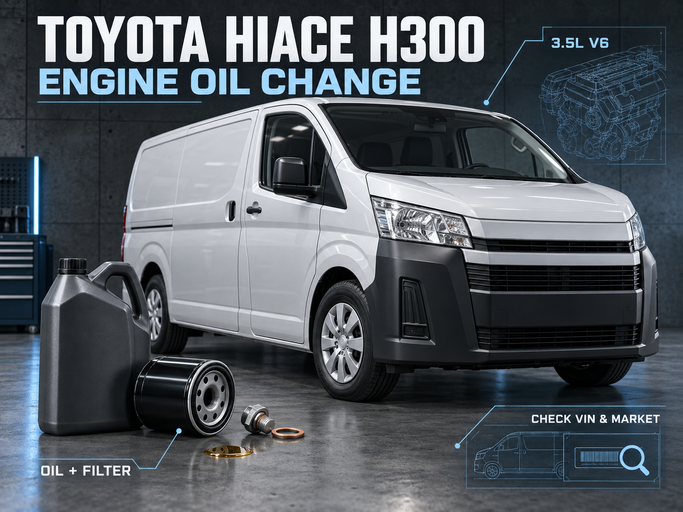
For a Toyota Hiace H300 with the 3.5-litre V6 petrol engine, a sensible upper limit between oil changes is 10,000 km or six months, whichever comes first. For delivery work, prolonged idling, short routes, heat, or dust, plan service at roughly 5,000 km or six months. This is a practical severe-use planning point; the VIN, model year, and documentation for the vehicle’s original market determine the final schedule.
5 Situations When a Hiace Should Not Wait for Its Scheduled Date
Mileage shows only part of a commercial van’s workload. Oil continues to age while the vehicle is stationary with the engine running, whether the air conditioning is cooling the cabin, the driver is waiting to load, or the van is moving slowly around a site. Choose the service date using distance, elapsed time, engine hours, temperature, dust, and changes in oil level.
- The distance or time limit has arrived. Change the oil when the first limit is reached. Low annual mileage does not prevent oxidation, condensation, or repeated heat cycles.
- The van idles for long periods or crawls along its route. The odometer barely moves at idle, but the engine continues to heat the oil. For a delivery, passenger-transfer, or service vehicle, this is a reason not to wait for the maximum interval.
- The level falls noticeably between checks. Leakage, oil consumption, or a crankcase-ventilation fault may be responsible. A top-up restores quantity, but it does not replace diagnosis or renew the additives in used oil.
- The level rises or the dipstick smells of petrol. Frequent cold starts and short journeys can dilute the oil with fuel. A clear change calls for an engine and fuel-injection check before the vehicle returns to service.
- The red oil-pressure warning remains on after start-up. This is an emergency warning, not a routine maintenance reminder. Switch off the engine, check the level, and follow the manual; continuing to drive may cause serious damage.
Why a Hiace Odometer Does Not Show the Oil’s Full Workload
One Hiace may cover hundreds of kilometres at a steady speed during a shift, while another makes dozens of stops and spends hours with the air conditioning running. At the same mileage, the second engine experiences more starts, idling, and heat cycles. The shorter interval accounts for this difference. Do not move to a thicker grade solely because the weather is hot: the approved viscosity depends on the exact engine and market.
What Happens to Oil After the Interval Is Exceeded
Serviceable oil separates loaded surfaces, carries away part of the heat, and keeps contaminants suspended until the filter captures them. Over time, additives are depleted while oxidation products, moisture, fuel, and wear particles accumulate in the fluid.
- The lubricating film becomes less predictable. Fuel dilution reduces viscosity, while prolonged oxidation can increase it. Either change may weaken protection for bearings, camshafts, and other loaded components.
- Deposits adhere more readily inside the engine. As the detergent and dispersant reserve declines, varnish and sludge can build up more quickly in oil passages, on piston rings, and around valve-timing mechanisms.
- The filter loses its contamination reserve. A loaded element creates more resistance to flow. If the bypass valve opens, some oil travels around the filtering medium.
- The safety margin at high temperature decreases. A full load, sustained speed, climbs, and air-conditioning use add heat. Aged oil and an incorrect level provide less protection under these conditions.
- The risk of oil starvation rises. Loss of pressure is particularly dangerous for crankshaft bearings, camshafts, and valve-timing actuators. A red warning requires an immediate safe stop.
Reference Data for the Hiace H300 3.5 V6
The Hiace range includes different body styles, markets, and powertrains. This article covers the H300 with the 3.5-litre 7GR-FKS petrol engine. The figures below help with service preparation, but they do not replace vehicle-specific information. After start-up, a leak check, and the specified waiting period, establish the final level with the dipstick.
| Item | Hiace H300 3.5 V6 | How to verify |
|---|---|---|
| Engine | 3.5-litre 7GR-FKS petrol | VIN and identification plate |
| Normal planning point | Up to 10,000 km or six months | Schedule for the original market |
| Severe use | About 5,000 km or six months | Route, engine hours, heat, and dust |
| With a new filter | Approximately 6.2 L | Final level on the dipstick |
| Typical viscosity | Usually SAE 0W-20 | Manual for the correct year and market |
| Oil quality | API/ILSAC from vehicle documentation | Do not mix requirements from different markets |
The body style, model year, and engine can first be compared with current listings. Before purchasing oil, open the manual for the exact VIN and original market; its requirements take precedence over reference figures.
How to Use the Table Without Mixing Specifications
The labels “Hiace” and “3.5” are not enough to order service parts. Before purchasing, confirm the VIN, 7GR-FKS engine code, model year, and original market. Do not transfer H300 figures to a Hiace H200 with the 2TR-FE petrol engine or to an H300 with the 1GD-FTV diesel: their capacities, oil requirements, and filters differ.
The 6.2 L figure is an approximate service refill quantity with a new filter, not an instruction to pour in an entire container at once. Add less than the reference amount first, fill the new filter during a control start, observe the waiting period stated in the documentation, and approach the final dipstick level in small steps without exceeding MAX.
Matching the Interval to Real Hiace Use
- Long journeys at a steady speed. If the engine reaches full operating temperature, idling is limited, and maintenance history is documented, remain within 10,000 km and the calendar limit for the original market.
- Urban delivery work and frequent stops. Repeated starts, slow movement, and waiting with the engine running add operating hours faster than kilometres. Roughly 5,000 km or six months is a more suitable planning point for this pattern.
- Construction sites, unpaved roads, and sand. Dust raises filtration demands, while low road speed under load adds heat. Check the oil level and air filter more often instead of waiting for the outer service limit.
- Infrequent or seasonal operation. Storage does not stop calendar ageing. If the Hiace is rarely driven, track the date of the previous change as carefully as mileage, especially after repeated short starts without a full warm-up.
Problems Made More Likely by Overdue Oil
Overdue oil rarely acts alone. Risk usually combines aged lubricant with an incorrect level, a loaded filter, overheating, leakage, or fuel dilution. Noise, smoke, unstable running, or a dashboard warning calls for diagnosis rather than another fluid change alone.
| Condition | Why it matters for a Hiace | What to do |
|---|---|---|
| Prolonged idling | Engine hours rise with almost no change in mileage. | Shorten the interval and account for operating time. |
| Frequent short runs | Oil may not warm fully; moisture and fuel accumulate. | Use the severe-operation schedule. |
| Dust and sand | The load on filtration increases. | Check the oil and air filter more often. |
| Level below MIN | The pump may draw air, reducing pressure and cooling. | Do not continue until the cause is checked. |
| Rising level or fuel odour | Dilution reduces the strength of the lubricating film. | Diagnose the engine and injection system. |
| Red pressure warning | Lubrication of loaded components may stop. | Stop safely and switch off the engine. |
Checks Before the Oil Change
- Confirm the engine and market. Match the VIN, identification plate, and vehicle documents. The 3.5-litre label does not replace the 7GR-FKS code, and information for another country may belong to a different specification.
- Verify the SAE grade and quality standard. Take viscosity and API/ILSAC requirements from one manual version for the correct year and market. Do not assemble a specification from several mismatched sources.
- Match the filter and seal by VIN. Parts that look alike can have different threads, valves, and dimensions. Confirm the oil-filter and drain-washer numbers before draining the engine.
- Inspect access to the sump and drain plug. Underbody protection varies with body style and specification. Correct damaged threads, a deformed plug, or a faulty seal before refilling.
- Begin below the reference capacity. After the filter has filled, raise the level gradually. MAX is not a target for overfilling; the oil must remain within the permitted range.
- Verify the result after start-up. Confirm that the pressure warning goes out and that the filter and drain plug remain dry. Recheck the level, then record the date, mileage, viscosity, and oil standard in the service history.
- Four Hiace Service Mistakes
-
- Conclusion
- For a Toyota Hiace H300 3.5 V6, base service planning on a ceiling of 10,000 km or six months. Urban delivery work, prolonged idling, short journeys, heat, and dust reduce the practical planning point to roughly 5,000 km or six months. Confirm the 7GR-FKS engine by VIN before purchasing supplies, then verify viscosity, oil quality, and capacity in the vehicle documentation.


