


When to replace spark plugs and glow plugs in the Hyundai Staria
Hyundai Staria
Hyundai Staria•
•41 views
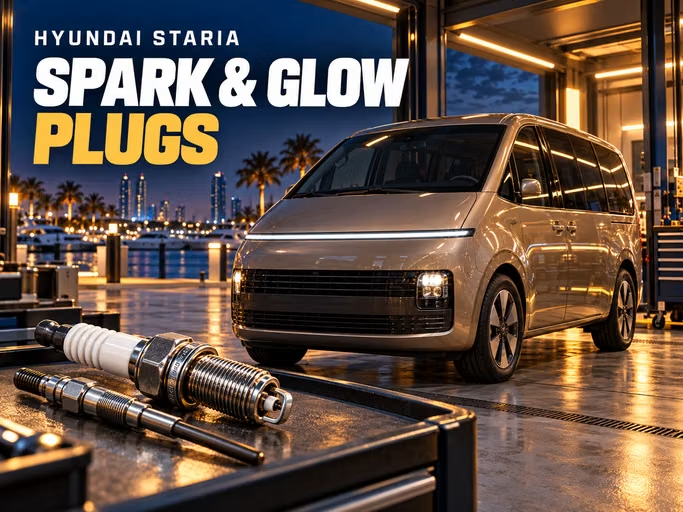
For the petrol Hyundai Staria 3.5 covered by the US4 2025 manual, the normal-use spark plug replacement interval is 150,000 km. Prolonged idling, shuttle duties and other severe conditions can call for earlier servicing. Check the schedule against the VIN and service booklet.
The diesel Staria 2.2 CRDi uses glow plugs, which assist starting and work differently. The petrol interval does not apply to them. This guide explains the systems, symptoms and part selection requirements for a vehicle in the UAE.
Before ordering, establish the model year, engine code and service history. Similar-looking Staria models can have different powertrains, so seat count and trim name do not replace an engine check.
Which plugs does the Hyundai Staria need
According to the specifications published on hyundai-uae.com, the passenger Staria is offered with the Smartstream G3.5 MPI petrol engine. This six-cylinder engine uses spark ignition and needs spark plugs of the correct specification.
| Powertrain | Plug type | What to check |
|---|---|---|
| Smartstream G3.5 MPI | Spark plugs | VIN, engine code and part number |
| 2.2 CRDi diesel | Glow plugs | Voltage and heater type |
| Smartstream G1.6 T-GDi HEV | Spark plugs | Hybrid catalogue and schedule |
Petrol and diesel Staria models
The powertrain description on hyundai.com lists the 2.2 CRDi diesel separately. Its fuel ignites through compression, while glow plugs help create suitable temperatures. Petrol-engine spark plugs are not suitable for it.
MPI refers to petrol port injection; CRDi identifies a common-rail diesel system. These abbreviations help identify the engine type but do not replace an original part-number check. Matching threads or appearance does not establish compatibility.
What changes with the hybrid
The Staria Hybrid section on hyundai.com describes the Smartstream G1.6 T-GDi HEV. An electric motor does not remove the petrol engine’s need for spark plugs. Check its separate schedule: the 3.5 MPI interval does not automatically apply.
A model-family description does not mean every powertrain is available in every local trim. For a used vehicle, establish the actual engine and original specification. A cargo or passenger body alone does not identify its plug type.
Spark plug replacement schedule
The Staria US4 2025 manual on ownersmanual.hyundai.com specifies 150,000 km for normal petrol-engine use. The selected schedule section covers Middle Eastern applications; check it against the actual vehicle’s documentation.
| Application or use | Replacement timing | Condition |
|---|---|---|
| Petrol Staria 3.5 under US4 2025 | Every 150,000 km | Normal operating conditions |
| Specified severe conditions | More often, according to condition | No fixed shorter mileage |
| Hybrid or another specification | Its own schedule | Check VIN-specific documentation |
| 2.2 CRDi diesel | Glow-system schedule and diagnosis | Do not transfer the petrol interval |
Shuttle duties and waiting for passengers
The severe-use section of the same manual calls for more frequent plug replacement. Listed conditions include short journeys, prolonged idling, heavy traffic, frequent stop-and-go driving and commercial use.
If a Staria waits for passengers with its engine and air conditioning running, its odometer does not capture all engine operating time. Describe the daily pattern to the workshop: waiting time, trip frequency and route conditions. The table does not prescribe a universal shorter interval for these vehicles.
Checking a vehicle before purchase
When browsing current offers for the Hyundai Staria, request plug replacement records showing the date, mileage and part numbers. A detailed service history is particularly useful for a former shuttle vehicle.
A “scheduled service” entry does not confirm plug replacement. If records are missing, establish the applicable schedule and check the system first. Rough running needs investigation without waiting for the stated mileage.
Signs that the plugs need attention
Jerking when accelerating with passengers, an uneven idle and difficult starting can involve the ignition system. Coils, injectors, air leaks and mechanical faults can produce similar symptoms. Establish the cause before buying a set, particularly if rough running began immediately after servicing.
| Observation | Possible explanation | What to investigate |
|---|---|---|
| Jerking during acceleration | Unstable spark or mixture | Plugs, coils and engine fuelling |
| Oil in a plug well | External leak through a seal | Leak source and coil boot |
| Oil on the firing end | Oil entering the cylinder | Oil consumption and mechanical condition |
| Dry black deposits | Fouling or poor combustion | Mixture, trip pattern and plug suitability |
| Rough running after replacement | Installation or selection error | Part numbers, insulators and connectors |
Why reading a fault code is not enough
A misfire code points towards an investigation; it does not instruct you to replace a plug. Diagnosis should account for the operating conditions and individual cylinder checks. Clearing the code without a repair leaves the cause unresolved.
The ignition troubleshooting article on ngkntk.com explains the effects of plug fouling and installation errors. An unsuitable heat range, damaged insulator or incorrect tightening can cause problems even with a new set.
If the engine shakes badly and the malfunction indicator flashes, stop accelerating and pull over safely. Running with severe misfires can damage the catalytic converter. Arrange transport to a workshop if the problem persists.
What to tell the technician
Explain when the symptom occurs: after overnight parking, with the engine warm, during acceleration or following recent servicing. Keep removed plugs in cylinder order. Differences between them can assist diagnosis, but deposit colour alone does not provide a definitive answer.
Glow plugs in the diesel Staria 2.2 CRDi
Glow plugs in a diesel Staria heat the combustion area to help starting; they do not create a spark. In systems with post-glow, heating continues after startup to support stable combustion. A hot climate therefore does not make the system unnecessary.
When to check the system
Reasons to investigate include difficult starting after parking, uneven running in the first seconds, increased smoke and preheating fault codes. A failure may be less noticeable in warm conditions. A weak battery, low compression or a fuel-system fault can produce similar symptoms.
Petrol spark plug replacement mileages do not apply to diesels. Check the separate schedule for the actual CRDi. Where no scheduled glow plug replacement is specified, base the decision on system testing rather than the petrol version’s interval.
Check the plug and its power supply
NGK’s technical guide on ngkntk.com describes resistance checks for glow plugs. Compare readings with the specification for the actual component. Do not connect a plug directly to the battery to test its heating: this can damage the element.
Check the wiring, connections and control module alongside the plugs. A fault in one channel may originate in the supply circuit. Replacing a working heater will not resolve that problem.
Avoiding damage during replacement
The practical fault-finding and installation guidance on denso-am.eu helps assess failure causes and fitting requirements. A replacement must match the engine’s required voltage, length, thread and heater type.
Do not keep increasing force on a seized glow plug without control. Preparation and permissible force must follow the repair procedure. If breakage is a concern, use a workshop with suitable equipment. After removal, check that the heating tip is intact.
Decide whether to replace one plug or the set after assessing the remaining components and the cause of failure. If a control-system fault caused the damage, address it first to avoid a repeat failure of the new parts.
Selecting and fitting spark plugs
Start Staria plug selection with the VIN and engine code. Then check the part number, heat range, thread, reach, seat and gap. Electrode material, such as iridium or platinum, does not establish compatibility or justify extending the factory interval.
Pre-replacement checklist
☐ Confirm the engine, quantity and plug part numbers.
☐ Switch the ignition off and prevent accidental starting, including hybrid READY mode.
☐ Allow the petrol engine to cool.
☐ Clean the wells and inspect the coils and boots.
☐ Prepare the correct socket and tightening specifications.
The installation procedure on ngksparkplugs.com calls for a cooled engine, clean wells and correct tightening. Start the plug without cross-threading; select the torque specified for the engine and component rather than a universal figure for all Staria models.
Do not lubricate the threads without an explicit manufacturer instruction. Avoid rough adjustment or wire-brush cleaning of fine electrodes. If a plug has been dropped or its insulator is damaged, check its suitability before installation.
Frequently asked questions
Should the ignition coils be replaced at the same time?
There is no automatic requirement. Test coils and replace them when a defect is confirmed. During plug servicing, inspect boots and connectors and address any oil or water entering the wells.
Can you wait until the engine runs roughly?
No: smooth running does not cancel scheduled maintenance. After replacement, retain the date, mileage and part numbers. If a fault was repaired, check the result under the conditions in which it occurred.
Conclusion
For the petrol Hyundai Staria 3.5 covered by the cited manual, the normal-use reference interval is 150,000 km. Shuttle duties and prolonged idling call for the severe-use schedule. The 2.2 CRDi diesel needs separate glow-system checks, while a hybrid requires its own schedule. If the engine runs poorly, identify the cause before replacing confirmed faulty or service-due parts.


