When should you replace the spark plugs in a Ford F-150?
Ford F-150
Ford F-150•
•16 views
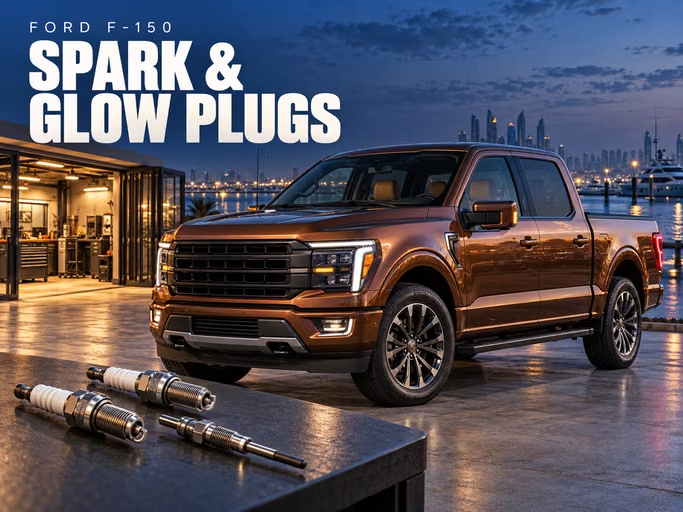
The cover illustrates plug maintenance. Enlarged parts are shown for clarity; their shape, quantity and placement do not replace the technical diagram for a particular engine.
Replace Ford F-150 plugs according to the schedule for the particular engine, or earlier when diagnosis confirms a fault. Petrol EcoBoost engines, V8s and the PowerBoost hybrid use spark plugs; the 3.0 Power Stroke diesel uses glow plugs. Identify the version before ordering: a shared model name does not mean identical parts, intervals or procedures.
How the truck works matters. Unladen driving, towing a trailer, travelling over sand and running while parked create different operating conditions. A low odometer reading alone does not establish that the engine has had an easy life.
This guide explains how to select the schedule, recognise symptoms and arrange checks before buying parts. It also covers the diesel, hybrid and older petrol engines for which an apparently routine replacement needs additional preparation.
Which plugs does your F-150 use?
Start with the model year, engine and original specification, using the VIN, or vehicle identification number. First-registration year and the trim badge may be insufficient. If the engine has been replaced, confirm the identity of the unit actually installed.
The UAE model information on me.ford.com lists the petrol 3.5 EcoBoost, 5.0 V8, 3.5 PowerBoost hybrid and Raptor variants. Other model years include different engines, so the current trim range cannot replace identification of an individual truck.
| Version | Plug type | Selection priority |
|---|---|---|
| 2.7 and 3.5 EcoBoost | Spark plugs | Engine code, year and specification |
| 5.0 V8 | Spark plugs | Dedicated V8 specification |
| 3.5 PowerBoost Hybrid | Spark plugs | Confirm hybrid compatibility |
| Raptor and Raptor R | Spark plugs | Distinguish 3.5 from 5.2 and check year |
| 3.0 Power Stroke diesel | Glow plugs | Diesel preheating system |
| F-150 Lightning | Neither type | Fully electric version |
PowerBoost still needs plug servicing
A hybrid can travel or remain stationary with its petrol engine switched off. When that engine runs, however, a spark still ignites the air-fuel mixture. Do not assume that the electric motor makes plugs unnecessary or calculate a replacement interval from an estimated share of electric driving.
Lightning has no internal-combustion engine and needs neither spark nor glow plugs. This distinguishes it from PowerBoost. Keep that distinction in mind when reading advice about an “electrified F-150” or comparing workshop quotations.
Confirm quantity in the catalogue as well. Do not extend a one-plug-per-cylinder assumption to every generation: older engine designs can differ. For scheduled replacement, the workshop should identify the complete required set before quoting, rather than discovering a quantity difference after work begins.
How to establish the replacement interval
Use the service schedule for your particular version. For example, the F-150 2023 maintenance table lists spark-plug replacement at 100,000 miles, shown as 160,000 km. Its 60,000-mile, or 96,600 km, entry carries a footnote limiting it to vehicles with a pickup-bed power outlet used in severe service.
| Entry in the cited document | Interval | Qualification |
|---|---|---|
| Normal schedule | 160,000 km | Applicable manual version required |
| Bed power outlet and severe service | 96,600 km | Read the complete footnote |
| Another version or model year | Its own schedule | Do not transfer figures automatically |
This comparison explains how to read the document; it is not a universal UAE F-150 schedule. Check the relevant sections for a different vehicle specification, particular operating conditions and Raptor requirements. Petrol spark-plug schedules do not apply to the diesel glow system.
Towing and stationary running matter
Describe the truck’s actual use: time spent idling, heavy loads, trailer towing and travel over sand. An occasional weekend trip differs from daily loaded work. A shorter interval recommended to the owner of a similar-looking truck is not sufficient evidence for choosing your own.
Bed-outlet use also deserves attention. When the engine runs to power equipment, operating hours accumulate without a corresponding increase in distance. However, the presence of Pro Power Onboard alone does not remove the other condition in the footnote or make every operating pattern severe.
Keep the oil-change reminder separate from the plug schedule. An oil service does not reset the age of the fitted plugs. Smooth running does not justify postponing replacement once it is due; symptoms before the scheduled distance still require investigation.
Five signs that need an ignition check
Plug wear may be difficult to notice while parked. DENSO’s explanation of replacement needs describes how electrode erosion increases the gap and voltage demand. A fault can therefore appear during acceleration or under load even when the engine idles smoothly.
- Starting takes longer. Note whether it follows an overnight stop, occurs with a warm engine or depends on a particular temperature.
- Idle becomes uneven. Vibration can also involve mixture, injectors or engine mounts, so it does not identify a plug fault by itself.
- Hesitation or loss of pull develops under load. For an F-150, record whether this occurs when towing, climbing or accelerating without a trailer.
- Check Engine illuminates. A fault code helps direct investigation but is not a completed diagnosis calling for plug replacement.
- Fuel use rises on familiar routes. First account for loads, tyre pressures, waiting with air conditioning and changes in driving speed.
Why a jolt is not enough to condemn plugs
A gear-change jolt and a combustion misfire can feel similar from the driver’s seat. Record vehicle speed, engine speed, engine temperature and accelerator input when describing hesitation. These details help the technician reproduce the complaint and compare it with diagnostic information.
Do not deliberately recreate a serious fault with a heavy trailer or on difficult terrain. The workshop should choose safe conditions for testing. If a symptom remains after parts have been changed, investigation must continue rather than attributing it to new plugs needing to “bed in”.
What happens when misfires are ignored?
Unburnt fuel can enter the exhaust and overheat the catalytic converter. Persistent faults reduce usable performance and can turn a relatively modest service into a much larger repair. Investigation is particularly important when symptoms appear shortly after the previous plug replacement.
What to check before buying parts
Begin by retaining fault codes and the conditions in which they appeared. Freeze-frame data records engine parameters when a fault was detected; losing it makes an intermittent starting or acceleration problem harder to investigate. Do not erase codes before a workshop visit just to extinguish the lamp.
P0300 identifies random or multiple combustion misfires. P0301 and subsequent cylinder-specific codes relate to cylinders within the particular engine’s cylinder count. These codes do not automatically distinguish a failed plug from a coil, injector or compression problem.
A useful diagnostic sequence
- Confirm the complaint and save the original codes and available operating data.
- Inspect connectors, wiring, coils, boots and plug wells.
- Identify the source of any oil or water before fitting replacement parts.
- Compare plug condition with ignition tests; investigate injection, mixture and engine mechanical condition where necessary.
- Repeat the appropriate checks after repair and confirm the original symptom has disappeared.
HELLA’s technical guide describes testing coils and their electrical circuits. Resistance figures from a general example are not specifications for every F-150. Use the procedure and acceptable values for the installed system; a satisfactory result for one coil does not establish the condition of all the others.
What removed plugs can reveal
Compare parts by cylinder. The DENSO troubleshooting reference describes characteristic wear and damage. These observations guide further investigation; they do not provide a complete diagnosis from a photograph.
| Observation | Possible explanation | Next check |
|---|---|---|
| Dry black deposits | Incomplete combustion or rich mixture | Mixture and operating conditions |
| Oil at the firing end | Oil entering the cylinder | Source of the oil |
| Worn electrodes | Service wear | Mileage and gap |
| Cracked ceramic | Damage | Handling and installation |
| Melting | Overheating | Cause before replacement |
Oil outside a plug, in its well, needs a different investigation from oil at the firing end. Ask the technician to retain cylinder identification when removing parts. Cleaning every plug before inspection can erase useful evidence. Deposits returning on a new plug suggest that the underlying cause may still be present.
Selecting parts and arranging replacement
Check part number, thread, reach, seat, heat range, design and specified gap. An iridium label does not make a plug suitable for every EcoBoost. Verify superseded part numbers against current application data, rather than relying on a photograph of the packaging.
Do not assign a single gap to the entire F-150 family. Matching thread dimensions are insufficient too. Establish whether the manufacturer permits adjustment of the selected plug: careless contact with a fine centre electrode can damage it before installation.
Cleanliness and correct tightening
Clean the wells before removal, start replacement plugs without cross-threading and tighten according to the repair procedure. DENSO’s installation guidance explains the connection between correct torque, sealing and heat transfer. Both insufficient and excessive tightening can create problems.
Do not routinely lubricate the threads: lubrication alters friction and tightening conditions. Make exceptions only where the applicable procedure expressly requires them. On a hybrid, prevent automatic petrol-engine starting before work; READY mode must not be mistaken for a safe shutdown.
A concern on some older 5.4 V8 engines
A Ford service bulletin describes plugs breaking during removal on some 2004–2008 F-150 trucks with the 5.4 3V engine. Applicability includes engine production-date restrictions. The workshop must check current instructions and prepare the appropriate tools; the issue should not be attributed to every V8.
Unusually high removal resistance must not become an attempt to force the plug out at any cost. Agree how additional work will be authorised if damage is discovered. The bulletin is intended for trained technicians and does not replace practical experience with the extraction procedure.
What determines the cost in AED?
Compare like-for-like quotations covering diagnosis, the correct quantity of plugs, labour and genuinely necessary additional parts. Replacing all coils alongside plugs needs separate justification. Leak repairs, connector work or broken-part extraction should not appear in the final bill without explanation.
Retain part numbers, date and mileage after servicing. Ask for confirmation that connectors are secure and checks after repair were satisfactory. When considering another pickup among current offers for the Ford F-150, compare its records with its condition: a documented service history matters more than a fresh set of plugs alone.
Glow plugs in the F-150 3.0 Power Stroke
Diesel fuel ignites in air heated by compression. Glow plugs provide additional heat rather than an ignition spark. They are listed separately for the F-150 3.0 diesel in the owner’s manual. Petrol EcoBoost and V8 plug information does not apply to this system.
Warm weather can make a fault less obvious but does not remove the need to investigate symptoms or stored errors. Do not treat the glow system as equipment that only needs attention in winter. Equally, smoke alone does not establish that its plugs have failed.
Symptoms worth investigating
Difficult starting after standing, uneven running immediately after startup and preheating-system fault messages warrant assessment. Battery condition, cranking speed and the fuel system also need consideration. Replacement glow plugs cannot correct a weak electrical supply or a faulty injector.
Follow the manual’s starting sequence and preheat-indicator instructions. Lamp duration is not a universal test of each plug. A lack of noticeable starting delay on a hot day does not confirm that the complete electrical circuit is healthy either.
Testing and deciding on replacement
The workshop reads faults and checks supply, wiring, connectors and control before testing individual plugs according to the engine procedure. DENSO’s diagnostic guide explains why low-resistance measurements must account for test-lead resistance. Use the specification for the actual plug, not a value copied from a general example.
A petrol spark-plug interval does not apply here. Decide whether to replace one plug or a set after assessing the remaining parts, access requirements and the service documentation. The job record should identify which tests established the fault, rather than merely listing parts supplied.
DENSO’s glow-plug fault and installation guidance discusses heating-control faults and installation damage. Correct the cause before fitting a new set. Otherwise replacement may provide only a temporary improvement, even when the parts themselves are correctly specified.
Frequently asked questions
Does 160,000 km apply to every F-150?
No. It is an entry in a particular manual. Use your version’s schedule, operating conditions and all applicable footnotes.
Should plugs be replaced at 60,000 km?
Do not confuse kilometres with miles. The cited table’s 60,000-mile entry is shown as 96,600 km and carries a specific condition.
Does PowerBoost have spark plugs?
Yes. Its petrol engine uses spark plugs. The hybrid’s electrical system does not eliminate their maintenance requirements.
Does Lightning need a set too?
No. The fully electric F-150 Lightning uses neither spark plugs nor diesel glow plugs.
Must coils be replaced at the same time?
Only with a valid reason. Plug wear and coil failure are different repair needs, although their symptoms can overlap.
Can plugs from another EcoBoost be used?
Only after catalogue compatibility is confirmed. The engine-family name and a similar-looking part are insufficient.
Is cleaning old plugs enough?
Cleaning cannot restore lost electrode metal or repair cracks. When deposits are present, identify what caused them.
Why does hesitation remain after replacement?
Check selection and installation, then continue diagnosis. Coils, injection, engine mechanical condition or the transmission may be involved.
Checklist before servicing
☐ Engine, model year and specification are identified.
☐ Schedule and any shorter-interval conditions are verified.
☐ Codes and circumstances of the symptoms are retained.
☐ Part numbers, quantities and quotation scope are agreed.
☐ Hybrid, diesel or older V8 requirements are considered.
☐ Results are checked and service records retained.
Conclusion
Ford F-150 plug servicing begins with identifying the engine and applicable schedule. Petrol and hybrid versions need ignition checks, while the 3.0 Power Stroke diesel needs assessment of its glow system. Correct parts, diagnosis before replacement and checks after repair help resolve the cause and avoid repeat expenditure.