


When should you change differential oil in a Ford F-150?
Ford F-150
Ford F-150•
•21 views
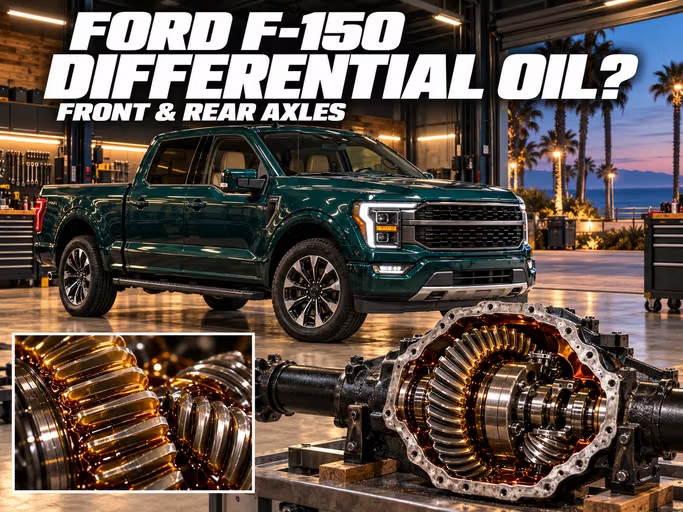
Illustration only: the differential cutaway and gear close-up are conceptual visuals, not a technical drawing of a specific Ford F-150 axle.
There is no single axle-oil interval for every Ford F-150. The model year, drivetrain, axle specification and operating conditions all matter. For UAE owners, towing, sand driving and axle immersion deserve particular attention. On a 4×4, the front differential and rear axle are separate service items, each with its own requirements.
Which versions does this article cover?
This article concerns petrol-powered F-150 trucks and PowerBoost hybrids; the electric Lightning needs separate guidance. The regional model range includes different configurations, including Tremor and Raptor. An identical engine size does not establish an identical axle. Before choosing lubricant, identify the VIN, model year and the axle actually fitted to the truck.
Why does a differential need its own lubricant?
A differential allows the driven wheels to turn at different speeds when cornering. The final drive changes rotational speed and transfers torque to the axle shafts. Its gears and bearings carry substantial loads, so they need a durable oil film. The lubricant also helps carry heat away and protects metal surfaces against corrosion.
A rear-wheel-drive F-150 has a rear axle to service. A four-wheel-drive truck also has a front differential, with a transfer case between the transmission and the driven axles. These are separate fluid compartments with separate requirements. Changing the automatic transmission or transfer-case fluid does not mean the oil in either differential has been renewed.
A locking differential does not automatically need an additive
An open differential, an electronic locking differential and a limited-slip differential are not interchangeable descriptions. A locking switch does not prove that an axle needs a friction modifier intended for clutch packs. Certain configurations have specific instructions, including the Tremor front Torsen unit. Select the lubricant from the axle documentation, rather than from an “off-road” label on a bottle.
Warning signs that deserve attention
▪ A new whine under acceleration or on overrun, especially if its pitch follows road speed rather than engine speed.
▪ Oil around the axle cover, pinion area or axle-shaft seal. Establish whether it is a fresh leak or residue from earlier work.
▪ Repeated clunks, vibration or an unusual noise in turns. A driveshaft, wheel bearing, tyre or another component can produce similar symptoms.
▪ Cloudy emulsion, water droplets or conspicuous metal particles found when inspecting lubricant after hard use or axle immersion.
No single symptom proves that the differential is faulty. Off-road tyre noise can change considerably between road surfaces, while driveline movement can accompany changes in load. Record the speed, load and circumstances in which a sound appears. Do not investigate a suspect axle through prolonged wheelspin or repeated hard launches.
What can happen if a fault is ignored?
- A leak or contamination compromises lubrication. A small leak can gradually lower the oil level without creating an obvious puddle.
- The risk of bearing and gear wear increases. Additional wear material enters the oil, and the noise may become more pronounced.
- The damage becomes mechanical. Fresh oil cannot restore damaged surfaces; repair may require dismantling and accurately setting up the axle.
This is a possible progression of an unresolved fault, not an inevitable sequence for every truck. Stop safely if there is severe metallic noise, a substantial leak or loss of drive, and arrange assessment without placing further load on the assembly. A relatively inexpensive inspection can establish whether routine servicing is still appropriate.
How should you interpret the maintenance schedule?
The Other Maintenance Items table in the 2024 F-150 owner’s manual lists front and rear axle-fluid replacement at 240,000 km, with the front axle applying to four-wheel-drive vehicles. However, the same maintenance section includes an exception describing axles and the transfer case as not requiring regular scheduled servicing, alongside qualifications concerning severe use, immersion and leaks.
These statements should not become either “drive to 240,000 km regardless of conditions” or “the oil never needs changing.” The document covers different configurations. Obtain the applicable regional schedule for the VIN and establish which table entry and exception govern the installed axles. This source does not support a universal 40,000–60,000 km interval for every F-150.
| Operating situation | What it means for maintenance planning |
|---|---|
| Normal use | Read the table together with the exceptions for the correct model year. A long listed interval does not eliminate inspections or leak checks. |
| Raptor used off-road | The 2024 manual specifies 48,000 km for front axle fluid in off-road use. Do not apply it to the rear axle or every F-150. |
| Frequent towing or sand driving | Discuss service needs according to the duration and severity of the load. A workshop’s preventive interval is not automatically a universal Ford requirement. |
| Rear axle submerged in water | The manual requires rear axle lubricant replacement after submersion. Do not wait for the next mileage-based service. |
Why UAE operating conditions matter
High ambient temperatures occur alongside very different workloads. A truck used mainly on paved roads without cargo has a different duty cycle from one regularly pulling a trailer across sand. Sustained low-speed pulling, repeated wheelspin and heavy loads warrant closer attention to the driveline. Simply living in the UAE, however, does not establish a precise replacement interval in kilometres.
The boat-launching section explicitly requires new rear axle lubricant after submersion. After crossing deep water or entering a flooded area, establish whether the axle was actually submerged. Splashing through an ordinary puddle and keeping an axle housing underwater are different events. Inspect seals and the breather as well as the lubricant: a blocked or damaged ventilation path can contribute to pressure or contamination problems.
Which differential oil does a Ford F-150 need?
Viscosity alone, or a label saying “suitable for SUVs,” does not establish compatibility. You need the Ford requirements for the actual axle. The published 2024 F-150 sections for the rear axle and front differential specify SAE 75W-85 and WSS-M2C942-A. These are verified examples, rather than substitutes for checking another model year or assembly.
| Assembly: 2024 F-150 examples | Capacity | Specified fluid / qualification |
|---|---|---|
| 8.8-inch rear axle, excluding Raptor | 1.9–2.0 L | SAE 75W-85; WSS-M2C942-A |
| 9.75-inch rear axle, excluding Raptor | 2.64 L | SAE 75W-85; WSS-M2C942-A |
| Standard front differential | 1.7 L | SAE 75W-85; WSS-M2C942-A |
| Tremor front Torsen unit | 1.55 L | A specific additive instruction applies; see below. |
For that front Torsen application, the manual specifies 118 mL of XL-3 friction modifier meeting EST-M2C118-A for a complete refill. This quantity is included in the total capacity. Do not extend this instruction to every electronically locking axle. Adding a friction modifier “just in case” is not a universal upgrade to the lubricant.
A listed capacity helps plan the materials required. It is not an instruction to force that quantity into the housing regardless of residual oil or vehicle position. Establish the correct level using the procedure for the specific assembly with the vehicle positioned as required. A refill following a repair may also differ from the amount recovered during an ordinary drain.
What should the bottle and invoice identify?
Ask for the exact product name, viscosity and required specification before the job begins. A GL-5 designation or the word Synthetic does not, by itself, replace verification against WSS-M2C942-A where that specification is required. Check the precise product on the container: similar names or a shared brand do not guarantee an identical formulation or application.
If a workshop proposes another lubricant, such as a thicker grade because of the heat, ask for a technical basis for that particular axle. Changing viscosity without justification does not repair a worn bearing or replace a level check. Engine oil, automatic transmission fluid and transfer-case fluid cannot simply be substituted for the specified differential lubricant.
Choose service parts just as carefully. A cover gasket or sealant, plug seal and shaft seal must match the axle and repair procedure. Replacing a pinion seal can affect assembly adjustments; it should not be treated as a casual addition to an oil drain. If play or another defect is found, establish the repair scope before approving the work.
What should be checked before changing the oil?
For a quiet, leak-free axle receiving scheduled maintenance, the preliminary assessment can be straightforward. With a whine, vibration or evidence of water, the task changes: identify the cause before deciding between a fluid service and repair. Draining everything before examining the truck and recording the symptoms can remove useful diagnostic evidence.
| Observation | A sensible next step |
|---|---|
| Whine under load or on overrun | Locate the sound during a diagnostic drive; assess the axle, driveshaft, wheel bearings and tyres. |
| Wet housing | Clean the area, identify the fresh leak, and check lubricant level and ventilation. Do more than repeatedly top it up. |
| Milky or cloudy lubricant | Establish water exposure and investigate the entry path. Colour alone cannot determine the condition of internal parts. |
| Chips or large metal particles | Assess mechanical wear. An oil change may be insufficient; agree on further investigation before authorising repairs. |
Dark colour and the distinctive smell of gear oil do not, on their own, prove a failure. Consider them alongside mileage, noise, water contamination and the character of any particles. Fine paste on a magnetic plug and distinct large fragments require different assessments. Ask the workshop to show you the drained oil and explain its findings before approving an expensive repair.
What determines the service cost?
A single price for every F-150 would be misleading without the model year, axle type and work scope. A rear-wheel-drive truck has one driven axle to consider; on a 4×4, confirm whether the quotation also covers the front unit. Oil quantity and specification, access to the plugs, cover removal and replacement seals all affect the total.
Ask for an itemised quotation separating lubricant, consumables, labour and diagnosis. Any seal or bearing repair should appear as a distinct operation. Establish whether the price includes checking the breather, cleaning the affected area and checking for leaks afterwards. This makes it easier to compare equivalent work rather than two totals covering different tasks.
What an oil change cannot promise
A service restores appropriate lubrication conditions when fresh, suitable oil and the correct level are sufficient. It cannot guarantee that a whine will disappear, fuel consumption will fall or axle life will increase by a specified distance. Damaged gears or bearings need a mechanical solution. Be cautious about promises to cure an axle with an additive before the noise has been diagnosed.
On a truck with suspension modifications, larger wheels or altered final-drive ratios, document the changes separately. Standard configuration information may no longer describe the installed assembly. The workshop needs to know who carried out the conversion and which components were used. A VIN helps establish the original configuration, but does not prove what is fitted today.
What does a proper axle-fluid service involve?
The job starts with identifying the axle, verifying the lubricant requirement and inspecting for leaks. Before draining, the technician confirms that the fill point is accessible and its plug can be removed. This matters on trucks with additional protection, corrosion or previous careless repairs. The condition of the old lubricant is then recorded and the correct drainage method selected.
Where the cover is removed, the mating surfaces must be cleaned and the specified sealing method used. Dirt, excess sealant and fragments of an old gasket should not enter the housing. Tightening torques, sealant instructions and vehicle positioning come from the relevant service procedure, rather than a generic guide for any pickup truck.
After filling, the technician checks the level, tightens the plugs as specified and cleans away external oil residue. A leak check and, where appropriate, a short verification drive complete the work. Keep the date, mileage, axle identification, fluid name and materials used on the invoice. The front and rear units should be recorded separately.
What should you check before buying a used F-150?
When comparing current listings, look beyond the engine, mileage and trim. Towing history, sand driving, boat launches and chassis modifications matter on a pickup. Ask when each axle was serviced, which lubricant was used, and whether seals or bearings have been replaced. Dated invoices identifying products are more useful than a general “fully serviced” claim.
During inspection, look for fresh oil, damaged breathers and evidence of poor earlier work. On a test drive, listen at a steady speed, under acceleration and when lifting off the accelerator. Test the locking differential and four-wheel-drive system only according to the manual and on a suitable surface. Fresh paint or a recently washed housing is no substitute for diagnosis.
Missing paperwork does not prove that an axle is faulty, but it leaves the likely expenditure uncertain. Budget for inspection of both units on a 4×4 and an agreed baseline service. If there is already noise, obtain an assessment first: a routine fluid change and a final-drive rebuild belong to very different cost categories.
Conclusion
Choose F-150 axle oil for the installed assembly and follow the applicable schedule. Check leaks, account for water immersion and record each axle’s maintenance separately. These steps help distinguish a routine fluid service from necessary mechanical repair.


