


GCC Specs or not: which Fortuner specifications should you choose?
Toyota Fortuner
Toyota Fortuner•
•26 مشاهدة
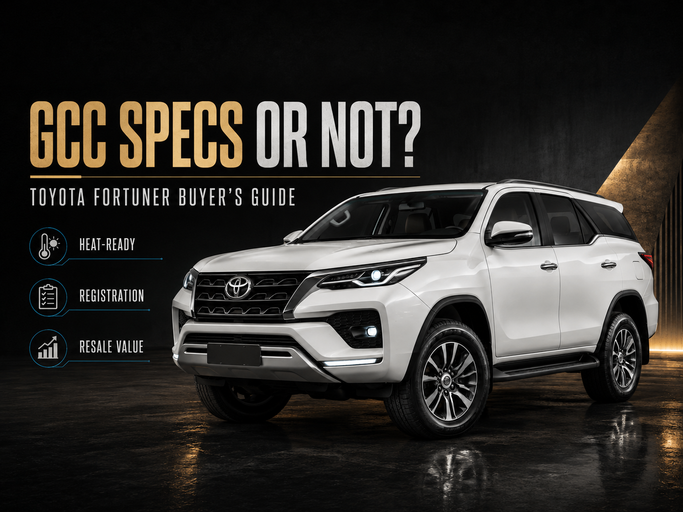
A practical guide for Dubai buyers: origin, registration, inspection and ownership
Buying a Toyota Fortuner in Dubai is not only about choosing a colour, engine or trim. Regional specification affects registration, insurance, repairs and future resale. A lower-priced import is not necessarily a bad car, but the labels American Specs, European Specs or Japanese Specs are no substitute for a transparent history and professional inspection. Below are clear criteria that will help you distinguish GCC Specs and assess the risks before paying a deposit.
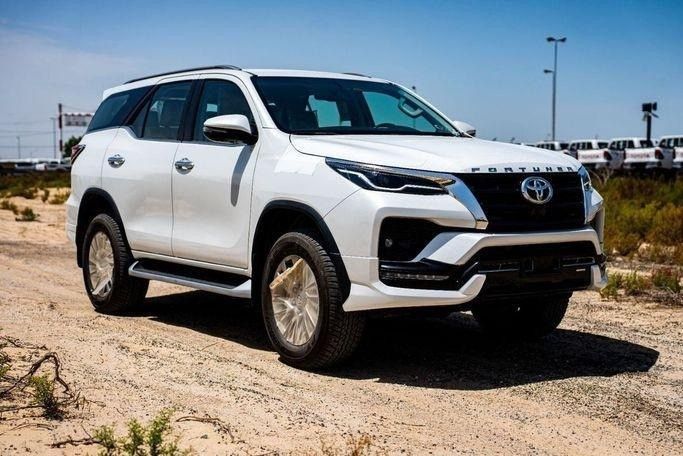
Left-hand-drive Toyota Fortuner 2025: exterior view of the vehicle from the listing
What are GCC Specs on a Fortuner?
GCC Specs refers to a vehicle specification intended for one or more Gulf Cooperation Council countries: the UAE, Saudi Arabia, Kuwait, Qatar, Bahrain and Oman. Reliable proof is not a sticker or a seller's wording, but a consistent chain of evidence: the VIN, original market specification, conformity documents, service history and registration records.
A Fortuner for the GCC market is homologated for local requirements and receives equipment and settings selected for the region. However, the exact design depends on the model year, engine and destination country. You should therefore not assume that every GCC vehicle automatically has a different radiator, suspension or paint formulation. If a seller claims a special component, ask for an official specification sheet or part number.
Vehicles intended for Gulf countries are commonly associated with the following features:
- Engine cooling and air conditioning. System performance is selected for the intended market. But condition matters just as much as specification: a blocked condenser, weak fan, worn compressor or old coolant will spoil the summer ownership experience in any vehicle.
- Parts and diagnostics. Regional configurations are generally easier to service in the UAE because workshops can identify the required parts and software more readily. Imported vehicles may use different electronic modules, lamps, multimedia systems and emissions components.
- Instruments and equipment. Units of measurement, lighting, interface languages, navigation and radio-frequency spacing depend on the market. These differences do not always affect safety, but every function should be checked before purchase.
- Warranty and service history. Regional warranty coverage applies only under the original distributor's terms. The word GCC in a listing does not, by itself, prove that the warranty remains valid.
- Documents and registration. A vehicle originally supplied to the GCC usually has a clearer history. An imported used vehicle may require additional origin and conformity checks.
Why are GCC Specs important when buying in Dubai?
The main advantage is less uncertainty. For registration in Dubai, RTA checks the required documents, valid insurance and the vehicle's technical condition. For imported used vehicles, the UAE Ministry of Industry and Advanced Technology provides a status check confirming eligibility for registration. Certain hazardous vehicle categories are prohibited, including burnt, flooded, dismantled, scrapped and irreparable vehicles. An administrative check, however, does not replace a structural and mechanical inspection.
The key differences between GCC and Non-GCC vehicles are as follows:
| Criterion | GCC Specs (recommended) | Non-GCC (USA / Europe / Japan) |
|---|---|---|
| Cooling system | Optimised for heat up to +50 °C | Standard; overheating is possible in summer |
| Air conditioning | Powerful and effective in hot weather | Less powerful; may struggle in summer |
| Resale | High liquidity and easier to sell | Lower liquidity and harder to sell |
| Insurance cost | Standard rate | May be 1.5–2 times higher |
| RTA registration | Usually straightforward | Possible difficulties and additional checks |
| Navigation and multimedia | Supports local maps and services | Local functions may be unavailable |
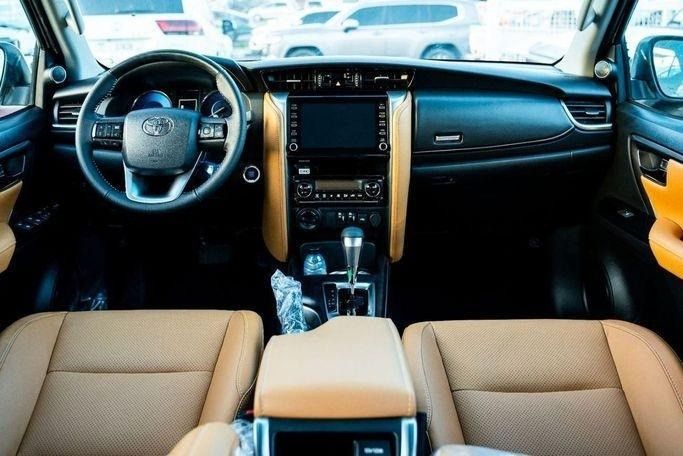
Left-hand-drive cabin, climate-control system and Fortuner multimedia
How can you verify a Fortuner's origin before buying?
Use a consistent process rather than relying on a visual guess:
- Record the complete VIN. Compare the number beneath the windscreen, on the body plate and in every document. A mismatch, signs of tampering or an unreadable marking are reasons to stop the deal.
- Decode the VIN correctly. The first characters identify the manufacturer and the country or region of manufacture, but they do not prove GCC Specs on their own. The destination market should be confirmed through Toyota documents, a dealer catalogue and reliable vehicle records.
- Check the history in the country of origin. If the vehicle is connected to North America, obtain Carfax or AutoCheck, locate auction photographs and check title status, mileage records, flood exposure and airbag deployment. For other regions, use the relevant local databases and export documents.
- Confirm eligibility for registration in the UAE. Check the status of the imported used vehicle and ask RTA in advance for the exact documents required for that VIN.
- Inspect the body and safety systems. Measure paint thickness and inspect structural members, welds, crumple zones, seat-belt dates, airbags and stored diagnostic faults. A clean exterior does not prove a high-quality repair.
- Test the cooling system under load. Inspect the radiator and condenser, fans, hoses, expansion tank, coolant and water pump. After the engine is fully warm, leave the air conditioning running at idle and repeat the check during a road test.
- Obtain an insurance quotation. Send the VIN and vehicle details to several insurers and request written prices for Third-Party Liability and Comprehensive Insurance.
Can you buy a Fortuner with American specifications?
Technically, you can buy a Non-GCC Fortuner if it was legally imported, is eligible for registration and has passed inspection. However, the description American-spec Fortuner requires particular attention: the Fortuner is not a mainstream official Toyota model in the United States. The wording may refer to a vehicle routed through North America, a North American auction history or simply an inaccurate description by the seller. The VIN and original documents must explain the label.
Many vehicles from North American insurance auctions are repaired for export. This does not mean that every such car is unsafe, and no honest percentage can be applied to all imports. What matters is finding out what happened to this particular VIN: a collision, flood, theft recovery, fire, hail damage or an ordinary dealer sale.
Walk away if the seller will not provide the VIN before inspection, hides auction photographs, cannot explain the title status or refuses an independent structural and electronic inspection. Pay particular attention to airbags, warning lights, factory seams, wheel alignment and signs of moisture beneath carpets and inside connectors.
What should you consider with European and Japanese specifications?
European imports may differ in emissions equipment, lighting, navigation maps and part numbers. Japanese domestic-market vehicles are often right-hand drive and may have region-specific multimedia. Origin alone does not make a vehicle bad, but it does require document checks, an insurance quotation and confirmation that the vehicle can be registered in Dubai.
The climate question should not be oversimplified either. A European or Japanese vehicle will not necessarily overheat in the UAE, while a neglected GCC Fortuner can certainly suffer from overheating. Actual condition, genuine parts, the quality of previous repairs and the exact factory configuration matter more than the regional label alone.
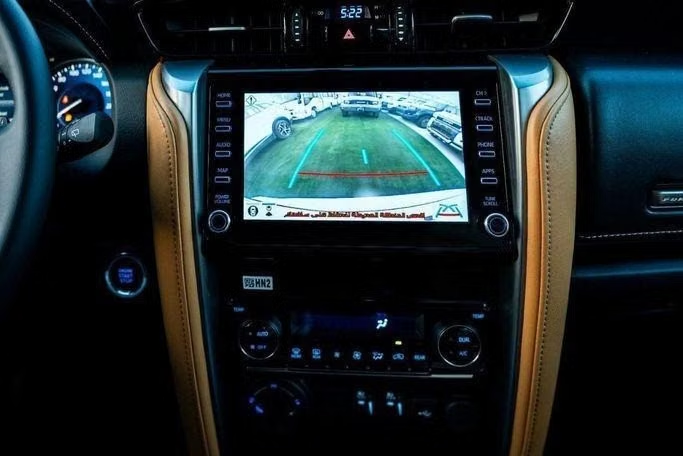
Rear-view camera, multimedia display and climate-control panel
Can you register a right-hand-drive Fortuner in the UAE?
For ordinary private registration in Dubai, no. Current RTA guidance states that a right-hand-drive vehicle cannot be registered unless it is issued with classic plates. RTA also states that ownership of a right-hand-drive vehicle in Dubai generally cannot be transferred: an already registered vehicle may only be renewed subject to the applicable conditions.
Traffic in the UAE keeps to the right, and standard vehicles are left-hand drive. A right-hand-drive Fortuner offered for sale may be intended for export, private land, parts or a special classic category. Such a listing is not necessarily fraudulent, but the vehicle is unsuitable for an ordinary buyer unless RTA confirms a lawful registration route for that specific car.
Which Fortuner specifications should you choose?
For most Dubai buyers, the default choice should be a left-hand-drive Fortuner with documented GCC Specs, a transparent history and a successful independent inspection. This reduces uncertainty around registration, insurance, repairs and resale. A Non-GCC vehicle is worth considering only when its origin, status, damage, repairs and registration eligibility are fully documented and the price compensates for the additional risk.
Compare available options, review the specification stated by each seller and build a shortlist in the Toyota Fortuner section.
Final recommendation
Choose GCC Specs by default, but always verify the claim. Assess every imported vehicle individually, reject undocumented repairs, confirm insurance terms in advance and do not buy a right-hand-drive Fortuner for ordinary Dubai registration based solely on a seller's assurance. The safest specification is the one supported by matching documents, a clean history and a professional inspection.


