


Ferrari 365 GTB/4 "Daytona" Berlinetta, 1970
Ferrari 365 GTB/4 Daytona أنا
Ferrari 365 GTB/4 Daytona أنا•
•41 مشاهدة
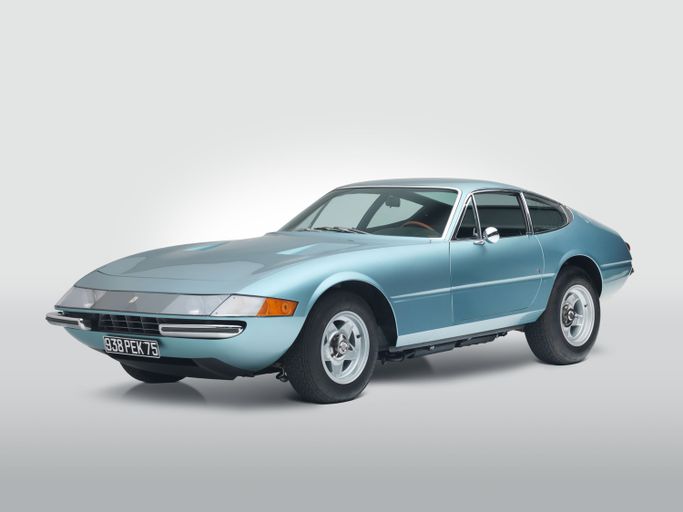
Chassis No.: 13407
Estimate: €750,000 - €850,000 EUR
- Delivered new to Garage Francorchamps in Belgium
- Desirable Plexiglass version
- Matching numbers example
- Recently repainted in its original Celeste Blue while retaining the original black leather interior
- Almost €100,000 spent this year
- The Ferrari Classiche will be handed to the buyer after the sale
Every Ferrari is, to a greater or lesser extent, a 'landmark' car, but few of Maranello's road models have captured the imagination of Ferraristi like the 365 GTB/4. The ultimate expression of Ferrari's fabulous line of V12 front-engined sports cars, the 365 GTB/4 debuted at the Paris Salon in 1968, soon gaining the unofficial name 'Daytona' in honour of the sweeping 1, 2, 3 finish by Ferrari sports prototypes at that circuit in 1967.
Pininfarina's Leonardo Fioravanti, later the famed Carrozzeria's director of research and development, was responsible for the influential shark-nosed styling, creating a package that restated the traditional 'long bonnet, small cabin, short tail' look in a manner suggesting muscular horsepower while retaining all the elegance associated with the Italian coachbuilder's work for Maranello. One of Pininfarina's countless masterpieces, the influential shark-nosed body style featured an unusual full-width transparent panel covering the headlamps, though this was replaced by electrically-operated pop-up lights to meet US requirements soon after the start of production in the second half of 1969.
Fioravanti later revealed that the Daytona was his favourite among the many Ferraris he designed.


Although the prototype had been styled and built by Pininfarina in Turin, manufacture of the production version was entrusted to Ferrari's subsidiary Scaglietti in Modena. The Daytona's all-alloy, four-cam, V12 engine displaced 4,390cc and produced its maximum output of 352bhp at 7,500rpm, with 318lb/ft of torque available at 5,500 revs. Dry-sump lubrication enabled it to be installed low in the oval-tube chassis, while shifting the gearbox to the rear in the form of a five-speed transaxle meant 50/50 weight distribution could be achieved. The all-independent wishbone and coil-spring suspension was a recent development, having originated in the preceding 275 GTB.
Unlike the contemporary 365 GTC/4, the Daytona was not available with power steering, a feature then deemed inappropriate for a 'real' sports car. There was, however, servo assistance for the four-wheel ventilated disc brakes. Air conditioning was optional, but elsewhere the Daytona remained uncompromisingly focussed on delivering nothing less than superlative high performance.
At the time of its introduction in 1968 the Daytona was the most expensive production Ferrari ever and, with a top speed in excess of 170mph, was also the world's fastest production car. Deliveries commenced in the second half of 1969 and the Daytona would be manufactured for just four years; not until the arrival of the 456 GT in 1992 would Ferrari build anything like it again. Only 1,300 Berlinetta models and 121 Spyder convertibles had been made when production ceased in 1973.


Chassis number '13407' was completed by the factory on 8th May 1970 and delivered new to Ferrari agent Jacques Swaters' Garage Francorchamps in Brussels, Belgium later that same month. Originally finished in Celeste Blue with black Connolly leather interior, the Ferrari was sold to its first owner, a Mr Vandevelde of International Anodizing Polioxal SA in Machelen, Belgium on 28th May 1970. The declared selling price was 666,700 Belgian Francs (a Ferrari 330 GTC Coupé was traded in). Mr Vandevelde kept the Daytona for a few years before selling it to a new owner. The car was registered in northern France and subsequently in Paris as '659 EA 92' on 13th May 1974.
The Ferrari had been repainted red by the time it was acquired by the third owner, 'Christophe', in 1983. Born Daniel Bevilacqua, Christophe (1945-2020) was a French singer/songwriter who enjoyed considerable popular success, mainly during the 1970s and 1980s, with hits such as Aline, Les Mots Bleus and Les Marionettes. The Daytona was registered on 16th March 1983 (as '84 EHZ 75') in the name of his wife, Véronique Bevilacqua, as were many of the other cars in his collection.
By this time the Ferrari needed a major mechanical overhaul and Christophe delivered the Daytona at the end of March 1983 to the Ferrari importer Charles Pozzi in Levallois-Perret, where it was confirmed that the engine, gearbox, radiator, suspension, etc all needed attention (see photographs on file). On 3rd March 1984, 12 months later, the work was completed and Christophe could at last enjoy his Ferrari. Pozzi continued to maintain the Daytona until 1990, by which time Christophe had covered around 60,000 kilometres in the car. In April 1993 the Ferrari was taken by a friend in lieu of payment of a debt; the friend registered the car in his name but never drove it.


On 25th July 2002 the Daytona was sold to a Parisian enthusiast, who immediately commissioned specialist Alain Coquelet to carry out a complete restoration of the body and interior, retaining the seats' original leather trim. The Ferrari was re-registered as '938 PEK 75'. Recently extensively restored by the current owner with no expense spared, including a repaint in its original Celeste Blue livery (the original interior, in exceptional condition, has been retained). Invoice on file for €89,141 and by time of sale they will have charged our vendor another €8,000 for the Ferrari Classiche certification.
Additional documentation includes reports by Marcel Massini and Marc Rabineau; copies of old French registration papers; a selection of photographs; and Pozzi's letter to Christophe dated June 1984 concerning its restoration by them. The car also comes with an original owner's manual.
A wonderful opportunity to own a well-documented example of the defining sports car of its generation in a rare and highly desirable combination.


