


Toyota Camry Fuel Filter Replacement and Diagnostics
Toyota Camry
Toyota Camry•
•69 просмотров
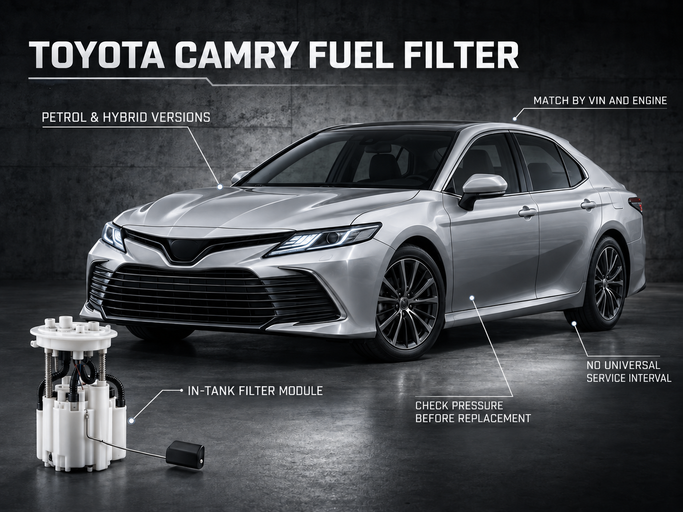
Camry owner’s manual OM33F01E schedules fuel-filter replacement at 80,000 km or 96 months, whichever comes first. A note states that this item includes the filter in the fuel tank. The requirement applies to the vehicle covered by that document; a different model year, engine or destination market may use another module design and service schedule.
Signs That Call for a Fuel System Check
The in-tank filter works with the pump, regulator and inlet strainer. As restriction rises, reserve delivery falls first, so the initial change often appears during starting or acceleration. A symptom alone cannot condemn the filter because pump wear, electrical loss, injector faults, air leaks and poor fuel can produce similar behaviour.
● The engine takes longer to start. Pressure may build slowly after the vehicle has stood because of restricted flow, a weak pump or loss through the return-control system. On a hybrid Camry, assess petrol-engine starting and transitions between operating modes rather than only the READY indication.
● Acceleration brings a hesitation or loss of pull. Delivery may remain adequate at light load but fall behind demand as fuel consumption rises. The pump, supply voltage, injectors, intake, exhaust and engine controls also need consideration.
● Idle becomes uneven, jerking develops or the engine stalls. Contaminated fuel and inadequate delivery are possible causes, although plugs, coils, injectors, sensors and an intake air leak can create the same complaint.
● The in-tank pump becomes noticeably louder. Increased noise can accompany a restricted inlet or outlet, but it also occurs with pump wear, a low fuel level or a damaged module. Pressure and electrical load should be tested before parts are ordered.
● Lean-mixture or fuel-pressure faults are stored. A code identifies a circuit or operating condition, not the failed component. Freeze-frame data, live pressure, pump voltage and connector condition are needed to narrow the cause.
● The change follows a recent fill. Water or debris may enter with the fuel or from a portable container. Inspect the remaining fuel, tank and lines so a replacement element is not installed into the same contaminated system.
Why a Camry Fuel Filter Can Load Ahead of Schedule
Filter life depends on the cleanliness of the fuel before it reaches the vehicle. Sediment can come from a storage tank, container or careless repair; water can arrive with a fill or form as temperature changes. Clean working conditions matter whenever the filler or tank module is open because introduced debris remains inside the system.
Long storage and repeated driving with little fuel do not create a separate service interval, but they can help explain an early complaint. When starting or performance changes after a particular fill, a fuel sample and pressure test are more useful than waiting for the scheduled date.
How Restricted Flow Affects a Camry
Restriction usually develops gradually. The control system can compensate for a small deviation until fuel demand rises. A serviceable filter restores the intended supply, but it cannot correct low pump voltage, worn injectors or contamination left in the tank.
- Delivery margin falls under load. Pressure may remain acceptable during steady cruising and then fail to follow the requested value during acceleration or a climb.
- Fuel-trim correction approaches its limit. The control unit adjusts within its available range and eventually stores a fault. These records guide testing but do not replace a pressure measurement.
- The pump operates under greater strain. A restricted inlet or outlet increases the demand on the assembly and may coincide with noise or unstable pressure. Check voltage and current before replacing the module.
- A new fault can be introduced during reassembly. A displaced tank-cover seal, damaged connector or incorrectly routed hose can cause fuel odour, leakage and repeat removal of the module.
- Severe restriction can cause poor performance or a no-start condition. Following contaminated fuel, one new component may not be enough; the fuel, tank, pump, regulator, lines and injectors all require assessment.
What the Camry Manual Specifies
Select the relevant document in the manuals section. Enter the model and year, then match the schedule, engine notes and VIN to the vehicle.
| Parameter | Camry covered by OM33F01E | Other Camry versions |
|---|---|---|
| Replacement interval | 80,000 km or 96 months, whichever comes first. | Use the schedule for the exact year, engine and destination market. |
| Location | The note includes the filter in the fuel tank. | Module design and supplied components may differ by generation. |
| Versions | Document notes reference A25A-FKS, M20A-FKS and 2GR-FKS. | Confirm a hybrid or other configuration by VIN and its manual. |
| Diagnostic basis | Test pressure, pump supply and fuel condition before replacement. | Do not transfer pressure values or procedures between engines. |
| Part selection | VIN, model code, engine and fuel-module contents. | A generic ‘fits Camry’ description is insufficient. |
Applying the 80,000 km or 96 Month Interval
OM33F01E uses mileage or elapsed time, whichever is reached first. A low-mileage Camry can therefore become due by age, while a heavily used car reaches the odometer limit sooner. Confirm the starting point and applicability from the service history and the document for the exact vehicle.
The note ‘including the filter in fuel tank’ shows that the scheduled item covers the in-tank filter. It does not establish that every Camry has a separate external cartridge or that the filter can be changed without dismantling the fuel module.
Diesel water-separator warnings must not be transferred to a Camry. Petrol and hybrid versions do not use the sedimenter drain-plug and hand-priming procedure found on certain diesel vehicles. Select the correct manual by model, year, engine and VIN for another generation or market.
Choosing the Correct Toyota Camry Fuel Filter
Start with the VIN, model code, engine and destination market. Camry variants can use different tanks, pumps, level senders and attachment methods. Some catalogues supply filtration parts separately, while other applications call for a larger module assembly.
● Identify the generation and engine before ordering. A25A-FKS, M20A-FKS, 2GR-FKS and hybrid powertrains represent different configurations. A matching advertised year does not prove compatibility.
● Confirm what the part includes. Distinguish the inlet strainer, fine filter, pump, pressure regulator, level sender and housing. Similar appearance does not show which components are supplied in the package.
● Fit a new tank-cover seal. A compressed ring may not recover its shape, and the wrong profile can allow vapour or fuel leakage. Clean the surrounding surface before opening the tank so debris cannot fall inside.
● Check performance specifications as well as dimensions. Flow capacity and filtration efficiency must suit the system. Excessive resistance reduces delivery, while weak media allows contamination to reach the injectors.
● Do not replace the pump without measurements. Before buying a costly module, compare requested and actual pressure, inspect the electrical supply, measure current, check residual pressure and examine the wiring.
Distinguishing Filter Restriction from Another Fault
Relate the diagnosis to the conditions in which the complaint occurs. Record fuel level, temperature, recent refuelling, load and stored faults. Then inspect sealing, pump supply and fuel pressure under the same operating conditions that produce the problem.
| Observation | Possible filter connection | Other checks | First action |
|---|---|---|---|
| Long starting | Pressure builds slowly because flow is restricted. | Pump, residual-pressure control, supply and injectors. | Measure pressure build-up and retention. |
| Hesitation under load | The filter cannot pass the required fuel volume. | Pump voltage, intake, exhaust and ignition. | Compare requested and actual pressure. |
| Loud fuel pump | Restriction increases load on the assembly. | Fuel level, pump wear and module attachment. | Test current, voltage and pressure. |
| Lean-mixture faults | Insufficient delivery is one possible cause. | Air leaks, sensors, injectors and exhaust. | Preserve freeze-frame data and measure. |
| Complaint after a fill | Water or debris may have entered the tank. | Fuel sample, tank, lines and injectors. | Assess the fuel before installing a new element. |
Checks to Complete Before Replacement
● Establish the exact vehicle specification. Record the VIN, model code, engine marking and destination-market details. ‘Camry 2.5’ or ‘hybrid’ is not enough information for ordering the assembly.
● Compare the schedule with the service history. Note the date and mileage of any earlier work and the fitted part number. A missing record does not prove that replacement did or did not occur.
● Reconstruct the last refuelling event. Note the station, fuel level before and after the fill, any portable container and when the symptom began. Retain a sample when contamination is reasonably suspected.
● Read codes and freeze-frame data before clearing memory. Fuel trims, load, engine speed and pressure help separate restricted delivery from ignition, intake or injector faults.
● Measure pressure while reproducing the complaint. An idle-only test may miss a restriction that appears during acceleration. Compare the result with the specification for the selected engine.
● Inspect pump voltage and connectors. Voltage drop, contact resistance or damaged wiring can produce the same signs as a loaded filter.
● Prepare a safe work area. Remove ignition sources, provide ventilation and relieve pressure by the specified procedure. In-tank module access also requires clean tools and careful contamination control.
● Check sealing and starting after reassembly. Connections and the tank cover must remain dry, fuel odour should be absent and pressure must meet specification. Clear faults only after the cause has been corrected.
Common Camry Fuel Filter Service Mistakes
● Applying 80,000 km or 96 months to every Camry. The figure comes from one specified manual; another model year, engine or market requires its own schedule.
● Ordering a part from a photograph. Similar housings can contain a different pump, medium, regulator, level sender or electrical connector.
● Confusing the inlet strainer with the fine filter. Replacing one component does not establish that the entire fuel path has been serviced correctly.
● Replacing the module without testing pressure and voltage. Wiring, a relay, pump control, injectors or contaminated fuel may be the real cause of poor delivery.
● Washing a disposable filter element. Solvent and compressed air can damage the medium and cannot restore its specified filtration performance.
● Reusing the tank seal or opening the system near an ignition source. This increases the risk of vapour leakage, fire and repeat work.
● Stopping after filter replacement following contaminated fuel. Water or particles left in the tank and lines can load the new element quickly.
Conclusion
For a Camry covered by OM33F01E, replace the fuel filter, including the in-tank filter, at 80,000 km or 96 months, whichever comes first. Confirm that schedule against the VIN, model year, engine and destination market before work begins. Test symptoms of inadequate delivery because the filter, pump, electrical supply and fuel quality can present in similar ways. Current listings help compare model years and specifications, but they do not confirm filter or module compatibility; verify that by VIN and catalogue number.


