Bugatti Veyron 16.4, 2008
Bugatti EB Veyron 16.4
Bugatti EB Veyron 16.4•
•28 просмотров
Chassis No.: VF9SA25C7M795228
Auction: Monterey 2018
Auction date: August 25, 2018
Lot No.: S121
$950,000 | High bid
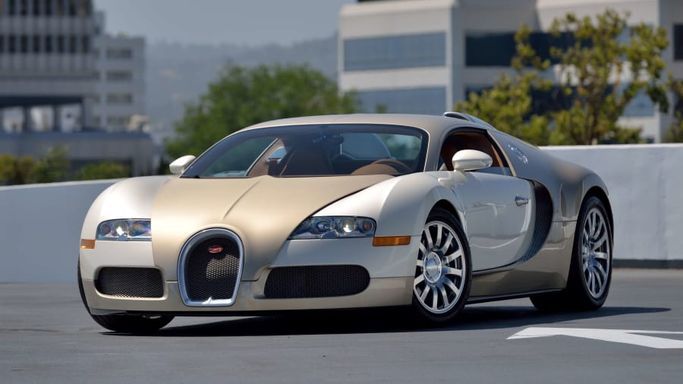
- Exterior: Gold/Beige
- Interior: Taupe
- 7,975 miles
- Quad turbocharged 8.0/1001 HP W16 engine
- 922 ft/lbs of torque
- 9.3:1 compression
- Three coolant radiators
- Twin air-to-liquid intercoolers with heat exchanger
- 7-speed DSG transmission with paddle shifters
- All wheel drive
- Limited slip differential
- Top speed of 253 MPH
- Two tone Gold and Beige Metallic paint
- Premium Taupe leather interior
- Alloy interior trim
- Leather shift handle
- Burmester premium stereo
- Double wishbone front and rear suspension
- Speed-responsive rear wing
- MUST BE SOLD TO AN OUT OF STATE RESIDENT OR LICENSED DEALER
The Bugatti Veyron 16.4 is the car that answered questions no-one thought to ask until Volkswagen Group Chairman Ferdinand Piech forced unheard-of demands on his elite team of engineers, which answered them brilliantly. So brilliantly, in fact, that almost 15 years after the first Veyron turned a wheel in private hands, it remains the standard that defines excellence in the stratospheric world of the supercar. The Veyron’s inspiration, of course, was Le Patron himself, the great Ettore Bugatti. No Enzo Ferrari or Ferdinand Porsche, this fellow.
Ettore Bugatti approached making cars from the opposite end of the spectrum occupied by those two pioneers of performance automobiles, engineers who placed the machinery before all other considerations. He was innately an artist first, born of a long line of sculptors, painters and designers whose works adorned the parlors of the European aristocracy. Ettore Bugatti proved the exception to the family rule. Displaying a pronounced mechanical aptitude, he took an apprenticeship with Prinetti & Stucchi, a Milanese sewing-machine manufacturer beginning to venture into motorized cycle manufacturing.
By the time he was 19, Ettore had already won an award from the Automobile Club of France in 1899 and a gold medal at the Milan Exhibition of 1901, both in honor of his first four-wheeled automobile. His Type 35—first raced in 1924—came to symbolize all that was great about Bugatti cars, by then widely considered every bit as much works of art as they were high-priced automobiles of magnificent performance.
Through the course of his career and the 70 years since his passing in 1947, Bugatti’s contribution to automotive history was primarily as an artist, and remaining faithful to that greatness drove the design, development and finally the realization of the Veyron under Piech’s unbending leadership. Piech’s overriding promise upon the prototype’s unveiling at the 2001 Geneva Auto Show was that the Veyron would surpass the 250 MPH barrier. Making good on that assurance required an unusual level of engineering prowess and sophistication.


Dialing that much power into a racing engine designed to last two hours was simple even then; building a powertrain capable of that feat that was also reliable, flexible and met emission standards, however, was then simply the stuff of dreams. In fact, most if not all of the first-generation production Veyron engines put out between 1,001 and 1,040 HP. That’s not to say it was easy: the Veyron’s powerplant is a wonder of engineering displacing a full 8 liters in a W-16 arrangement fed by four turbochargers. Its 9.3:1 compression virtually eliminates turbo lag and contributes to the 922 lb-ft of torque generated to all four wheels between 2,200 and 5,500 RPM.
Shedding the enormous heat generated by this blast furnace of an engine requires three coolant radiators, a heat exchanger for the twin air-to-liquid intercoolers, two air-conditioning condensers and one cooler each for the engine, the paddle-shifted 7-speed DSG transmission and limited-slip differential. Three different driving modes adjust the Veyron’s ride height, all-independent suspension and rear spoiler settings as speeds rise to its 253 MPH limit, and the specially designed cross-drilled, vented carbon-silicon-carbide disc brakes work with the rear spoiler in upright air-brake position to stop the car from 250 MPH in less than 10 seconds.
All these qualities inform the magnificent 208 Bugatti Veyron presented here in beautiful two-tone gold and beige Metallic paint with a premium interior dominated by fine taupe leather, specially developed aluminum-alloy trim and the distinctive steering wheel and center console with controls for the Burmeister premium sound system. As both automobile and objet d’art, the Veyron 16.4 is unmistakably a Bugatti in the tradition of Le Patron.