Showroom, private seller, auction, or broker: which way of buying a car in the UAE is really the best value?
•415 views

This article is only about choosing a seller. In-depth analysis of prices, risks, and hidden fees. No registration or logistics, which I wrote about earlier in this article.
When I was just starting to figure out the UAE market, my head was spinning. In one place, they offer you a “clean GCC” car with a warranty; in another, an “excellent private-sale option” for 70% of the price; and in a third, they whisper about auctions where cars go for next to nothing.
And the main question facing any newcomer is: where should you go?
A showroom? A private seller? An auction? Or maybe hire a local broker who will handle everything?
I tried all the options myself, with my own hands and my own money. I talked to sellers in Ras Al Khor, negotiated with private sellers in Sharjah, and figured out how brokers operate. Now I’m sharing what I learned—perhaps it will be useful to someone.
In this article, I’ll break down every option. No fluff, no advertising. Just pros, cons, risks, and concrete figures. At the end, there’s a checklist and a clear recommendation for different situations.
Showrooms. Paying for peace of mind. When is it worth it?

Showrooms are the first thing visitors see in Ras Al Khor in Dubai or Industrial Area in Sharjah. Rows of cars under the scorching sun, salespeople in vests, the smell of new plastic and fried coffee from street cafés.
It looks impressive. But is it really?
Pros of showrooms
1. A legal entity. A showroom has a registration, a license, and a checkbook. If something goes wrong, you may be able to file a complaint. In theory, because no one recommends that tourists sue a local company in the UAE. But the fact that the seller is a registered business does encourage them to behave responsibly.
2. A short-term warranty. Many showrooms offer a 1–3 month warranty on the engine and transmission. It’s not the same service you’d get from a dealer, but at least it offers some protection against obvious scams. If the engine starts knocking after a week, you can go back, argue, and they’ll replace it.
3. Help with paperwork. For a tourist, arranging an export is a headache. Showrooms usually have contacts at typing centers and Tasjeel. They’ll help you get an export certificate and invoice, and submit the car at the port. For an extra fee, of course, but without the added stress.
4. The car is already here. You don’t have to wait for delivery from the US or Japan. You come, take a look, and drive away (well, almost—after the paperwork, of course).
Cons of showrooms
1. Markup. A showroom is a business, not a charity. The markup over the market price is 10% to 20%. Sometimes more if you look like “fresh meat.”
2. Not everyone is honest. Some showrooms disguise damaged cars as clean ones. This is especially true of “Americans”—they’re brought in from auctions, quickly “touched up,” and listed as being in “perfect condition.”
Geography
- Dubai, Ras Al Khor (Ras Al Khor Industrial Area) — the main hub. Lots of showrooms, a huge selection, and well-developed infrastructure. Prices are higher, but competition also forces sellers to maintain standards.
- Sharjah, Industrial Area 6 — prices are 10–15% lower than in Dubai. But there are also more damaged/repainted cars. The infrastructure is worse—there are only a couple of cafés, and you’ll have to look for a restroom. It’s better to go with someone who understands bodywork.
Verdict on showrooms. A good choice for a newcomer if you’re willing to pay 10–20% more for peace of mind and help with the paperwork. But you still need to keep your eyes open.
Private sellers. Save money, but take a risk. How do you avoid buying a pig in a poke?
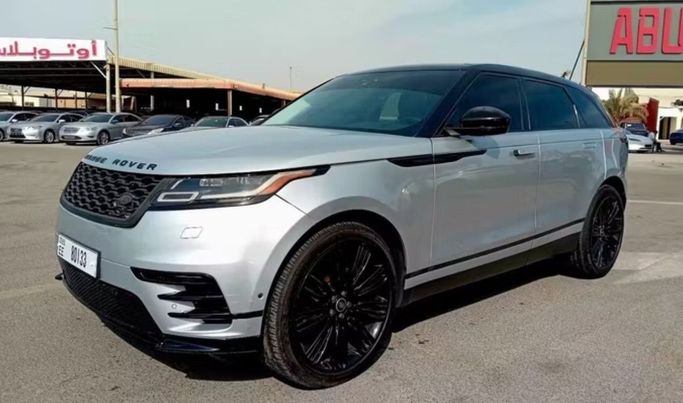
Buying directly from an owner is a classic. The price is attractive, and the descriptions are heartfelt, along the lines of: “Selling my beloved car because I’m moving back home.”
I started out with private sellers myself. I wanted to save money. I spent a week and nearly bought problematic cars twice. Here’s how not to repeat my mistakes.
Pros of private sellers
1. No markup. A private seller is selling their own car. They don’t factor in showroom rent, salespeople’s salaries, and other expenses. The price may be 10–15% below market value.
2. Negotiation is welcome—and practically mandatory. In the UAE, you can and should negotiate. It’s easy to get 5–10% off a private seller simply by saying, “I’m ready to buy today; here’s the cash.” I got 15% off once, when the car had already been listed for a month.
3. An honest private seller will tell you the car’s history. If it’s the actual owner, not a dealer, and especially if they’re a responsible car owner, they’ll proudly show you the service book and tell you where and what they’ve replaced. Sometimes they’ll even show you their chat with the dealer.
Cons of private sellers
1. No guarantees. None whatsoever. You buy it—it’s your problem. The transmission fails a week later? Sorry, but that’s no longer the seller’s problem.
2. Risk of running into a dealer. Many “private sellers” are actually professional resellers. Even we don’t always recognize them, and abroad it’s easy to get taken for a ride.
3. Paperwork can be difficult for tourists. Don’t have an Emirates ID? A private seller can’t simply transfer the car into your name. You’ll need a broker or an intermediary with local residency. That means extra costs and hassle.
How to check a private seller. A step-by-step checklist
Step 1. Verify identities. Ask for the seller’s Emirates ID and compare it with the details on the Mulkiya (vehicle registration document). The names must match. If the seller says, “It’s my brother’s car; he’s away on a business trip,” that’s already a reason to be wary.
Step 2. Check the VIN. Download the Dubai Police or MOI UAE app. Enter the chassis number. The system will show whether there are fines or liens (mortgages), or whether the car has been reported stolen. Even one unpaid fine means you won’t be able to complete the transaction until the seller pays it.
Step 3. Insist on an inspection at a service center. At your own expense (200–400 AED, about 5,000–10,000 rubles), take the car to an independent service center with a lift. If the seller refuses or says, “There’s a garage nearby; we’ll check it there,” that’s a red flag. Only use a neutral location.
Step 4. Check the service history with the dealer. If the car is GCC-spec, call or message the official dealer (Al-Futtaim for Toyota/Lexus, Arabian Automobiles for Nissan/Infiniti). Give them the VIN and they’ll tell you when the car was serviced and what the mileage was. If the mileage in the listing is much lower than at the last recorded service, well, you know what that means.
Verdict on private sellers. Suitable for experienced buyers or those willing to spend time on checks. The savings are real, but so is the risk of losing both time and money. I don’t recommend it for your first time.
Auctions are for pros. Newcomers should stay away
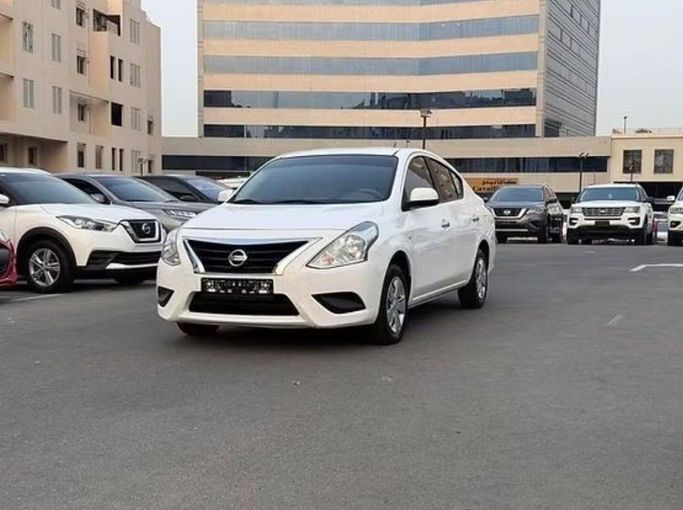
Emirates Auction, Copart, IAAI—these names make some people shudder and others’ eyes gleam with greed. Yes, you can buy a car here for half the market price. Yes, Patrols go for AED 40,000 and Land Cruisers for AED 50,000. But there’s a catch.
Auction problems for newcomers and foreigners
1. You need an Emirates ID or a local agent. You can’t just participate in Emirates Auction with a tourist visa. You need a local resident. Copart and IAAI are even more complicated: you need a verified account and a deposit.
2. You’re buying a “pig in a poke.” Auctions provide photos (usually 10–20) and a damage report. But these reports aren’t always accurate. “Minor damage” may turn out to mean a bent frame. “Water flood” means the car was submerged up to the roof.
3. It’s easy to overpay. The excitement of bidding works against you. You see that the price is low, get carried away, place a bid… and a minute later realize someone outbid you. Or you win, but at a price close to market value, plus auction fees, delivery, customs clearance, and repairs.
4. You’ll be responsible for delivery and customs clearance in the UAE. The car may end up at Jebel Ali Port, and you’ll have to collect it yourself, pay duties (which can be substantial for older cars or cars with large engines), and take it to a service center. If the car is damaged, you’ll need to transport it on a tow truck.
5. Repairs. Even if the car isn’t damaged, it may need work. Battery, tires, oil, air conditioning—at least $500–1,000. If it’s damaged, the cost could rise to $5,000–10,000.
Who are auctions suitable for?
- Pros who resell cars. They know what to look for and have connections with service centers and logistics companies.
- Enthusiasts with their own garage and bodywork experience.
- People who have hired a broker (more on that in the next section). A broker can find an auction lot, oversee repairs, and handle the paperwork.
A broker. When do you need one, and how much does it cost?

A broker (also known as a car-finding specialist or agent) is a local professional who helps you buy, inspect, and process a car using your money. For a tourist or newcomer, this is often the best investment.
What a broker does
- Finds a car to match your budget, model, year, mileage, and specifications. They don’t show you 100 options; they select 3–5 genuinely worthwhile ones.
- Checks the VIN, history, and legal status. They search the Dubai Police and MOI UAE databases and dealer service records.
- Arranges an inspection at a service center. They take the car there, attend the inspection, and ask the mechanic questions. They know which garages are honest and which are “partners” who turn a blind eye to problems.
- Negotiates with the seller. Professional negotiation is a skill in its own right. A good broker gets a 10–15% discount, which often covers their fee.
- Helps with export paperwork. Export certificate, invoice, power of attorney (POA), port submission—the whole process, end to end.
- Oversees loading into the container. They go to Jebel Ali Port, watch the car being secured, and take photos. That way, there won’t be any surprises later, like “where did that scratch on the fender come from?”
When you can’t do without a broker
- I’ve said this several times already, but I’ll repeat it: if you don’t have an Emirates ID (you’re a tourist or visiting on a guest visa).
- You’re buying a car at auction—a broker can bid in their own name and then transfer the car to you.
- You don’t speak English or Arabic. Almost everyone in the UAE speaks English, but it’s easy to get confused about the details of a transaction. A broker who speaks your language removes the language barrier.
- You don’t have a week to spend searching. If you’ve flown in for five days and need to leave with a car that’s been processed, a broker can compress the process into 2–3 days.
How much does a broker cost?
Prices vary, and given the current economy, it’s hard to guess what the exchange rate will be today or tomorrow. But broadly speaking, the average market rates are:
- $500–800 for a basic package: search, VIN check, inspection, and help with paperwork.
- $1,000–1,500 for an extended package: includes negotiation, overseeing loading at the port, and help with logistics to Russia.
- A percentage of the deal—some charge 1–3% of the car’s price. For a $30,000 car, the fee is $300–900.
How to find an honest broker
- Look for reviews in Russian-language chats. Telegram channels such as “Cars from the UAE” and “Russians in Dubai,” as well as WhatsApp groups. Search for “broker,” “car finder,” or “helped me buy.”
- Look for recommendations on forums. Drive2.ru, Pikabu, and the Patrol Owners Club all have threads about buying cars in the UAE.
- Don’t trust anyone who asks for 100% upfront. A normal arrangement is 30–50% after you choose the car (and sign a preliminary agreement), with the rest due after the paperwork is completed and the car is submitted at the port.
- Go in person to a typing center in Ras Al Khor. Many brokers work out of these centers. You can drop by, meet them, and ask questions. If the person really works in the business, they’ll have an office, colleagues, and a license.
Verdict on brokers. For a first-time buyer and a tourist, this is the best option. Yes, you pay an extra $500–1,500. But you can sleep peacefully while a professional handles the routine work. And in 90% of cases, the savings from negotiation cover the fee.
Comparing what’s more cost-effective and safer for a newcomer
I’ll put everything into one table for clarity.
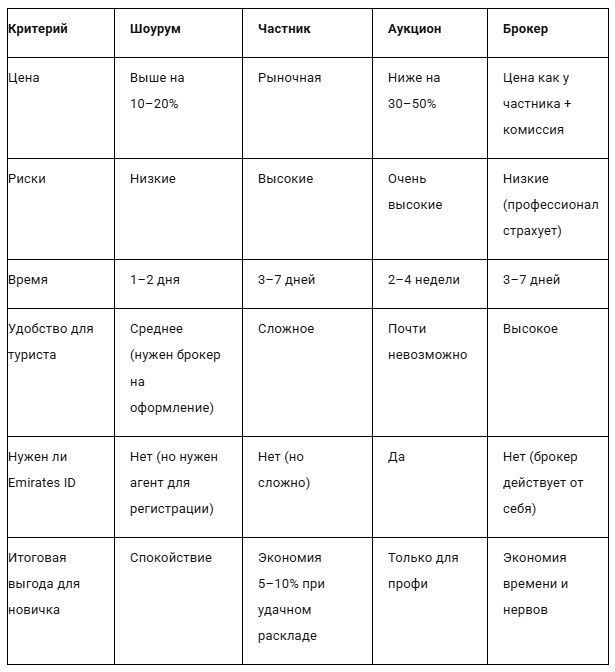
If your car budget is $20,000 or more (about 1.5–2 million rubles at the current exchange rate), a broker pays for themselves through the discount they negotiate and the risks they eliminate. Plus, you won’t spend your vacation running around Ras Al Khor.
If your budget is under $15,000, it may make sense to try private sellers, but be prepared to do your checks and deal with possible paperwork complications.
A showroom is a compromise. More expensive, but easier. It’s suitable if you want to “buy and forget about it.”
An auction is definitely not for newcomers. Leave it to people who resell cars or have their own garage.
Checklist. How to avoid losing money with any purchase option
I put this checklist together based on my own hard-earned experience.
What you must do
- Check the VIN through MOI UAE or Dubai Police. The apps are free, and the check takes a minute. You’ll see fines, liens, and whether the car has been reported stolen.
- Insist on an inspection on a lift. At your expense. AED 200–400 is nothing compared with potential problems.
- Confirm agreements in WhatsApp. In the UAE, messaging-app conversations can be used as evidence in disputes.
- Transfer large sums only by bank transfer. Don’t carry a briefcase full of cash around Ras Al Khor. A bank transfer leaves a record and offers protection.
- Check the broker through genuine reviews. Don’t trust their Instagram alone. Search Telegram chats for questions like “Has anyone worked with this person?” There are bound to be plenty—just use the search function.


What you must NEVER do
- Never pay a “reservation” deposit before inspecting the car. Never. Not AED 100, not AED 1,000. A reputable seller won’t take money until you’ve decided to buy.
- Don’t sign a contract in Arabic without a translation. You could be signing anything—from agreeing to a 50% commission to transferring ownership of the car. Demand an English version or a translation by a notary.
- Don’t agree to the arrangement “I’ll buy the car in my name and then transfer it to you” without a notarized power of attorney (POA). If someone proposes this, demand a POA certified by a notary. Otherwise, the seller remains the legal owner.
- Don’t believe “it’s a copy; the original is lost.” Without the original Mulkiya (registration document), the transaction is impossible. A lost document can be replaced in 2–3 days. If the seller can’t be bothered, that’s clearly their problem, not yours.
When I was looking for a car in the UAE myself, I started with private sellers. I wanted to save money. I spent a week and nearly bought problematic cars twice (one had rolled-back mileage, and the other had a damaged chassis geometry). In the end, I went through a reputable showroom and hired a broker to handle the paperwork.
Yes, I paid a little more than I might have in a successful private sale. But I slept peacefully instead of tossing and turning at night, wondering, “Did they scam me?”
The choice is yours.
- Want peace of mind and willing to pay extra? Go to a showroom.
- On a tight budget and have time to do the checks? Try private sellers.
- A pro who enjoys risk? The auctions are waiting.
- A tourist, short on time, and buying for the first time? Hire a broker—it’s the best $500–1,000 you’ll spend.
The main rule I learned is: don’t rush. The UAE market isn’t going anywhere. Check every step, ask questions, and trust your instincts. If something seems suspicious, it probably is.
That’s all for now. I’m planning to prepare something else interesting soon. Happy buying and safe travels!