


Toyota Raize 1KR-VET turbo engine: boost, fuel economy, applications and faults
Toyota Raize
Toyota Raize•
•151 views

Article illustration. The vehicle and turbocharger are illustrative; this image is not a technical diagram.
The Toyota Raize 1.0 Turbo delivers its 140 Nm peak torque across 2,400–4,000 rpm. The UAE version is rated at 97 hp at 6,000 rpm. Boost helps the small engine produce this torque, while adding components that depend on lubrication, a clean intake and temperature control.
This guide focuses on the 1KR-VET turbo system. Maintenance figures use manual OMBZ358E for export-market Raize models, including the UAE. The naturally aspirated WA-VE 1.2 and Japanese versions are kept separate: the same model name does not guarantee identical specifications.
1KR-VET specifications: identify the version
| Parameter | Value | Application and context |
|---|---|---|
| Layout | Inline three-cylinder petrol | 1.0 Turbo; not the WA-VE 1.2 |
| Displacement | 998 cc | Export manual OMBZ358E |
| Bore × stroke | 71.0 × 84.0 mm | As specified in that manual |
| UAE output | 72 kW; 97 hp at 6,000 rpm | 97 hp rounds the manual’s 96.5 hp rating |
| Torque | 140 Nm at 2,400–4,000 rpm | Peak torque is available across an engine-speed band |
| Valve gear | 12 valves, DOHC* | Two overhead camshafts |
| Valve timing | Variable; VVT-i** | Regional brochures use different terminology |
| Fuel system | Electronic injection | Do not substitute naturally aspirated 1KR-FE data |
| Boost system | Turbocharger and intercooler* | The intercooler cools compressed intake air |
| Timing drive | Chain | Separate from the external accessory belt |
| Valve clearances | Mechanical adjustment | Do not assume the WA-VE’s automatic compensation |
| UAE gearbox and drive | CVT, front-wheel drive | CVT means continuously variable transmission, not a conventional fixed-ratio automatic |
* DOHC — double overhead camshaft.
** VVT-i — variable valve timing with intelligence.
* Intercooler — a heat exchanger that cools air after compression.
Why do some specifications show 996 cc and 98 PS?
The Japanese 2019 Raize sheet lists 996 cc, an 83.9 mm stroke and 72 kW, expressed as 98 metric horsepower (PS). The export manual lists different displacement and stroke figures. Thus 97 hp versus 98 PS does not establish a power difference, and Japanese engine specifications should not replace the export vehicle’s data.
Sources: UAE specification; manual, p. 420; Japanese specifications.
Fuel economy and applications
The figures below belong to specific vehicles and documents. The current UAE model page and its linked 2025 brochure show different fuel-economy values; neither identifies the test cycle. This does not establish an engine-efficiency improvement.
| Vehicle / source | km/L → L/100 km | Basis |
|---|---|---|
| Raize Turbo G UAE, 2025 brochure | 19.3 → 5.18 | CVT, front-wheel drive; cycle unspecified |
| Raize Turbo G UAE, 2026 web page | 20.6 → 4.85 | CVT, front-wheel drive; cycle unspecified |
| Raize A200A, Japan, 2019 | 18.6 → 5.38 | CVT, front-wheel drive; WLTC* |
| Raize A210A, Japan, 2019 | 17.4 → 5.75 | CVT, four-wheel drive; WLTC* |
* WLTC — Worldwide harmonized Light vehicles Test Cycle. Conversion: 100 ÷ km/L; these are not separate road-test results.
Where else is the 1KR-VET used?
| Model / market | Confirmed application |
|---|---|
| Toyota Raize, UAE | Turbo G in 2022 and 2024–2026 documents; CVT, front-wheel drive |
| Toyota Raize, Japan | November 2019 launch: A200A / A210A, front- / four-wheel drive |
| Daihatsu Rocky, Indonesia | April 2021 launch: 1KR-VET, front-wheel drive, CVT or five-speed manual |
| Perodua Ativa, Malaysia | March 2021 launch: 1KR-VET, front-wheel drive, D-CVT* |
* D-CVT — Daihatsu’s dual-mode continuously variable transmission. A shared engine code does not prove turbocharger or ancillary-part interchangeability.

Toyota Raize 1.0: confirm the engine version through vehicle records and identification data, not appearance.
Sources: UAE brochure; current model; Japan; Rocky; Ativa.
Oil, filters and cooling: maintenance schedule
These tables follow OMBZ358E for the 1KR-VET, using the schedule for countries other than Mexico. Also check the vehicle’s service booklet and local requirements. Where two limits are given, use whichever comes first.
Oil service
| Item | Value / condition |
|---|---|
| Oil refill with filter | Approximately 3.1 L; without filter: 2.9 L |
| Viscosity | 0W-20 is the factory recommendation; 5W-30 is also listed |
| Quality grade | For example, API SP Resource-Conserving*; use an approved grade/viscosity combination |
| Normal schedule | At the maintenance reminder; replace within six months even if no reminder appears |
| Mainly dusty / dirt-road use | At the reminder; if it does not appear, replace oil and filter every three months |
* API — American Petroleum Institute oil classification; Resource-Conserving is its fuel-saving performance designation.
The turbocharger uses engine oil; there is no separate periodic “turbo oil change”. Correct oil level and unobstructed supply and drain paths matter. Refill capacity is a guide, with the final level checked using the manual’s dipstick procedure.
Consumables and cooling system
| Operation | Normal schedule | Detail |
|---|---|---|
| Air filter | Inspect: 20,000 km / 24 months; replace: 40,000 km / 48 months | Dust: inspect 2,500 km / 3 months; replace 20,000 km / 48 months |
| Spark plugs | Replace every 100,000 km | NGK SILKAR7G8G; 0.8 mm gap, do not adjust |
| Fuel filter | Replace: 80,000 km / 96 months | Includes the in-tank filter |
| Coolant | First at 160,000 km; then every 80,000 km | Toyota Super Long Life Coolant or an equivalent meeting the stated requirements |
Judge dusty-road exposure by actual driving, not the registration address. After heavy contamination, check the filter housing seal and intake duct condition: a new element will not repair a damaged connection.
Sources: manual, pp. 295–300, 423–425; turbo-system diagnostics.
Boost and valve timing: service-life factors
Exhaust gas drives the turbine, which is coupled to the intake compressor. The compressor supplies pressurised air, and the intercooler reduces its temperature. A boost leak can therefore reduce performance even when the turbo’s rotating assembly is sound.
| Situation | Action |
|---|---|
| Cold engine | Avoid sudden acceleration and high engine speed |
| Immediately after high-speed driving or a hill climb | Idle for approximately one minute before shutdown, as specified in OMBZ358E |
| Boost or exhaust modifications | The factory schedule does not establish durability after boost or calibration changes |
When to replace the chain and check valves
| Component | Schedule / criterion |
|---|---|
| Timing chain and turbocharger | No scheduled replacement mileage in the reviewed schedule; this does not mean unlimited life |
| 1KR-VET valve clearances | Inspect at 80,000 km / 96 months; adjust if outside specification |
| Cold-engine clearances | Intake 0.145–0.235 mm; exhaust 0.275–0.365 mm |
| External accessory belt | Inspect at 20,000 km / 24 months; this is not the timing chain |
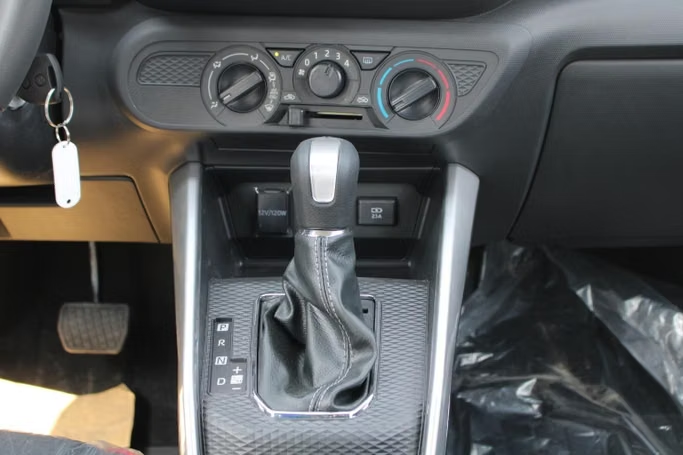
Toyota Raize CVT selector. Rising engine speed under acceleration does not, by itself, establish a turbo fault.
Sources: boost-system operation; manual: operation and maintenance.
Fault diagnosis: what to check before replacing the turbo
The reviewed sources provide no verified statistics establishing a mileage at which the Raize turbo must fail. The table below outlines diagnostic checks, not a list of widespread 1KR-VET defects.
| Complaint | Possible area | Checks |
|---|---|---|
| Lost power with a new whistle | Intake or intercooler leak | Hoses, clamps and cracks; pressure-path leak testing |
| Lost power without a clear whistle | Flow restriction or control issue | Air filter, fuel delivery and exhaust; diagnostic data |
| Blue smoke or oil consumption | Turbo, engine or crankcase ventilation | External leaks, turbo oil drain, crankcase pressure; consumption trend |
| New metallic noise | Mechanical damage or loose supports | Locate the noise, inspect turbo wheels and mountings; rule out contact |
| Hesitation or rough running | Ignition, injection or engine mechanics | Fault codes, plugs and coils; cylinder sealing if indicated |
What are the Raize 1.0 Turbo’s weak points?
The turbo version adds a high-speed component that depends on lubrication and a sound air path. A whistle or an oil trace alone does not justify replacement. If a restricted oil drain or crankcase ventilation fault caused the problem, fitting another turbo without correcting it can lead to a repeat failure.
Are there confirmed service campaigns?
Toyota’s Saudi website lists an engine-control software campaign for certain Saudi-market Raize vehicles from model years 2022–2024. Under specific conditions, brake-booster vacuum may be insufficient. This is not a turbo-replacement campaign. Check the individual vehicle’s VIN*, especially for an imported car.
* VIN — vehicle identification number.
A severe mechanical noise, significant smoke or an oil-pressure warning calls for stopping load and pulling over safely for assessment. Repeated hard acceleration is not a suitable way to test whether boost returns.
Sources: Garrett diagnostic principles; Saudi-market campaign.
Turbocharger and engine prices: reference points
The examples below were checked on 7 November 2026. They are overseas sellers’ indicative asking prices, not UAE market averages or complete repair quotations. Compatibility between Japanese A200A/A210A parts and an export Raize must be established through the parts catalogue.
| Item / source | Price | Comparison limits |
|---|---|---|
| New turbo 17201-B1020; YoshiParts, shipping from Japan | USD 1,657.87* | After-coupon price; A200A listing, replacement number 17201-B1021; shipping calculated separately |
| Used 1KR-VET engine, A210A; Torens, Novosibirsk, stock T54097270 | RUB 39,000** | Excludes alternator and air-conditioning compressor; UAE fitment is not established |
| Turbo / engine for an individual UAE Raize | Individual quotation | The reviewed listings do not establish a single local installed price |
USD — US dollar. * RUB — Russian rouble. Prices, discounts and availability may change; UAE delivery, duties, taxes and labour are not included in these reference figures.
What a repair quotation should cover
| Quotation item | What to confirm |
|---|---|
| Turbo or engine | Part number, new / rebuilt / used condition, included components and warranty |
| Root cause | Oil supply/drain, intake and crankcase ventilation test results |
| Associated work | Oil, filter, gaskets, air-path cleaning and any required pipes |
| Total | Itemised labour, delivery, taxes, consumables and post-repair checks |
If the repair estimate is substantial, compare the age, mileage and service history of other Raize vehicles through current offers. A bare engine price is not equivalent to the cost of a roadworthy car.
Conclusion
The Raize’s 1KR-VET delivers 140 Nm across a useful engine-speed band, but oil, intake integrity and turbo-system cooling deserve attention. Maintenance depends on the exact version, time since the oil change and actual operating conditions. Replace the chain or turbo on diagnostic evidence, not an invented lifespan. A shared engine code alone is not a basis for treating export and Japanese Raize vehicles or parts as interchangeable.
Sources: OMBZ358E manual; UAE specification; model catalogue.
Price sources: YoshiParts listing 17201-B1020; Torens stock T54097270. Checked 7 November 2026. Photographs: Toyota Raize 2025, vehicle listing 288134.


