


Toyota Hilux manual or automatic: which is better for city and desert driving?
Toyota Hilux
Toyota Hilux•
•7 views
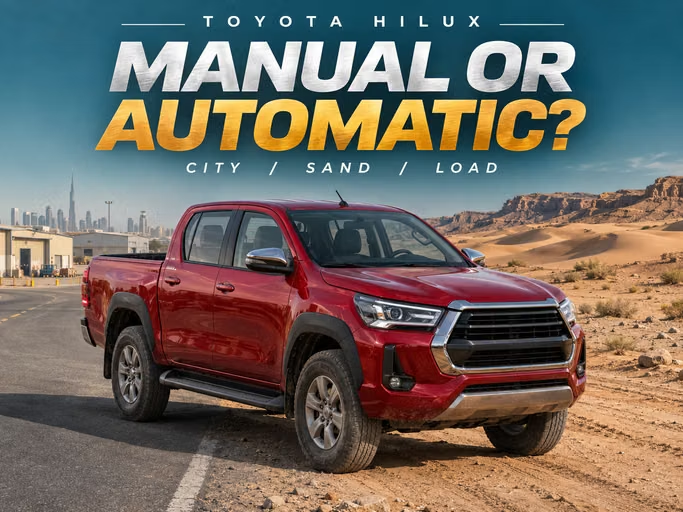
Illustration for the article. Vehicle appearance is illustrative; confirm the transmission, drivetrain and equipment for the individual version.
For daily traffic and sandy routes, an automatic Toyota Hilux is usually easier to drive: there is no clutch pedal, and smooth starts require less coordination. A manual suits a confident driver who understands the workload. It does not guarantee lower costs: a worn clutch can change the purchase calculation.
This comparison covers eighth-generation Hilux models, including updated 2.8 diesels and 2.7 petrol versions. Confirm the generation and market before applying specifications. Comfort, condition and servicing in hot weather are the main considerations.
Which transmissions does the Hilux use?
The local model description includes five-speed manual and six-speed automatic transmissions. Diesels can also have six-speed manuals. Check the generation, engine and market in the model catalogue, then confirm the specification against the VIN*.
* VIN — vehicle identification number, used to establish the factory configuration and parts applicability.
| Example version | Manual | Automatic |
|---|---|---|
| 2.7 petrol, 2TR-FE, UAE | 5 speeds | 6 speeds |
| 2.4 diesel, 2GD-FTV, United Kingdom 2021 | 6 speeds; 400 Nm* | 6 speeds; 400 Nm* |
| 2.8 diesel, 1GD-FTV, United Kingdom 2021 | 6 speeds; 420 Nm* | 6 speeds; 500 Nm* |
* Nm — newton-metre, a unit of torque. These are engine outputs with the stated transmission, not universal gearbox torque limits.
For the updated 2.8, the manufacturer’s description specifies 420 Nm with the manual and 500 Nm with the automatic. The comparison therefore includes different powertrain calibrations. More torque does not automatically increase permitted payload or trailer weight; check those ratings separately.
Engine changes are covered in “The 1GD-FTV engine before and after the update: what changed on the Toyota Hilux”. Here, the focus is the transmission’s suitability for your driving.
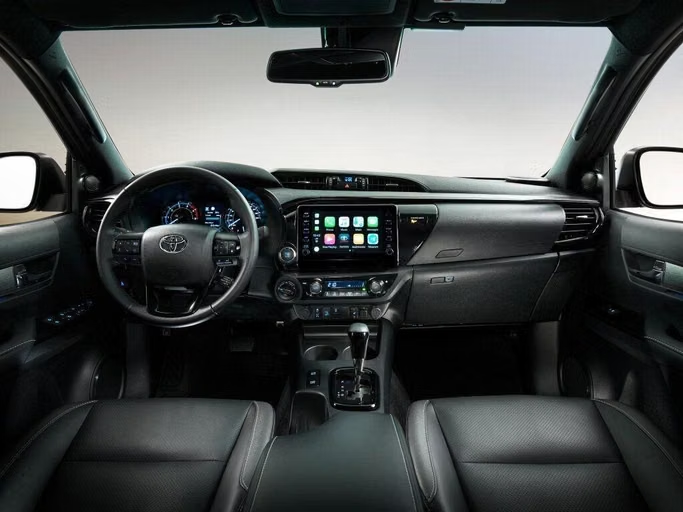
Eighth-generation Hilux cabin. Controls and equipment vary by version. Photo: model catalogue.
Which gearbox is easier in city traffic?
An automatic reduces the driver’s workload in stop-start traffic, when parking and when moving with a load. On a test drive, assess forward and reverse engagement, pulling away and shifts after warming up. Repeated harsh engagement or a long delay should not be dismissed as normal simply because this is a working pickup.
A manual places more responsibility on clutch technique. Toyota’s handbook warns against holding the vehicle on a hill with a slipping clutch or resting a foot on the pedal while driving. For daily urban use, these habits matter more than the manual gearbox’s reputation for simplicity.
What works best on sand and during slow driving under load?
A torque-converter* automatic makes smooth starts easier without manual clutch operation. However, prolonged wheelspin when stuck can overheat the transmission. The Hilux handbook describes this risk and a protection function. Do not keep trying to escape while ignoring a temperature warning; follow the procedure for the individual vehicle.
* A torque converter transfers engine power through fluid within an automatic transmission and allows smooth starts.
A manual gives the driver direct control of shift timing, but an ill-timed change can interrupt drive or lead to prolonged clutch slip. Where fitted, transfer-case low range helps in appropriate slow, demanding conditions. It is not the right setting for every sandy route: select the mode according to conditions and the handbook.
Gearbox choice does not establish the drivetrain. Hilux models can be rear-wheel drive or four-wheel drive. Observe the operating limits of a selectable four-wheel-drive system; an automatic does not give a rear-wheel-drive pickup the capability of the equivalent four-wheel-drive version.
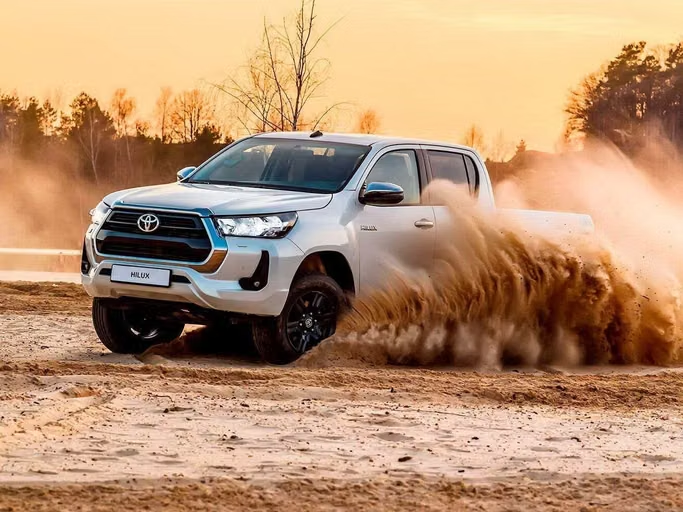
Hilux on an unpaved route. Surface, load and driving technique influence transmission demands. Photo: model catalogue.
Which transmission is more reliable, and what needs checking?
A manual is generally simpler, but its clutch, release mechanism, bearings and synchronisers still require assessment. An automatic needs suitable fluid, sound hydraulic and electronic control, and protection from overheating. No single guaranteed overhaul mileage applies to every Hilux; a reference estimate is not a factory service-life promise.
On a manual, investigate difficult shifts, unusual noises and rising engine speed without corresponding acceleration. Repeated jolts, vibration and engagement delays warrant diagnosis on an automatic. These symptoms do not establish the failed component: engine faults, mounts and the propeller shaft can create similar sensations.
Does a manual always use less fuel?
There is no universal rule. For the United Kingdom 2021 Hilux 2.8, the model brochure gives approximately 8.5–9.0 L/100 km for the manual and 9.4–9.9 L/100 km for the automatic after conversion from imperial miles per gallon. These are specification-dependent WLTP* ranges, not a UAE test of two identical trucks. Sand, payload and idling change real consumption.
* WLTP — a standardised fuel-consumption and emissions test procedure. The conversion uses imperial gallons, which differ from US gallons.
Which transmission oil should you use, and when should it be changed?
Handbook OM0K404E specifies Toyota ATF WS for the automatic and SAE 75W-90, API GL-3 (GL-4)* gear oil for the manual. These are different products. Confirm the requirement for the gearbox and model year; a “universal transmission oil” label alone does not establish compatibility.
ATF WS — Toyota World Standard automatic transmission fluid specification. * SAE — viscosity classification; API GL-3 and GL-4 — gear-oil performance categories.
| Component | Heavy-load schedule in the cited handbook |
|---|---|
| Manual gearbox | Oil replacement: 40,000 km or 48 months |
| Automatic gearbox | Inspection: 40,000 km or 24 months; replacement: 80,000 km or 48 months |
Use whichever limit comes first. This is the stated heavy-load schedule, not a universal interval for every Hilux. The transfer case and axles have separate oils and maintenance operations. Total fluid capacity should not be mistaken for the amount required in every partial change.
Which engine consumables should be considered alongside the gearbox?
| Example engine | Oil viscosity and quality in the handbook |
|---|---|
| 2.7 petrol, 2TR-FE | Preferred SAE 0W-20; for example API SN Resource-Conserving* |
| 2.8 diesel, 1GD-FTV, Euro V / VI** | Preferred SAE 0W-30, ACEA C2* |
| 1GD-FTV, except Euro V / VI | Preferred SAE 5W-30; ACEA B4* is one permitted quality category |
API SN — petrol-engine oil quality category; Resource-Conserving identifies resource-saving performance. Euro V / VI — emissions standards. ** ACEA — European engine-oil performance categories; B4 and C2 are not automatically interchangeable.
Synthetic oil is suitable when it meets the required viscosity and performance category; the base-oil description does not replace the specification. Change engine oil and its filter under the applicable schedule. Inspect the engine air filter for dust exposure and service the cabin filter separately. Match coolant to Toyota Super Long Life Coolant requirements or a suitable equivalent, rather than colour.
Brake fluid remains a scheduled item with either gearbox; a manual also has clutch hydraulics to consider. Petrol engines use spark plugs, while diesels use glow plugs, with different service requirements. The diesel’s emissions specification also affects its maintenance needs.
How should you make the purchase decision?
- Compare current offers with the same engine, cab configuration and drivetrain.
- Establish the load, servicing and repair history; arrange an inspection and diagnostic scan.
- Test the truck cold and warm, then obtain a quote for upcoming work based on the findings.
Conclusion
For city and regular sandy-route use, an automatic is usually more convenient. A manual suits a confident driver with an appropriate workload. Prioritise mechanical condition and documented maintenance over promises of unlimited service life.


