


How to assess a Toyota Hilux before buying for resale: 10 key checkpoints
Toyota Hilux
Toyota Hilux•
•7 views

Editorial illustration. Vehicle and diagnostic equipment are illustrative; the inspection scope depends on the pickup specification.
Buying a Toyota Hilux for resale involves more than assessing its engine. A tidy pickup may have worked hard carrying loads, towing or travelling off-road. Inspect its frame, load bed and drivetrain, then deduct confirmed restoration costs from the expected selling price before committing. The model’s reputation cannot establish the condition of an individual vehicle.
This checklist primarily concerns eighth-generation Hilux pickups with conventional petrol or diesel powertrains. Different cabs, drivetrains and original markets need separate assessment. With the 2.8 diesel, identify the precise 1GD-FTV version: an advertised year or a newer grille does not establish which engine specification is fitted.
Confirm specification and condition first, then calculate the maximum purchase price. An unexplained fault does not become a profitable opportunity simply because the asking price is low.
1. Do the identifiers, specification and mileage history agree?
Match the VIN*, identification plate and documents, then confirm the engine, transmission and steering position. Request dated service invoices with mileage, previous inspection reports and fleet-use information. Compare these with the instruments and available control-module data. A worn steering wheel does not prove mileage tampering; new upholstery does not prove low mileage. Resolve discrepancies before paying a deposit.
* VIN means vehicle identification number.
2. Is fresh coating concealing damage to the frame?
Inspect the chassis on a lift, including rails, crossmembers and cab and suspension mounts. Look for creased metal, cracks, unusual welds, displaced mountings and corrosion beneath fresh coating. Rust protection is not evidence of deception, but missing photographs of the untreated surface make assessment harder. Suspected distortion requires specialist geometry checks; measuring paint thickness on body panels cannot replace them.
3. What does the load bed reveal about previous work?
Check its floor, sides, tailgate hinges, mounting points and load restraints. With permission, inspect accessible areas beneath a removable liner for damage, corrosion or repairs. Ask what was carried and which installations were removed. Toyota’s payload guidance explains that passengers and accessories also use carrying capacity. A claim that the truck can carry “a tonne in the bed” cannot be applied to every Hilux.
4. Do the suspension and tyres suggest excessive loading?
Check vehicle stance on level ground, then inspect leaf springs, mountings, dampers and joints. Compare tyre wear and verify suitable load ratings for the specification. Heavy-duty springs or a lift kit require installation checks; they do not establish sound condition. A low rear end warrants investigation rather than an automatic overloading diagnosis, because different faults can create similar symptoms.

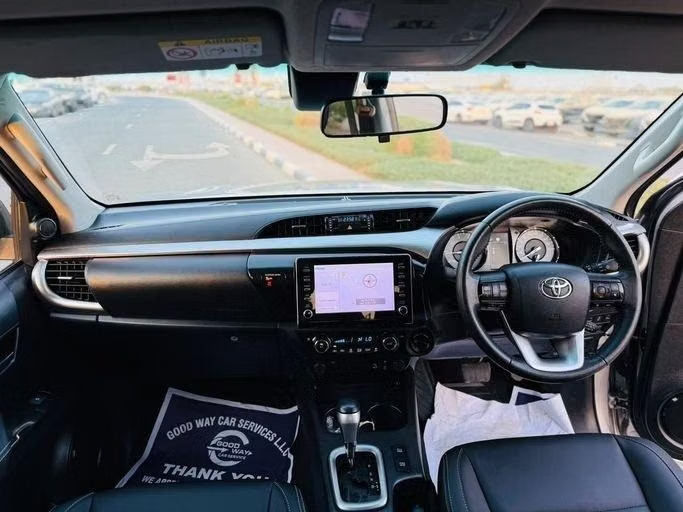
Toyota Hilux: assess exterior and cabin condition alongside the documents. The pictured vehicle is right-hand drive; do not automatically treat it as equivalent to a local-use specification.
5. How do you check the engine and identify an updated 1GD-FTV?
Arrange a cold start. First check fluid levels, visible leaks and signs of recent cleaning; then observe running quality, smoke and warnings. Scan before faults are cleared. On a diesel, have a specialist assess injection and boost readings against the correct specification. Arriving to find a warm engine prevents a proper cold-start assessment.
The Australian 2020 update announcement specifies 150 kW and 500 Nm for the 2.8 automatic, versus 420 Nm with the manual. These figures help identify the relevant versions, not every Hilux. See “The 1GD-FTV engine before and after the update: what changed in the Toyota Hilux” for the detailed comparison.
6. Are the injection, exhaust and starting systems sound?
Establish whether the diesel has a DPF* and check available operating data, warnings and repair history. A DPF notice on toyota.com.au concerns certain Hilux, Prado and Fortuner vehicles with 1GD-FTV/2GD-FTV engines acquired in Australia between 1 October 2015 and 23 April 2020. This warrants checking origin and completed repairs; it does not establish that every diesel Hilux is defective.
* DPF means diesel particulate filter. Regeneration removes accumulated soot by burning it off.
For difficult starting on a petrol version, checks include spark plugs and ignition coils. Diesel glow plugs assist cold starting and should be assessed with their control system. Do not prescribe replacement of every plug without diagnosis or transfer the petrol replacement schedule to a diesel.
7. Is there evidence of overheating or cooling-system trouble?
With the engine cool, inspect the reservoir, connections, radiators and accessible components. Dried deposits, mixed fluids and repeated top-ups need explanation. After a safe drive, compare diagnostic temperature readings with the specification. Test air conditioning stationary and moving. A new reservoir cap or recently replaced radiator does not prove that the underlying cause of overheating has been resolved.
8. How do the gearbox and propeller shaft behave under load?
On an automatic, assess forward and reverse engagement, warm shifts, delays and vibration. On a manual, check clutch operation, gear selection and unusual noises. Use progressive acceleration in suitable conditions, not aggressive launches. Inspect drivetrain leakage and propeller-shaft play on a lift. A seller’s suggestion that it “only needs an oil change” cannot replace a diagnosis and repair estimate.
9. Do four-wheel drive and the differential lock work?
Establish which modes are fitted: body accessories do not turn a rear-wheel-drive Hilux into a four-wheel-drive model. On suitable ground, a specialist should check front-axle engagement, low range and the differential lock where fitted. Follow the exact version’s operating procedure. The 2024 India manual warns against four-wheel drive on dry, hard roads. Check the indicators and shift actuators, and inspect drivetrain housings for leaks.
10. Are the brakes, steering and electrical systems sound?
Assess braking, pulling, vibration, the parking brake and steering play. Inspect belts, seat mountings, warning lamps and accessible connectors. Unusual corrosion beneath carpets, moisture or altered wiring needs investigation. Airbag assessment requires diagnostics and inspection, not just an extinguished warning light. Postpone road testing if brake or steering faults remain unresolved.
How should the ten checks affect your purchase offer?
Compare current offers for similar years, origins and configurations, separating export-only vehicles. Even “What does a 2015 Hilux cost?” requires generation and specification details. Asking prices are not confirmed transaction values. Record each fault and obtain estimates covering parts, labour and availability.
Consider an illustrative calculation: an expected sale at AED 85,000, repairs of AED 4,000, other recorded costs of AED 2,000, a contingency of AED 3,000 and a target remainder of AED 6,000 leave a purchase ceiling of AED 70,000. Another AED 5,000 of repairs lowers it to AED 65,000. This is a worked example, not a market valuation; account separately for taxes and other costs not already included.
Pause the purchase if independent inspection is refused, major repair costs remain unknown or frame condition is doubtful. A discount does not resolve technical uncertainty.
Conclusion
A Hilux worth considering for resale has a documented working history and verified condition. These ten checks help separate cosmetic wear from expensive faults and connect the purchase price to a repair estimate. Identify whether a 1GD-FTV is the earlier or updated version, while remembering that additional power never removes the need to inspect the chassis, load bed and drivetrain.


