


Toyota Highlander or Nissan Pathfinder — which family SUV should you buy in the UAE?
Toyota Highlander
Toyota Highlander•
•17 views
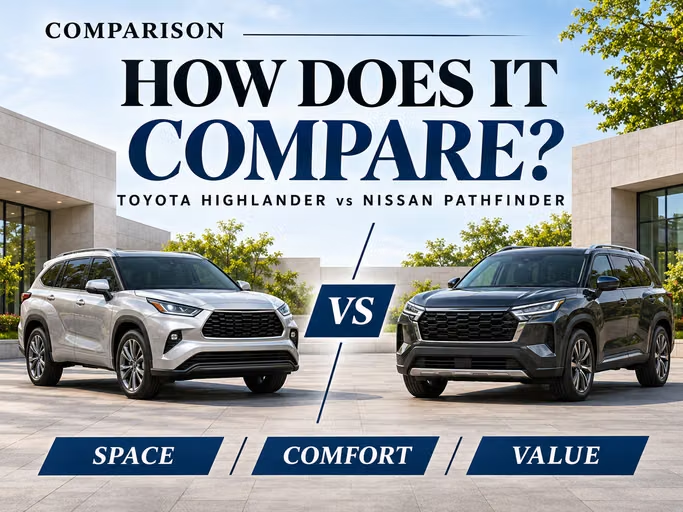
Article illustration. Vehicle appearance is illustrative; equipment and prices depend on specification. Information checked on 4 November 2026.
The Toyota Highlander and Nissan Pathfinder take different approaches to the same family requirement: a large vehicle with three rows. Highlander offers a hybrid powertrain, while Pathfinder combines a petrol V6 with seating for up to eight. Their advertised starting prices differ by AED 56,000, but that gap is not simply the price of choosing a hybrid.1
1 SUV: sport utility vehicle; UAE: United Arab Emirates; AED: UAE dirham; V6: six-cylinder engine with V-shaped cylinder banks.
This comparison covers the officially offered UAE Highlander Hybrid VXR 2026 and the current Pathfinder range published by Nissan's Dubai distributor. The decision comes down to priorities: a lower initial budget, an extra seat or reduced fuel use on regular journeys.2
2 VXR denotes a Highlander trim level.
Which SUV costs less to buy?
Pathfinder has the lower advertised starting price. Toyota.ae lists the Highlander Hybrid from AED 205,900. The Pathfinder page quotes AED 149,900, plus AED 3,600 for handling and logistics. Adding that charge brings Nissan's starting amount to AED 153,500, before other individual costs.
Toyota's specification includes VAT but excludes shipping and handling, with possible colour surcharges. The AED 56,000 headline difference therefore compares advertised figures before additional charges. Two written quotations with matching cost categories are needed to establish the actual gap.3
3 VAT: value-added tax.
First request a Pathfinder quotation with the drivetrain and equipment you need, then compare it with Highlander VXR. One model's lowest price and another's well-equipped version show entry costs, not the price of equivalent features. Confirm the production year and warranty terms for the actual vehicle too.
What hybrid system does Highlander use, and what does Pathfinder offer?
Highlander combines a 2.5-litre hybrid system, eCVT and all-wheel drive. The VXR specification lists 240 hp. Pathfinder's specifications show a 3.5-litre V6, 271 hp and a nine-speed automatic, with different drivetrain versions available.4
4 eCVT: electronically controlled continuously variable hybrid transmission; hp: horsepower.
Highlander does not need plugging in. As explained in Toyota TGS's hybrid overview, a conventional hybrid combines petrol and electric power and recovers energy during deceleration. It suits buyers who lack home charging but want electric assistance during everyday journeys.5
5 TGS: Toyota Gibraltar Stockholdings, a Toyota vehicle supplier.
The 31 hp difference does not establish which feels better. Overtaking response, smoothness at low speed and noise under load matter in a family vehicle. Test both on the same route: power figures cannot replace experiencing two different transmission systems.
How do the published fuel figures compare?
Highlander's stated 19.3 km/l converts to approximately 5.18 l/100 km. The Pathfinder brochure lists 11.1 km/l for 2WD and 10.8 km/l for 4WD, equivalent to around 9.01 and 9.26 l/100 km. Toyota has the advantage on these published figures.6
6 2WD: two-wheel drive; 4WD: four-wheel drive.
At an assumed 20,000 km annually, the arithmetic difference between Highlander and Pathfinder 4WD is approximately 816 litres. This uses specification figures, not a joint road test. The sources do not establish a common test cycle; heat, speed, load and prolonged air conditioning use can change actual results.
For budgeting, multiply your expected difference in litres by the current fuel price, then consider servicing and insurance. Dividing the entire starting-price gap by calculated fuel savings would be misleading: the purchase also includes a particular equipment package, not only a powertrain choice.
Which offers more passenger and luggage space?
Pathfinder wins on seat count: eight against seven in the Highlander considered here. Nissan measures 5,004 mm long and Toyota 4,966 mm. That 38 mm difference illustrates why exterior size alone cannot establish usefulness; the seating layout matters.
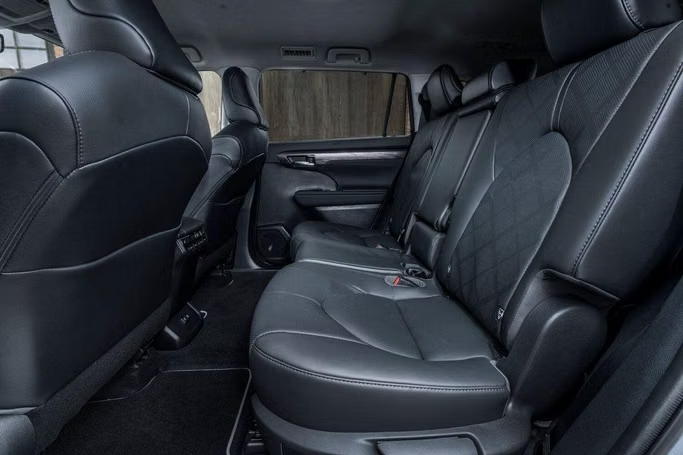
Highlander IV second-row seating. Check the seating position and equipment of the actual version. Photo: model catalogue.
If you regularly need the eighth seat, extra options cannot make Highlander provide it. If four or five people usually travel, focus on second-row width, rear access and whether your child seats fit. With the third row raised, try loading the pushchair or suitcases you actually use.
Pathfinder provides EZ FLEX access to the rear row. Assess that access with your passengers and child seats. Seat everyone in turn, set the front seat for the driver and check that making room in the third row does not require an uncomfortable compromise in the second.7
7 EZ FLEX: second-row seats tilt and slide forwards to ease third-row access.
Which is better equipped for family journeys?
Highlander VXR includes ventilated front seats, three-zone climate control and a panoramic roof. Its model page also lists two 12.3-inch displays, a head-up display and panoramic view monitor. This appeals to buyers seeking a defined set of conveniences in one package.8
8 A head-up display projects driving information ahead; the panoramic view monitor combines surrounding camera views.
Pathfinder equipment varies substantially by grade. The published SV 4WD specification includes ProPILOT and an around-view system with Invisible Hood View. Photographs of an expensive version cannot establish the features supplied at the advertised entry price. Obtain an equipment list for the vehicle being quoted.9, 10, 11
9 SV denotes a Pathfinder trim level.
10 ProPILOT assists with speed, following distance and lane centring; the driver remains responsible.
11 Invisible Hood View uses cameras to show the area beneath the front end, hidden by the bonnet.
Assess comfort as a family: check rear airflow, armrests, charging connections and climate controls. Switch off the audio during the test drive and compare noise at the same speed. Electronic assistance can be useful without automatically making one car quieter or more comfortable than the other.
What should you check before deciding?
Choose according to use. Highlander's hybrid system makes it worth considering for regular urban journeys when seven seats are enough. Start with Pathfinder if eight seats or a lower entry price are priorities. When comparing current offers, distinguish new official-channel vehicles from used examples and vehicles imported through other channels.
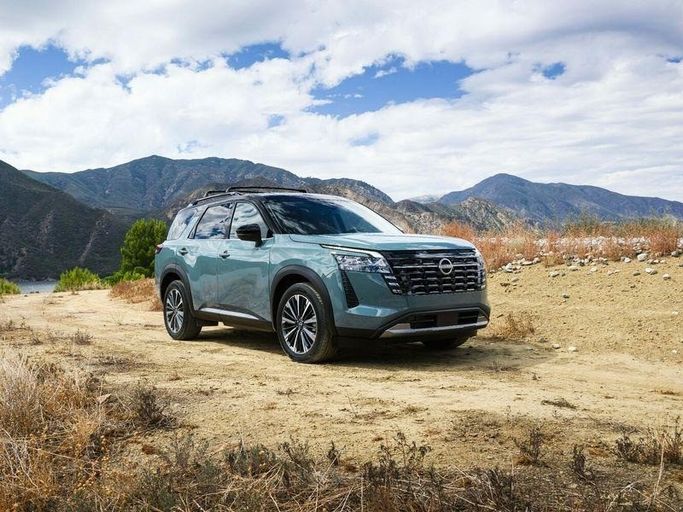
The updated Pathfinder. Trim and equipment vary by market and specification. Photo: model catalogue.
Before paying a deposit, use the same checklist for both vehicles:
☐ Obtain the full price and exact grade designation.
☐ Test the third row with passengers and luggage.
☐ Compare traffic, acceleration and parking behaviour.
☐ Confirm warranty terms and scheduled servicing costs.
☐ Commission an independent condition and history check for a used vehicle.
Do not treat a promise of strong future resale value as an established fact. On used examples, condition, mileage and repair history can matter more than specification advantages. Two comparable quotations and a family test drive provide a firmer basis for deciding than isolated advertising claims.
Conclusion
Highlander suits a family seeking seven seats, hybrid power and the VXR equipment package. Pathfinder offers an eight-seat layout, a V6 and a lower advertised entry price. Toyota leads on published fuel figures; Nissan leads on starting cost and seat count. Make the final decision after comparing complete quotations, exact specifications and comfort for every passenger.


