


What are the pros and cons of the Toyota Corolla?
Toyota Corolla
Toyota Corolla•
•18 views
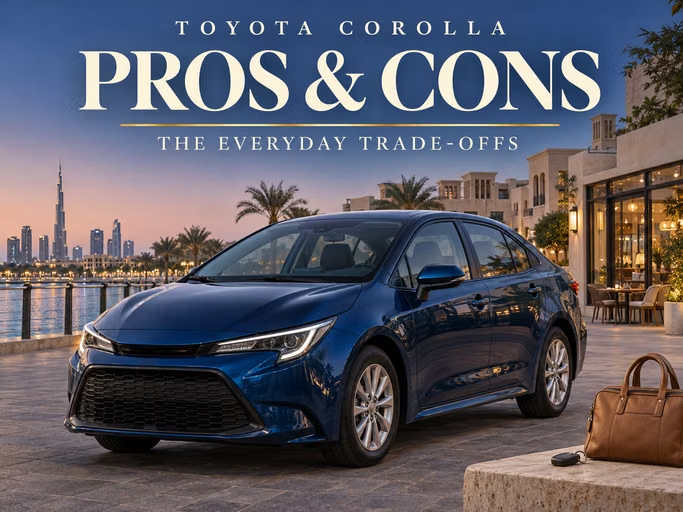
Article illustration. Vehicle appearance and equipment are illustrative; specifications depend on the market and trim.
The Toyota Corolla gives UAE buyers three distinct priorities: a lower purchase price, more engine power or lower fuel consumption. Prices for the 2026 sedan start at AED 76,900, while the hybrid starts at AED 89,900. Spending more does not improve every specification equally. Its main advantage is the ability to match a version to daily use; the main compromise is equipment that needs to be assessed separately from the powertrain.
This review considers the local-market sedan using information checked on 7 November 2026. Specifications for the Corolla Cross, performance models and cars built for other countries should not automatically be applied here.
What is the Corolla’s main advantage for a buyer?
It offers different ownership priorities within one familiar body format. The published Corolla 1.6 specifications price the entry XLI* at AED 76,900. The 2.0 is listed at AED 83,900 and the 1.8 hybrid at AED 89,900. The AED 13,000 gap between the starting petrol and hybrid versions lets buyers either invest in a more economical powertrain or retain that money in their budget.
* XLI is a trim designation; equipment depends on the engine, market and model year.
That flexibility matters when the car has a defined job. With low annual mileage, the initial price may carry most weight. Frequent longer journeys can make performance more important, while high mileage gives fuel consumption greater significance. There is no single best Corolla for all three situations.
The listed prices include value-added tax, but the specification sheets exclude shipping and handling and allow for additional colour charges. When comparing current offers, distinguish a new local-market car from a used example or an import. A shared model name does not make the purchase conditions equivalent.
How economical is the Corolla in everyday use?
The hybrid has the strongest published fuel-economy figure. Specifications list 18.2 km/L for the 1.6 XLI and 19.8 km/L for the 2.0; the Corolla Hybrid model page states 30.3 km/L. These convert to approximately 5.5, 5.1 and 3.3 L/100 km respectively. They are declared figures, not results from our own road test.
Speed, congestion, air-conditioning use and journey length affect actual consumption. For a low-mileage buyer, the hybrid’s drawback is the higher initial outlay: fuel savings may accumulate slowly. A payback claim needs the owner’s mileage and realistic consumption. Notice also that the petrol 2.0 has a better declared economy figure than the 1.6 XLI. Engine displacement alone does not determine fuel use.
Does the Corolla offer enough power for daily driving?
The petrol 2.0 is the most powerful of these versions. Local figures put the 1.6 at 121 hp and the 2.0 at 168 hp, a difference of 47 hp. Buyers regularly carrying passengers and luggage have a clear reason to consider that gap. It does not, however, establish an acceleration time or replace a comparison under similar driving conditions.
The 2026 hybrid specification lists combined system output of 121 hp. Its engine and motor outputs must not simply be added together. The higher purchase price buys a different powertrain, so treating the hybrid as the fastest Corolla merely because it costs more would be a mistake.
Petrol versions use a CVT, while the hybrid uses an e-CVT*. Assess their acceleration response on a representative route. A detailed engine and transmission explainer — https://auto.ae/blog/car/toyota/toyota-corolla/1zr-fe-in-the-toyota/555756/ — can provide the separate technical background for the chosen version.
CVT means continuously variable transmission. * e-CVT denotes an electronically controlled continuously variable hybrid transmission; it does not mean a conventional belt-type CVT.
Is the Corolla’s cabin practical for a family?
The sedan has five seats, but that rating does not guarantee equal comfort for five adults. It measures 4,630 mm long with a 2,700 mm wheelbase. Dimensions help compare cars, yet seating comfort still depends on the driver’s height and who sits behind them.
For a family with a child, fitting the usual child seat and assessing the space beside it is more informative. A separate boot keeps luggage apart from passengers, but a sedan opening limits the loading of tall items. A large pushchair, bicycle or bulky equipment may make the opening more important than the attractive purchase price. Five seats alone do not make the Corolla a universal substitute for a family crossover.
Where does the equipment involve compromises?
Local versions focus on everyday essentials. The Corolla 2.0 XLI equipment list includes fabric seats, manually controlled air conditioning and halogen headlights. These are specific limitations for someone expecting a more elaborate cabin or automatic temperature regulation.
The 2.0 also has 16-inch alloy wheels and six speakers. The hybrid XLI brings automatic climate control, but has 15-inch steel wheels and four speakers. The useful comparison is therefore between functions the buyer actually values. One owner may prioritise cabin temperature control; another may prefer the petrol version’s equipment and lower price.
Can buyers assume every Corolla has the same safety equipment?
No. Equipment depends on the market and version. The local 2.0 specification lists stability control, front and side airbags, and conventional cruise control. Adaptive cruise control and automatic emergency braking are not listed in that document. This is not a claim about every Corolla, but neither should a feature be promised on the strength of an overseas review.
That distinction matters if a particular driver-assistance function is essential. Its presence needs to be established for the actual version. A model’s reputation cannot replace equipment a buyer needs, and an airbag list alone does not establish an independent crash-test rating.
Conclusion
The Toyota Corolla is worth considering as an everyday sedan offering a choice between initial cost, power and fuel economy. The 1.6 lowers the purchase threshold, the 2.0 supplies the highest output of these versions, and the hybrid has the best declared fuel economy. Its main limitations concern trim-specific equipment and sedan practicality. The purchase makes sense when those trade-offs suit the owner’s journeys and needs, rather than resting on the familiarity of the model name.


