


Does a Toyota Corolla Need a Rear Differential Oil Change?
Toyota Corolla
Toyota Corolla•
•31 views
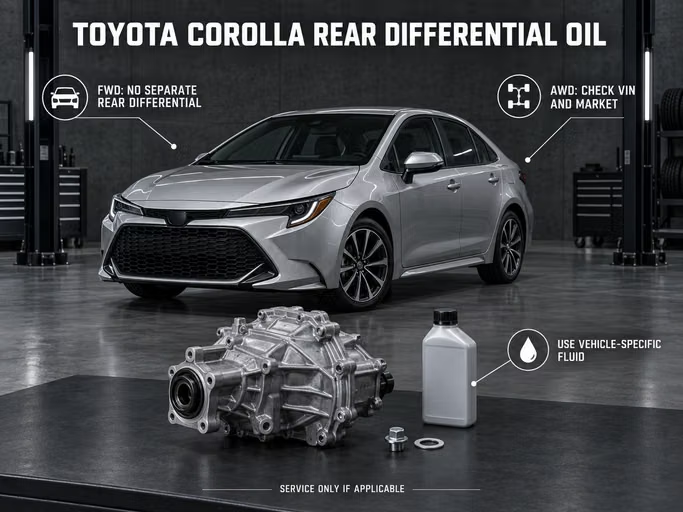
For most Toyota Corolla owners, the correct starting point is not a mileage interval but a drivetrain check. Current UAE-market Corolla sedans are front-wheel drive and have no separate rear differential. Rear-unit service applies only to selected Corolla AWD variants sold elsewhere and to certain older four-wheel-drive imports.
How Do You Know Whether a Toyota Corolla Has a Serviceable Rear Differential?
The Corolla name covers many generations, markets and drivetrain layouts. In a conventional front-wheel-drive car, torque does not travel to the rear wheels, so there is no rear final-drive housing filled with gear oil. The front differential is built into the transmission or transaxle and shares the fluid specified for that assembly.
Some Corolla Hybrid AWD models use a separate electric drive at the rear axle. Toyota documentation may still list Rear Differential Oil for these cars, but it adds the essential qualifier if applicable. Older imported Corolla 4WD models can use a mechanical rear differential. These arrangements must not be serviced from one generic instruction.
- Confirm the VIN, model code and original sales market.
- Verify any AWD or 4WD description against factory equipment data rather than relying on an advertisement badge.
- Inspect the rear axle: a front-wheel-drive Corolla has neither a differential housing nor driven half-shafts at the rear wheels.
- Distinguish an electrified hybrid rear drive from a conventional hypoid differential connected by a propeller shaft.
- Match the maintenance operation to the exact model year, market and powertrain document.
If a workshop proposes a rear differential oil change for a standard UAE Corolla 1.6 or 2.0, ask it to identify the component and its fill plug first. Draining CVT fluid cannot be presented as rear differential service. It is a separate operation, with a different fluid and level-setting procedure.
Which Corolla Versions Have No Separate Rear Differential?
A sophisticated-looking rear suspension does not prove that a differential is present. A front-wheel-drive Corolla may have a subframe and multiple links, yet the engine still drives only the front transaxle. The rear hubs rotate without drive shafts, leaving no rear gear-oil reservoir to drain or refill.
Do not transfer specifications from a Corolla Cross AWD or assume that petrol and hybrid Corolla models share a drivetrain. Two cars from the same model year can have different systems when sold in different countries. For a vehicle imported from North America, Japan or another region, the VIN takes priority over a familiar trim name.
An underbody inspection resolves the question quickly. A conventional mechanical rear differential connects to both wheels through half-shafts and usually to the transmission through a propeller shaft. An electrified hybrid rear unit has high-voltage connections and needs no mechanical shaft from the engine. A front-wheel-drive Corolla has neither layout.
What Happens If the Wrong Unit Is Serviced—or AWD Oil Is Ignored?
The mistake can go in either direction. On a front-wheel-drive Corolla, the owner may pay for an operation that the car cannot require, or a transmission-fluid service may be mislabelled. On an applicable AWD model, the opposite error is possible: a genuine rear unit may be omitted even though its condition is listed in the maintenance schedule.
1. A universal service package can create false confidence by adding a line item that does not correspond to any component on the vehicle.
2. Low fluid in a serviceable rear drive reduces cooling and protection for bearings, gears or electric-drive components, depending on the design.
3. An incorrect specification can affect bearings, seals and gear contact. One bottle is not automatically suitable for every Corolla AWD system.
4. Trying to cure every rear noise with fresh oil delays diagnosis of tyres, wheel bearings, brake shields or an electric-drive fault.
5. When a real leak exists, driving until a loud whine develops can turn a seal repair into an expensive unit repair or replacement.
After a wet patch is found, clean the area, check the level by the prescribed method and re-inspect to confirm the source. Airflow can spread fluid across the rear subframe, so a stain near the axle is not proof of differential leakage. It may come from a shock absorber, brake system or corrosion-protection treatment.
Do not continue a journey with a confirmed low level, metallic noise, abnormal housing temperature or an AWD warning. A hybrid electric rear drive also requires high-voltage safety procedures. A workshop must not treat it automatically as if it were a conventional live axle.
Fresh fluid cannot rebuild pitted bearing races or damaged gear teeth. If a sound developed gradually and remains after correct service, measure play and locate the source. A heavier oil might alter the tone temporarily, but it can also conceal a problem while wear continues.
Which Oil Is Correct for a Toyota Corolla Rear Drive?
There is no universal Corolla answer. A front-wheel-drive version needs no rear fluid. For a Hybrid AWD model or an older four-wheel-drive car, identify the exact fluid from the VIN, transmission or axle code, and market-specific service data. Do not assign API GL-5 or a popular viscosity merely because the component is described as a differential.
| Item | Current UAE Corolla FWD | Other-market Corolla Hybrid AWD | Older / imported Corolla 4WD |
|---|---|---|---|
| Rear unit | No separate rear differential | Electrified rear drive; design varies by market | May use a mechanical differential and propeller shaft |
| Oil change | Not applicable | Only when the exact vehicle procedure requires it | Required if the differential has a separate oil fill |
| Fluid | Do not confuse it with front CVT/e-CVT fluid | Use the exact Toyota designation confirmed by VIN and service data | Select grade and viscosity by axle code and manual |
| Capacity | Not applicable | Not universal across AWD versions | Varies by generation and differential |
| Inspection | Check rear hubs, suspension and brakes | Check sealing, AWD faults and the correct schedule | Check level, breather, seals and oil condition |
| Common error | Selling a service for a component that is absent | Adding ordinary hypoid oil without confirmation | Copying data from another Corolla generation |
Why the Corolla Name Alone Cannot Select the Fluid
The letters AWD do not describe the internals. In an older mechanical system, oil protects hypoid gears and bearings. In an electric rear drive module, the fluid may operate around reduction gears, an electric motor and electrical insulation materials. The compatibility requirements can therefore be fundamentally different.
Even two mechanical differentials can vary in ratio, materials, plugs and level-setting method. A product must match the complete required specification, not just one viscosity number. Noise-control additives should not be used unless Toyota documentation explicitly permits them.
If the only available answer comes from an oil seller's application list, verify it against primary service data and the unit code. A model-year selector may group several regions together. Waiting until the assembly is identified is safer than opening it and experimenting with fluid.
Checks to Complete Before Draining Anything
- Place the car level and provide safe access to the rear axle.
- Match the VIN, model code, powertrain and factory drive-system designation.
- Confirm that the housing actually has manufacturer-provided service plugs.
- Verify that the fill plug can be opened before removing a drain plug.
- Inspect seals, connectors, breather and subframe; follow high-voltage precautions on a hybrid.
- After service, check for leaks and reproduce the original noise under the same conditions.
Examine drained fluid under good lighting. Fine dark paste after a long interval is different from needle-like swarf, large fragments or a bronze sheen. Interpretation still depends on the design: do not expect an electric drive to use the same magnetic drain plug as a conventional axle unless its procedure says so.
For a used Corolla with an unclear history, begin with a diagnostic inspection and photograph the unit identification. When comparing model years and equipment, browsing current listings can show which versions are common locally. An advertisement is only a starting point; the individual car still needs a VIN check and underbody inspection.
Why Does a Toyota Corolla Hum at the Rear—and Is Oil Always Responsible?
A rear hum often makes drivers suspect a differential even though most Corollas do not have one. Structure-borne noise travels through the floor, so a front drivetrain sound or a wheel bearing can seem to come from under the rear seat. Diagnosis should track how the sound changes with speed, load, steering input and road surface.
| Possible cause | Typical clue | First check |
|---|---|---|
| Cupped rear tyres | The hum changes with road surface or appears after tyre rotation | Feel the tread and check pressure, rotation history and alignment |
| Rear wheel bearing | Pitch follows road speed and changes during a gentle left-right load transfer | Check play, roughness and hub temperature |
| Brake shield or dragging caliper | A rotational scrape is present and one wheel runs hotter | Inspect shield clearance, pads and free movement |
| AWD electric rear drive | Noise coincides with rear-axle engagement or an AWD message | Scan for faults and follow the procedure for that hybrid AWD system |
| Mechanical differential on an older 4WD | Whine differs between acceleration and coast; leakage may be visible | Check level, play, fluid and the leak source |
| CV joint or drive-unit mount | Vibration appears under load, acceleration or within a speed band | Inspect boots, mounts and runout |
| Front transaxle noise | The sound changes with torque and travels through the floor | Localise it during a controlled road test and lift inspection |
What to Check Before Authorising a Repair
Record the conditions first: road speed, vehicle temperature, acceleration, coasting, and left or right steering input. Then inspect the tyres and rear hubs. On a front-wheel-drive Corolla, these are much more plausible sources of a rear hum than a differential that does not exist.
On an AWD version, compare scan data with the moment when the sound appears. If the rear axle is inactive while the hum continues, the drive unit should not automatically be the leading suspect. When noise coincides with electric rear-drive engagement, check fault codes, mounts, sealing and the specified fluid procedure.
For an older mechanical 4WD differential, the difference between drive and coast is useful. A whine under power may point toward the loaded tooth face, while coast noise can relate to the opposite face or bearings. These clues guide testing; they do not replace play measurement and fluid inspection.
If noise began immediately after service, verify the exact fluid number, quantity, level procedure and plug sealing. If it built up over months, an oil change alone is not a diagnosis. A disciplined sequence costs less than random parts replacement and avoids dismantling a healthy component.
Conclusion
Current UAE-market Corolla sedans have no rear differential oil to change. For an AWD or older 4WD car, verify the system by VIN, follow its market-specific schedule, and diagnose noise before servicing.


