


When Should Toyota Corolla Cross Brake Pads and Rotors Be Replaced?
Toyota Corolla Cross
Toyota Corolla Cross•
•54 views
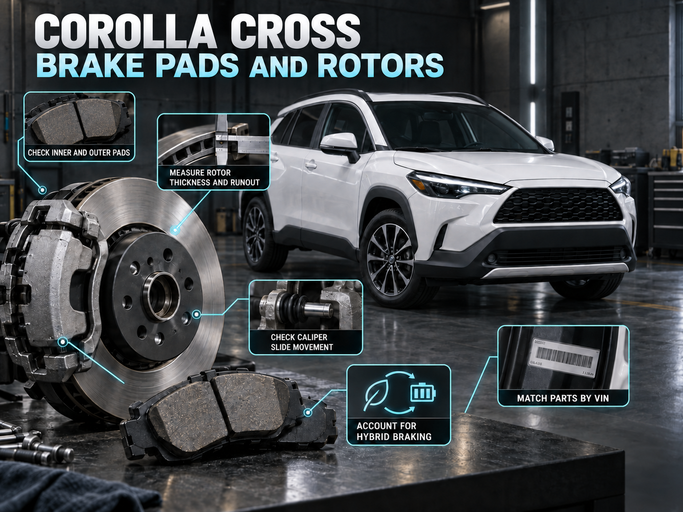
There is no single replacement mileage for every Toyota Corolla Cross brake pad and rotor set. Service life changes with crossover load, stop-and-go use, braking style, sand, moisture, long descents, caliper condition, and periods of storage. The hybrid adds regenerative braking: the traction motor supplies part of the deceleration, so the friction brakes may operate less often, but they must remain fully serviceable.
A reliable decision is not based on the odometer or a glance at one outer pad through the wheel. Identify the exact vehicle, inspect all four corners, measure pad lining and rotor condition, confirm free caliper movement, and assess how the vehicle behaves under braking. This sequence separates normal wear from a seized slide, contaminated hub face, or another fault that would quickly damage new parts.
Identify the Vehicle Version First
The UAE Corolla Cross Hybrid 2026 model page specifies a 1.8-litre hybrid powertrain, CVT, and front-wheel drive; the listed equipment also includes an electric parking brake and brake hold. Used-car stock, however, includes petrol and hybrid vehicles from different years and markets, and their brake construction and part numbers may differ.
Before ordering parts, record the VIN, complete model code, model year, original market, powertrain, and wheel size. Separately confirm front and rear rotor dimensions, the rear-caliper arrangement, and the correct method for placing the electric parking brake in service mode.
- Current UAE Corolla Cross Hybrid. Account for regenerative braking and the electric parking brake service procedure.
- Petrol Corolla Cross. Do not automatically transfer hybrid-specific assumptions even when the body looks the same.
- Imported vehicle. Brake diameter, trim equipment, and the electronic service procedure may not match the local specification.
- Repaired or modified vehicle. Compare the calipers, carriers, rotors, and sensors actually fitted with VIN-matched information.
How Hybrid Braking Changes the Wear Pattern
During gentle deceleration, the hybrid system can recover energy into the traction battery before requesting more hydraulic braking. This may reduce mechanical wear, but it does not eliminate it. The pads and rotors still work during firm braking, at low speed, while coming to a stop, when the battery cannot accept the required power, and in other operating conditions.
Infrequent friction-brake use has another consequence: surface rust and pad impressions may clear more slowly after washing, wet parking, or driving through water. A low odometer reading therefore does not prove that the rotors are healthy. On a hybrid, both remaining thickness and uniform contact across the swept surface matter.
Signs of Pad or Rotor Wear
- A persistent metallic squeal or grinding sound appears. It may be a wear indicator, pad backing contacting the rotor, or trapped debris; inspection should not be postponed.
- The brake pedal or steering wheel pulsates. Possible causes include rotor thickness variation, runout, contamination between rotor and hub, or play elsewhere in the chassis.
- The vehicle pulls to one side. Compare brake force, piston and slide movement, hose condition, tyres, and wheel alignment rather than blaming one pad immediately.
- One wheel is noticeably hotter after an ordinary drive. A binding caliper, parking-brake problem, or pad that remains in contact may be responsible.
- Braking feels less predictable or pedal travel changes. The pads, rotors, fluid, hydraulic system, and electronic controls need a combined diagnosis instead of parts selected by guesswork.
What to Check Before Approving Replacement
Inspect the vehicle on a lift with the wheels removed. The view through a wheel opening reveals only part of the assembly: the inner pad may be thinner than the outer pad, and the inboard rotor face may be more severely damaged. Record results for each wheel separately so that the next visit can be compared with measurements rather than memory.
| Item | How to assess it | What the result tells you |
|---|---|---|
| Inner and outer pads | Measure usable lining without the backing plate; compare sides and axles | A difference can point to slides, piston movement, pad fit, or contamination |
| Rotor thickness | Use a micrometer at several positions while avoiding the outer lip | Compare with the limit for the exact rotor and decide whether continued use is permissible |
| Runout | Use a dial indicator on a clean hub with the rotor secured correctly | Separates rotor geometry from dirt, hub corrosion, and bearing play |
| Swept surface | Look for deep scoring, cracks, blue areas, pitting, and incomplete contact | Shows overheating, corrosion, or mechanical damage |
| Caliper and carrier | Inspect boots, piston, slide pins, and free pad movement | Binding can ruin replacement parts in a short time |
| Hub and fasteners | Clean the mounting face; check play and even wheel-fastener torque | An error here can create runout with a new rotor |
For the specific Corolla Cross Hybrid 2026, the English Toyota owner's manual instructs the owner to have the pads checked promptly when the wear indicators squeal or scrape and warns that delay may damage the rotors. Obtain minimum thickness, runout, and service procedures from repair information matched to the VIN; a manual for another version is not a substitute.
Pads: Inspect Both Sides
Compare the inner and outer linings in each caliper, then compare the left and right sides of the axle. Tapered wear, a large difference between pads, or persistent heat marks calls for a mechanism check rather than a pad-only replacement. Cracked, delaminated, fluid-soaked, or damaged linings are assessed separately from their remaining thickness.
Replace pads as an axle set. Before assembly, clean the support lands, inspect shims and springs, apply the correct lubricant only where the procedure permits it, and keep all friction surfaces uncontaminated.
Rotors: Thickness, Runout, and Surface
A pronounced outer lip does not by itself prove whether a rotor can remain in service. A micrometer establishes thickness, while a dial indicator establishes axial runout after correct mounting. If resurfacing is being considered, the finished rotor must remain above its permitted minimum with allowance for subsequent use. Cracks, severe overheating, deep corrosion, or an out-of-limit dimension will normally rule out that option.
Reading Squeal, Vibration, and Pull
The same noise can have several causes, so record when it appears: with cold or warm brakes, on the first stop after parking, only at low speed, or under heavy load. For vibration, note road speed, pedal effort, and whether the disturbance is strongest through the steering wheel, body, or pedal.
| Observation | Possible causes | Next step |
|---|---|---|
| Brief noise after rain or washing | Light surface corrosion | See whether it clears after several safe brake applications; inspect the swept faces |
| Persistent high-pitched squeal | Wear indicator, glazing, pad vibration, or contamination | Remove the wheels, measure both pads, and inspect the caliper hardware |
| Metallic grinding | Wear limit exceeded or debris trapped | Stop normal use and inspect the rotor and pads |
| Pedal pulsation | Thickness variation, runout, hub contamination, or ABS operation | Reproduce safely, measure geometry, and consider the road surface |
| Pull under braking | Unequal force, binding, tyre, suspension, or alignment issue | Compare temperatures and brake forces, then inspect the chassis |
| Odour and a hot wheel | Binding caliper or parking-brake mechanism | Allow it to cool without water; check free movement and heat damage |
Why Vibration Does Not Always Mean a Warped Rotor
Braking torque can vary because of disc-thickness variation, transferred pad material, rust between rotor and hub, wheel-bearing play, or uneven wheel-fastener torque—not only because of rotor shape. If a new rotor is installed on a contaminated mounting face or the wheel is tightened unevenly, the complaint may return. Confirm the diagnosis with measurements before buying parts.
Conditions That Accelerate Wear
- frequent short trips with repeated stops, especially with passengers and luggage on board;
- long descents with continuous pedal pressure instead of sensible speed management;
- sand and dust retained around slide pins and pad support lands;
- water crossings, washing, and a long period of parking before the brakes can dry;
- infrequent vehicle use that allows corrosion to mark the swept surface;
- seized slides, tight pad fit, damaged boots, or an unsuitable lubricant;
- hard braking immediately after installation, before new friction surfaces have bedded correctly.
Heat alone does not define a replacement interval, but high ambient temperature can magnify the effects of demanding use and poor heat dissipation. After an overheating event, inspect the pads and rotors together with boots, hoses, fluid condition, and free wheel rotation.
Corolla Cross Hybrid Considerations
Low mechanical wear on a hybrid is not the same as no maintenance. When the friction brakes seldom clean the rotor, local corrosion can produce noise and patchy contact. Deliberate hard stops merely to “clean” the brakes are not a suitable remedy. Safe inspection, the specified bedding process, and normal system operation matter more than trying to alter regenerative-braking behaviour.
Diagnostic and Service Plan
A useful repair order should move from vehicle identification to measurements, correction of the cause, and a final verification. This checklist works for routine maintenance and for assessing a used vehicle before purchase.
☐ Record the VIN, complete model code, model year, original market, powertrain, and wheel size.
☐ Read brake-system messages and define the driver's complaint before dismantling anything.
☐ Remove all wheels and measure the inner and outer pads at every corner.
☐ Measure rotor thickness at several positions and compare it with the exact limit for the installed part.
☐ Check runout on a clean hub, together with bearing play and both mounting faces.
☐ Inspect pistons, boots, slide pins, pad lands, hoses, and the parking-brake mechanism.
☐ Select parts and single-use hardware by VIN; do not mix incompatible friction materials on one axle.
☐ Assemble to the correct procedure, tighten the wheels evenly, and complete the specified bedding process.
☐ After service, verify pedal feel, warnings, free rotation, leakage, and the result of a safe road test.
Mistakes to Avoid
- Buying pads from the model name alone without checking the VIN and the caliper actually fitted.
- Replacing only the more worn pad or only one side of an axle.
- Declaring a shiny rotor serviceable without measuring it or examining the inboard face.
- Installing new parts before correcting stiff slides or corrosion on the hub face.
- Clearing warnings or starting a road test before a safe brake pedal has been restored.
Conclusion
Toyota Corolla Cross brake pads and rotors should be replaced according to measured condition and the limits for the exact version. Regenerative braking must be considered on the hybrid, but it is not a reason to skip friction-brake inspection. The sound sequence is to confirm the VIN and hardware, compare every pad, measure the rotors, check calipers and hubs, correct the reason for uneven wear, and only then fit matching parts. When shopping for a used vehicle, current Corolla Cross listings can establish the market context, but brake condition still needs a separate lift inspection and a safe road test.


