


Toyota Corolla Cross Coolant Replacement: Intervals, Capacities and Diagnosis
Toyota Corolla Cross
Toyota Corolla Cross•
•35 مشاهدة
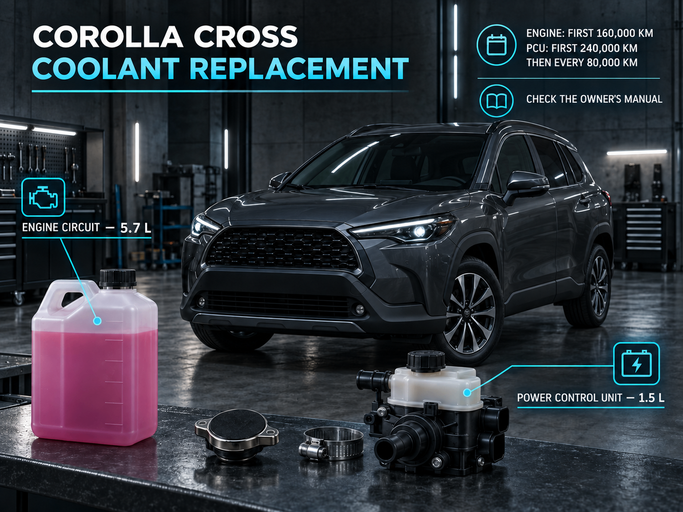
A Toyota Corolla Cross Hybrid has two separate liquid-cooling circuits: one for the petrol engine and another for the power electronics. Their initial replacement points and capacities are not the same. This guide sets out verified figures for the 2026 GCC model, early warning signs and practical checks between scheduled services.
When a Corolla Cross Needs Attention Before the Scheduled Point
The long rated life of SLLC does not make the reservoirs irrelevant until the replacement mileage arrives. This compact crossover spends much of its time in slow traffic with the air conditioning running, so dependable heat rejection matters. Judge the system from repeatable evidence rather than one isolated observation.
- Previous maintenance paperwork is missing. An entry that says “coolant top-up” neither proves a complete renewal nor identifies the circuit involved. Establish the model year, original market and powertrain, then compare invoices and workshop orders. On the hybrid, engine-circuit work does not renew the liquid in the power control unit loop.
- The cold level falls again after replenishment. Evidence may never reach the parking floor because a small seep can dry on a hot housing or collect on the undertray. Look for pink crystalline residue, damp joints and a characteristic odour around caps, hoses, pumps, heat exchangers and both expansion reservoirs.
- The liquid is no longer uniform. Flakes, persistent foam, cloudiness, brown sediment or an oily film call for identification of the source. Fresh fluid cannot correct internal leakage, corrosion or mixed chemistries. Inspect heat exchangers, seals and the product history before deciding how either circuit should be cleaned.
- Cabin-heater temperature changes without a new command. In the engine loop this can point to a low level, trapped air or uneven circulation, especially after recent work. Normal heater performance, however, says nothing conclusive about the separate loop that removes heat from the hybrid power electronics.
- Temperature rises in congestion, on a long grade or with a full load. Test fan operation, airflow through the condenser-radiator stack, the pressure cap, thermostat and pump performance. Treat a hybrid-system message as a separate clue: the PCU circuit can develop a fault without an obvious rise on the engine temperature display.
Checking Both Reservoirs Safely
Park the Corolla Cross on level ground and let it cool fully. The engine reservoir and power-control-unit reservoir should each read between FULL and LOW; neither reading substitutes for the other. If a level is low, use only compatible coolant and investigate the loss. Never remove a hot cap because the circuit is pressurised.
What Changes as Coolant Ages
Coolant does more than carry heat. Its additive package limits electrochemical attack between dissimilar metals, supports pump-seal life and discourages deposits. Once that protection weakens, external parts can still appear healthy while deterioration has already begun in narrow internal passages.
- Corrosion debris moves with the circulating liquid. It can lodge in fine radiator, heater and hybrid heat-exchanger passages, increasing resistance to flow. The first clue may be more frequent fan operation or a small dry stain at a joint; later, leakage and reduced thermal performance become more apparent.
- An incorrectly prepared mixture can leave mineral scale. Tap water, an accidental dose of concentrate or an incompatible coolant may create an insulating internal layer. The pump must then move liquid through a less effective heat exchanger, even though the colour in the reservoir can still look familiar.
- Air and contamination shorten pump life. Bubbles encourage cavitation, hard particles abrade working surfaces and unsuitable chemistry compromises seal conditions. Weak flow in the engine loop is often exposed by sustained load; in the PCU loop it can produce a system message or a temporary power limitation.
- Incomplete bleeding may reveal itself only after several journeys. The bottle looks correct immediately after filling, but trapped air later escapes and the level drops towards LOW. Each circuit therefore needs its own circulation and air-removal routine, followed by another check after the vehicle is completely cold.
- A red warning, visible steam or a strong sweet odour is a reason to stop, not to accelerate towards a workshop. Continued driving can distort engine components, damage the head gasket or trigger hybrid-system protection. Let the vehicle cool naturally; do not open a hot cap or pour cold water over heat-soaked parts.
Coolant Specified for a Toyota Corolla Cross
The manual permits Toyota Super Long Life Coolant or a similar high-quality ethylene-glycol product that is non-silicate, non-amine, non-nitrite and non-borate, with long-life hybrid organic acid technology. Toyota SLLC is supplied as a 50% coolant and 50% deionised-water premix rated to −35°C. Do not dilute it further or determine compatibility from colour alone.
Choose the document for the exact year, equipment and destination market from Toyota’s manuals. Its vehicle-specific requirement takes priority over a broad statement on a container: imported petrol Corolla Cross versions and hybrids can differ in circuit count, capacity and bleeding sequence.
Official 2026 Corolla Cross Hybrid Intervals and Capacities
According to the information presented on toyota.ae, the current 2026 Corolla Cross Hybrid uses a 1.8-litre hybrid powertrain. Its GCC regional manual gives two capacities: 5.7 litres for the petrol-engine circuit and 1.5 litres for the power control unit. Engine coolant is first replaced at 160,000 km and PCU coolant at 240,000 km; each then follows an 80,000 km interval.
| Parameter | Engine circuit | Power-electronics circuit |
|---|---|---|
| Component | 1.8-litre petrol engine | Power control unit (PCU) |
| First replacement | 160,000 km* | 240,000 km* |
| Later replacements | Every 80,000 km* | Every 80,000 km* |
| GCC system capacity | 5.7 L* | 1.5 L* |
| Factory coolant | Toyota SLLC, 50/50 premix | Toyota SLLC, 50/50 premix |
| Post-service check | Temperature, heater, level, leaks | Circulation, messages, level, leaks |
* These figures apply to the 2026 GCC Corolla Cross Hybrid, including the UAE specification. Capacity describes a dry system; a routine drain can release less because liquid remains in passages and heat exchangers. Verify another variant by VIN, model code and original market before ordering supplies.
Why the Figures Must Not Be Combined
The engine and power electronics have their own reservoirs, pumps, pipework and thermal duties. The 5.7-litre engine figure does not include the 1.5-litre PCU loop, and a correct reading in one bottle reveals nothing about the other. Even when both use SLLC, they are filled as independent systems.
Nominal capacity helps estimate the required stock but is not an instruction to force the whole quantity into a partially drained circuit. Record what was removed, follow the correct filling and bleeding routine, and set the final level after circulation, warm-up and complete cool-down. Overfilling cannot correct trapped air.
Why Heat Rejection Is Harder in a Hot Climate
High ambient temperature narrows the difference between outside air and the heat exchangers, while continuous air-conditioning adds heat ahead of the main radiator. In slow urban traffic, ram airflow is limited, making fan operation and stack cleanliness more influential. Fine sand can accumulate between layers while remaining hidden from a view through the grille. A full passenger load, a sustained climb and extended stationary running reduce the margin further. Diagnosis should therefore cover airflow, caps, pumps, thermostat and data from both cooling loops instead of blaming coolant age alone.
| Observation | What may be happening | Risk if ignored |
|---|---|---|
| Level falls again | Leakage or trapped air leaving the system | Loss of flow and a local hot spot |
| Cloudiness or flakes | Mixed chemistry or corrosion debris | Restricted heat-exchanger passages |
| Unstable cabin heat | Air or low engine-circuit level | Overheating under load |
| Hybrid-system message | Insufficient PCU-loop flow | Power limitation |
| Frequent fan operation | Weak heat transfer or dirty fins | Temperature rise in traffic |
| Dry pink residue | Slow seepage onto a hot component | Progressive reservoir loss |
Establishing the Next Service Point
- A detailed workshop order is available. Confirm that it records the circuit, product, date and odometer. The engine and PCU require separate entries because their initial schedules differ. After a verified complete replacement, calculate the next point for each serviced circuit using the subsequent 80,000 km interval.
- Only a generic “coolant” note remains. Identify the amount and location of the work because one line does not prove that both systems were renewed. Compare cold levels, clarity and signs of disassembly, then request detail from the workshop. A concentration tester cannot measure every remaining corrosion inhibitor.
- A radiator, hose or pump was recently replaced. Local repairs often end with a partial refill, so the repair date may not start a new full interval. Establish how much liquid left the system, which product restored the level, whether bleeding was completed and whether circulation was verified after cool-down.
- Unknown coolant or oil is visible in a reservoir. Identify the source and assess seals, heat exchangers and passages before cleaning. An aggressive flush without diagnosis can mobilise sediment and send it into a restricted channel. Inspect the circuits separately and never turn them into one shared drain path.
Pre-Replacement Checklist
☐ Record the VIN, model year, original market, complete model code and powertrain type.
☐ Locate the engine reservoir and the separate PCU reservoir; label them before starting work.
☐ Photograph both cold levels and inspect caps, hoses, clamps, pumps and the undertray for evidence.
☐ Verify the full chemical specification rather than relying on colour or a generic “for Toyota” claim.
☐ Prepare separate containers to collect and measure liquid from each cooling circuit.
☐ After filling, confirm circulation, complete bleeding, leak-free operation and a stable cold level.
Monitoring Between Replacements
- Compare both levels in the morning on the same level surface. A photograph taken after service creates a useful baseline; later images reveal a slow trend more reliably than a hot reading made on an incline. Record the amount, date and circuit every time any coolant is added.
- Inspect the heat-exchanger stack, fan operation, hoses and dry residue around joints. Remove dust after severe use without bending the fins. Stop driving after suddenly cold heater output, steam, a strong coolant smell, a red temperature warning or a hybrid-system alert, and investigate after the vehicle has cooled.
Conclusion
For a 2026 Corolla Cross Hybrid, first replace engine coolant at 160,000 km and PCU coolant at 240,000 km, then service both every 80,000 km. Before buying, compare the VIN and history with current listings for Toyota Corolla Cross vehicles.


