


How Often Should You Replace the Fuel Filter on a Toyota Corolla Cross?
Toyota Corolla Cross
Toyota Corolla Cross•
•15 views
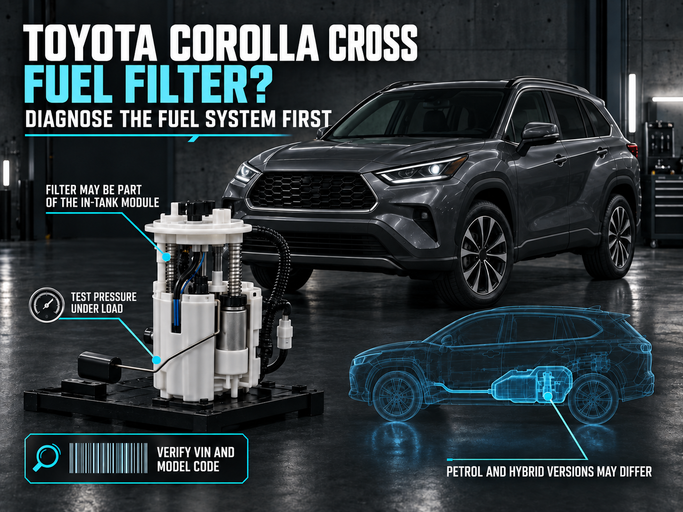
There is no single Toyota Corolla Cross fuel-filter replacement interval that applies to every vehicle carrying the name. The arrangement varies with powertrain, model code and destination market: the filtration section may be built into the in-tank module rather than scheduled as a separate service item. Identify the vehicle by VIN before consulting the plan for its exact version. If service history is missing, use fuel condition, pressure, delivery and pump-supply tests to decide whether opening the module is justified.
Signs of a Clogged Fuel Filter on a Toyota Corolla Cross
Loaded filter media reduces delivery reserve, but its symptoms are not unique. A weak pump, voltage loss, an intake leak, injectors, ignition faults or hybrid-control issues can create similar behaviour. The filter becomes a credible suspect only when the deviation can be reproduced and several measurements point to restricted fuel supply.
● There is a pause when accelerating after gentle driving. The system may hold its target at low demand and then fall behind as the vehicle joins a faster road or climbs a grade.
● The petrol engine takes longer than expected to start. On a hybrid, first confirm that the control system actually requested engine operation, then assess pressure build-up and retention, the check valve, injectors and auxiliary battery supply.
● The vehicle begins to hesitate or show a warning soon after a fill-up. Water and fine sediment can load the filter layer quickly, so take a fuel sample and inspect the tank before ordering parts.
● Pump noise becomes stronger at a low fuel level or after heat builds. Filter resistance is one possibility, but overheating, motor wear and a poor connection can do the same. Compare sound with current, voltage and pressure.
● Performance drops only in hot weather or near the end of a long journey. A temperature-sensitive pump fault can produce this pattern as well. Record fuel level, driving time and the exact moment the deviation begins.
On the Corolla Cross Hybrid, electric assistance can soften a small fuel-delivery shortfall during launch and light-load driving. A short urban trip may therefore fail to reproduce the complaint. Plan the test so the petrol engine operates long enough under a comparable load.
Why a Hybrid Corolla Cross Can Mask Early Symptoms
The hybrid system continually changes the work split between the electric motor and petrol engine. With sufficient traction-battery charge, the driver may not notice that the engine has less delivery reserve. During a sustained climb, higher speed or lower battery charge, the engine carries more load and the restriction becomes easier to detect.
Record the engine-start request, load, fuel trims, pump command and actual pressure together. If the hesitation appears after warm-up, compare the electrical and hydraulic values cold and hot. This separates loaded media from a pump that loses output as temperature rises.
What Happens If You Do Not Replace the Fuel Filter on a Toyota Corolla Cross?
As contamination accumulates, the system loses operating margin. The vehicle may still feel normal in gentle use yet fail to maintain delivery during sustained power demand. Pump workload rises at the same time. Replacement without diagnosis, however, will not correct a poor ground, a damaged connector, a faulty regulator or debris left in the tank.
- Available flow decreases. Pressure can look acceptable in a stationary test and then fall during acceleration or a long climb.
- Fuel trims move farther from normal. The control unit compensates until its useful range is exceeded and may then store a fault. Interpret it with freeze-frame data, intake checks and measured pressure.
- Pump current and heat can rise. Flow resistance makes the motor work harder, while normal wear further reduces its output.
- Unstable tank supply affects the next circuit. Where a separate high-pressure stage is fitted, shortage at its inlet can imitate failure of the more expensive engine-mounted component.
- Severe restriction can cause sudden power loss, engine shutdown or a no-start condition. On a hybrid, warnings and reduced-power operation may also appear; preserve the data before clearing memory.
Which Fuel Filter Does Toyota Recommend for a Toyota Corolla Cross?
According to the information presented on toyota.ae, the 2026 UAE Corolla Cross Hybrid uses a 1.8-litre hybrid powertrain and e-CVT. This information does not define the filter used by conventional petrol versions, other model years or different markets. Toyota identifies the component for the exact variant, so confirm the VIN, model code, engine and module contents before ordering. There is no universal filter or common interval for every Corolla Cross.
| Parameter | 2026 Corolla Cross Hybrid on toyota.ae | Other Corolla Cross versions |
|---|---|---|
| Powertrain | 1.8-litre hybrid; e-CVT. | Confirm the engine, system type and market by VIN. |
| Module contents | Establish from the exact variant catalogue. | Do not transfer construction between versions or years. |
| Service timing | Use the plan for the individual vehicle. | Do not assign one mileage figure without confirmation. |
| Diagnosis | Test with the petrol engine under repeatable load. | Account for injection type and pump control. |
| Part selection | VIN, model code and package contents. | A generic 'for Corolla Cross' description is insufficient. |
Why Current Hybrid Specifications Do Not Apply to Every Corolla Cross
A current specification describes only the vehicle offered in one market today. It does not establish the module used by a conventional petrol version, an earlier model year or a vehicle imported from another country. Similar bodywork and engine capacity do not prove that the pump, filter, connector or maintenance requirement is the same.
Scheduled work must come from documentation for the exact variant. An inspection entry is not automatically a replacement instruction, while the absence of a separate line does not make the filter immune to water and sediment. Unscheduled module access is justified by a measured restriction, discovered contamination or repair of the assembly itself.
Before dismantling, preserve loaded pressure, residual pressure, pump voltage and current, and fuel-trim values. Repeat the test in comparable conditions after assembly. The comparison shows whether the cause has been removed rather than whether the complaint happened to disappear during one short drive.
How to Choose a Fuel Filter for a Toyota Corolla Cross
Part selection requires the VIN, model code, engine designation, model year and destination market. Similar-looking Corolla Cross vehicles can use different pumps, controllers, level senders, flanges and package contents. A generic 'fits Corolla Cross' claim does not establish compatibility.
● Identify the powertrain. Conventional petrol and hybrid versions may use different modules, pump capacity and control strategies.
● Confirm the catalogue package. The inlet strainer, filter housing, pump, regulator, level sender and seal may be supplied separately or as one module.
● Match references and connectors. A similar shape does not confirm outlet direction, terminal count, sender range or designed delivery.
● Prepare a new seal and specified single-use items. A previously compressed ring can cause fuel odour, leakage and repeat removal.
● Order the assembly after testing. Loaded pressure, pump supply and current, pressure retention and fuel condition separate restriction from an electrical fault.
Clogged Fuel Filter and Toyota Corolla Cross Engine Problems
Reliable diagnosis begins with the complaint conditions. Record fuel level, temperature, hybrid-system state, petrol-engine engagement and the most recent refuelling. Review hydraulic readings, pump electrical behaviour and control data as one set. One lean-mixture code or a noise from the tank is not enough to justify replacement.
| Observation | Possible filter connection | Other checks | First action |
|---|---|---|---|
| Hesitation on acceleration | Flow falls short as demand rises. | Intake, ignition, high-pressure stage and hybrid strategy. | Record pressure under load. |
| Delayed engine start | Pressure builds slowly. | Start request, valve, injectors and supply. | Confirm that engine operation was commanded. |
| Hum after warm-up | Restriction increases pump workload. | Fuel level, temperature, voltage and current. | Compare cold and hot values. |
| Fault after refuelling | Water or sediment may have loaded the filter. | Tank, lines and injectors. | Take a fuel sample. |
| Lean-mixture code | Poor delivery is one possible cause. | Air leaks, sensors and exhaust. | Preserve freeze-frame data and test pressure. |
Checks to Complete Before Replacement
☐ Establish the exact variant. Record the VIN, model code, engine, powertrain type and destination market; model year alone is insufficient.
☐ Review previous work. Find why the tank was last opened, the part references used, the seal fitted and any record of contaminated fuel.
☐ Preserve codes and freeze frames. Engine speed, load, temperature, fuel trims and hybrid-system state are needed to reproduce the deviation.
☐ Assess fuel quality. A sample can reveal water and sediment; clean affected areas before installing the new component.
☐ Measure pressure when the complaint occurs. A stationary check or a test without petrol-engine operation can miss the drop during acceleration.
☐ Compare pump supply, current and delivery. A poor ground, terminal resistance or incorrect command can imitate a restricted filter.
☐ Test pressure retention. Rapid decay after shutdown may involve a check valve, regulator or injector.
☐ Prepare a safe work area. Relieve pressure by the specified method, remove ignition sources, provide ventilation and switch the hybrid system fully off.
☐ Verify the result after repair. Repeat the original operating state and confirm that pressure, current and fuel trims have genuinely returned to normal.
Common Toyota Corolla Cross Fuel Filter Service Mistakes
● Assigning one interval to every Corolla Cross. Powertrains, model years and destination markets can use different operations and module contents.
● Treating infrequent petrol-engine operation as evidence of blockage. Hybrid control strategy determines when the engine starts.
● Buying a component from a photograph. Visual similarity does not confirm the connector, regulator, level sender or delivery capacity.
● Treating the inlet strainer as the fine-filter section. Work on the strainer alone does not cover the module's remaining filtration elements.
● Starting with the high-pressure pump without evaluating tank delivery. Insufficient low-side supply can produce comparable downstream behaviour.
● Attempting to clean disposable media with solvent or compressed air. Either method can deform the material without restoring its specified performance.
● Leaving water and sediment inside the tank. Fresh media will become contaminated again, allowing the complaint to reappear.
Confirm the Toyota Corolla Cross maintenance requirement and fuel-module contents by VIN, powertrain, model year and destination market. If the history is unavailable, start with a fuel sample, loaded pressure and the pump's electrical values. Current listings illustrate the differences among petrol and hybrid Corolla Cross vehicles of different years, while part compatibility still depends on the catalogue for the individual vehicle.


