


Does a Toyota Corolla Cross Need Rear Differential Oil Changes?
Toyota Corolla Cross
Toyota Corolla Cross•
•47 views
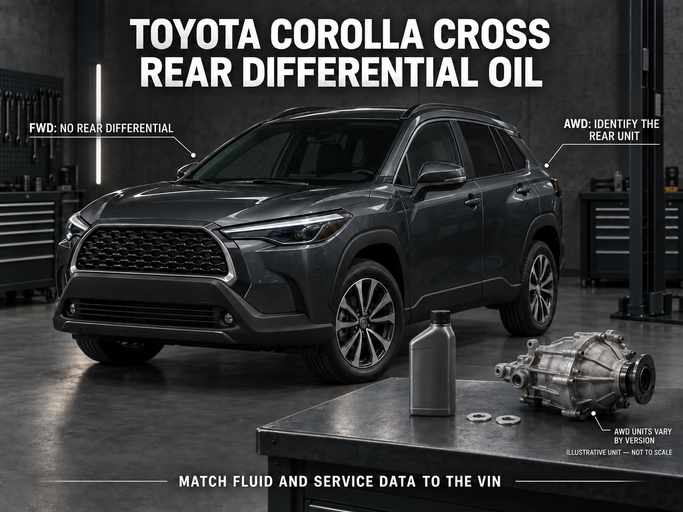
A front-wheel-drive Toyota Corolla Cross has no separate rear differential, so there is no rear differential oil to replace. For an all-wheel-drive vehicle, the answer depends on its rear unit and the maintenance schedule for that configuration. Petrol AWD with a mechanical driveline and hybrid AWD with a rear electric motor need different service information. Identify the drivetrain from the VIN and factory equipment data before choosing the operation.
How Do You Identify the Rear Drive in a Toyota Corolla Cross?
According to toyota.ae, the UAE Corolla Cross Hybrid 2026 has a 1.8-litre hybrid powertrain. The word Hybrid alone, however, does not establish that all four wheels are driven. When buying or servicing a vehicle, check its drive layout separately from its engine and hybrid-system description.
FWD means front-wheel drive; AWD means all-wheel drive. On an FWD car, no driven rear half-shafts run from a differential to the wheel hubs. Mechanical AWD has a longitudinal propeller shaft, while electric hybrid AWD uses a separate motor at the rear. The absence of a propeller shaft therefore does not, by itself, prove that the car is FWD.
☐ Match the VIN and complete model code to the factory equipment record.
☐ Confirm the model year, original sales market and petrol or hybrid powertrain.
☐ On a lift, identify the rear half-shafts, drive housing and how torque reaches the unit.
☐ Make sure the workshop estimate describes a component that is actually fitted.
Why a Hybrid Does Not Necessarily Have a Rear Differential
A front-wheel-drive hybrid delivers electric propulsion through its front drivetrain. A traction battery, an EV mode and two energy sources do not make the rear wheels driven. The front differential is incorporated into the transmission assembly; fluid work there must not be recorded as rear differential service.
When Should Corolla Cross AWD Fluid Be Checked or Replaced?
Use the maintenance schedule that matches the AWD vehicle’s year, market and assembly. An instruction to inspect is not an instruction to replace: checking for leaks, measuring the level and draining fluid are separate operations. A schedule bearing the same model name but covering another drivetrain cannot establish the correct interval.
In hot, dusty conditions, underbody inspection is a useful part of routine maintenance. Driving through floodwater or striking the underside calls for a separate assessment. If a workshop proposes a shorter interval, the reason should be recorded clearly, together with whether it is a factory requirement or preventive advice for the vehicle’s use.
- Fresh leakage appears. Establish the source first: residue on a shield may have travelled from a housing above it.
- A new hum or vibration develops. Record how it changes with speed and load, then investigate the drivetrain and running gear.
- The vehicle has passed through deep water. Inspect the housing, seals and any fitted breather, and assess the possibility of fluid contamination.
- An AWD or hybrid-system warning appears. Read fault codes and diagnose the conditions under which they were stored.
- Service history is missing. Establish what fluid was used, check sealing and decide on further work after the unit has been identified.
A confirmed low fluid level, loud metallic noise or housing damage warrants stopping the journey and assessing safe transport. Topping up does not repair a leak, and replacing lubricant cannot restore damaged bearings or gear teeth.
Which Oil Is Correct for a Corolla Cross Rear Unit?
Start with the assembly designation. Confirm the complete fluid specification, level-setting method, service-fill quantity and plug-sealing requirements. Fluid colour, a suitable-for-Toyota label or one matching viscosity number does not establish compatibility.
| Version | Rear hardware | How to determine service needs |
|---|---|---|
| Corolla Cross FWD | No driven rear final drive | No rear driveline oil is required. Front transmission fluid is a separate service. |
| Petrol Corolla Cross AWD | Mechanical rear differential | Select the specification and service-fill quantity by unit code; treat the transfer assembly separately. |
| Corolla Cross Hybrid AWD | Electric drive module with reduction gearing | Confirm the requirements of the rear module itself; do not assume it takes hypoid gear oil. |
| Unconfirmed drive type or history | Layout not yet established | Identify the equipment and obtain the applicable procedure before draining anything. |
Fluid Selection Mistakes to Avoid
In a petrol mechanical AWD layout, the rear differential and the front power-transfer unit occupy different housings. Even where the same product is approved for both, filling one does not service the other. On a hybrid AWD vehicle, identify the rear electric module independently of the front hybrid transaxle.
- Choosing fluid by the model name while overlooking the rear-unit code.
- Applying a petrol AWD capacity or specification to a hybrid version.
- Treating the container size as the required fill quantity.
- Adding a noise-reduction treatment without confirmed manufacturer approval.
Checks Before Draining and After Refilling
Begin only when the service procedure has been confirmed. Access to a hybrid rear module must account for high-voltage precautions; casually disconnecting orange cables is not part of a routine fluid change.
☐ Position the vehicle level and arrange safe access to the correct housing.
☐ Confirm that the fill plug can be loosened before opening the drain.
☐ Prepare the specified fluid, sealing parts and tightening-torque information.
☐ Inspect drained fluid for water and large metal particles; investigate suspicious debris.
☐ Set the level using the prescribed method, clean the housing and check for leakage.
☐ Record the date, mileage, product and operation, then assess the vehicle on a road test.
When comparing used Corolla Cross vehicles, current listings help reveal the available versions and model years. At the inspection, match the stated drive type to the VIN and the hardware under the rear of the car.
Why Does a Corolla Cross Hum at the Rear, and Is Oil the Cause?
The apparent location of a sound can be misleading. Tyre noise travels through the floor, and a wheel bearing may sound like a final drive. An FWD car has no rear transmission assembly at all, making a proposed oil change there an unsuitable starting point.
| Possible source | What to notice | Initial inspection |
|---|---|---|
| Tyres | Hum changes with road surface; tread wear is uneven | Pressure, tread condition, balance and alignment. |
| Wheel bearing | Speed-related noise that may change in bends | Localise the noise and check rotation; no measurable play does not exclude wear. |
| Brakes | Scraping, one hot wheel or a change when braking | Free movement, pad condition and shield clearance. |
| Mechanical AWD rear differential | Whine under power or on coast; fluid traces | Sealing, level, bearings and gear contact after excluding tyres and hubs. |
| Electric AWD rear module | Noise varies with operation or fault codes appear | Codes, drive operating data, mounts and unit condition. |
| Mounts and nearby components | Rattle after impact or repair; resonance in a narrow range | Supports, undertrays, exhaust and signs of contact. |
Separating Drivetrain Noise from Running-Gear Faults
Use a safe road-test route and note changes during acceleration, steady-speed driving and throttle release. Record the effects of road surface and gentle turns separately. No single observation proves that the differential has failed.
On hybrid AWD, scan data can help correlate the sound with rear-motor operation. An absence of drive torque does not rule out a mechanical noise inside the rear module: parts connected to the wheels may still be rotating. Investigate tyres, hubs and the reduction unit methodically instead of eliminating a component from one reading.
When symptoms begin after a fluid change, first verify the actual product used, the level-setting procedure and plug sealing. A whine that has grown steadily needs an assessment of the assembly’s condition. Replacing a healthy unit before locating the noise is no more useful than repeatedly changing the oil in a damaged one.
Conclusion
A front-wheel-drive Corolla Cross has no rear differential. On AWD versions, rear-unit construction and the documentation for the exact vehicle determine its service needs. VIN identification, correct fluid and proper leak and noise diagnosis are more useful than an interval selected solely from the model name.


