


How Often Should You Change the Automatic Transmission Fluid in a Toyota Camry?
Toyota Camry
Toyota Camry•
•117 views
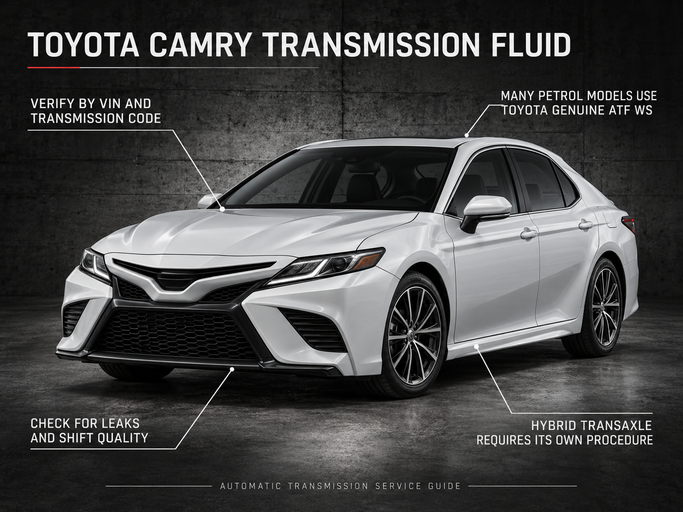
The correct transmission-fluid service point for a Toyota Camry depends on its generation, powertrain, transmission code, and operating conditions. The manual for the exact model year identifies the fluid and level-setting procedure. Data for a six-speed Camry should not be copied to an eight-speed version, while a hybrid transaxle is serviced differently from a conventional hydraulic automatic.
ATF is the working fluid in a conventional automatic transmission. It supplies hydraulic pressure, lubricates loaded components, carries heat away, and controls clutch engagement.
5 Signs Your Toyota Camry ATF Needs Inspection
In urban use, a Camry can spend considerable time in slow traffic and at idle. High ambient temperature, short journeys, and repeated acceleration add heat without adding much mileage. Each sign below calls for diagnosis, but none proves on its own that the fluid is worn out.
- D or R engages after a noticeable pause. If the delay repeats with the transmission warm, check the ATF level, leaks, hydraulic pressure, and stored faults.
- Shifts become abrupt. Identify the affected gears and whether the jolt changes with temperature. Adaptations, solenoids, the valve body, and engine mounts can create similar behavior.
- Oily traces appear on the undertray or near the pan. Inspect plugs, seals, case joints, and the cooling circuit. Repair the leak first, then set the level within the factory temperature window.
- A hot odor develops after congestion or a long climb. A sharp smell accompanied by slip, vibration, or altered shift logic requires lower load and vehicle inspection.
- A warning appears on the instrument panel. Restricted gear selection or fail-safe mode should not be handled by simply clearing codes; save diagnostic trouble codes and freeze-frame data first.
Why One Jolt Does Not Automatically Mean the ATF Is Old
A single harsh shift after battery disconnection, a cold start, or rapid accelerator input may be related to control adaptation. Compare operation at different temperatures and inspect mounts, drive shafts, and electronic data. New fluid cannot repair a mechanical or electrical fault.
What Happens When Camry Transmission Service Is Delayed?
In a hydraulic automatic, ATF transfers pressure, lubricates components, and removes heat. Overheating, contamination, or an incorrect level therefore affects several functions together.
- Resistance to heat declines. A depleted additive package controls oxidation less effectively, allowing deposits to form faster.
- Hydraulic circuit timing changes. Contamination in valves and passages can delay clutch application or make it more abrupt.
- Clutch slip lasts longer. The more time the clutch packs spend matching speed, the more heat they generate inside the transmission.
- Lubrication and delivery deteriorate. Low level, foaming, or restricted flow increases stress on the pump and bearings.
- Repair costs rise. Metal debris, persistent slip, and fail-safe operation may indicate internal damage that fluid replacement alone cannot correct.
How to Determine the ATF Inspection and Replacement Interval
Camry generations do not share one interval that can be applied without verification. Identify the model year, engine, drive type, and transmission code, then check mileage- and time-based operations in the Service book. An instruction to inspect should not be interpreted as mandatory replacement.
| Parameter | Reference for GUN125/GUN126 | When to inspect earlier |
|---|---|---|
| First ATF replacement | 80,000 km | After overheating, a leak, or changed shift behavior |
| Later replacements | Every 80,000 km | With frequent towing or heavy payload use |
| High-load operation | Does not replace the factory schedule | Low-speed work, sand, a trailer, constant payload |
| Fluid type | Toyota Genuine ATF WS | Confirm by VIN and transmission code |
| Level check | Procedure for the specific transmission | Vehicle level and fluid at the specified temperature |
For normal operation, follow the schedule for the exact variant. If maintenance history is unknown, begin with diagnostics, leak inspection, and fluid assessment instead of assigning an arbitrary interval.
When to Inspect the Transmission Earlier
- Frequent short journeys. The fluid repeatedly heats and cools, while the transmission rarely remains at a stable operating temperature for long.
- Extended congestion. Low road speed and repeated starts add thermal load even though the odometer increases slowly.
- Regular operation with a full load. Passengers and luggage increase acceleration demand, so assess the transmission earlier when this use is routine.
- Signs of overheating or leakage. Odor, a warning, fluid traces, or changed shift behavior justify an unscheduled inspection regardless of mileage.
Which Fluid Should Be Used in a Camry Automatic Transmission?
Many recent petrol Camry models with six- and eight-speed automatic transmissions use Toyota Genuine ATF WS. Before purchase, however, verify the VIN, transmission code, and vehicle documentation because the Camry name does not guarantee the same transmission.
A hybrid Camry must not be serviced by the procedure for a conventional automatic. Its transaxle does not use a conventional torque converter and shift-clutch arrangement, so drain points, level checks, and the service sequence require separate confirmation.
Why Total Capacity Is Not the Drain-and-Fill Quantity
Only part of the ATF exits through the drain plug; fluid remains in the torque converter, passages, and heat exchanger. Determine the refill quantity from the measured drain and factory level-setting procedure. Adding the published total capacity after a partial drain would overfill the unit.
Why Can a Camry Shift More Harshly on Aged ATF?
Heat and oxidation can alter hydraulic and clutch behavior. Similar jolts may also result from valve-body contamination, a faulty solenoid, worn mounts, drive-shaft play, or incorrect adaptations. Establish the cause from the complete symptom pattern and diagnostic data.
| Problem | What changes | What the driver notices |
| Overheating | ATF oxidizes faster and removes less heat. | Odor, altered shifts, warning indication. |
| Low level | The pump draws air and pressure fluctuates. | Delayed D/R, noise, slipping. |
| Excess ATF | The fluid foams and transmits pressure poorly. | Irregular operation, breather discharge, leaks. |
| Deposits | Particles interfere with valves and solenoids. | Jolts, delays, transmission codes. |
| Incorrect fluid | Friction properties do not match calibration. | Vibration, harsh shifts, accelerated wear. |
| Mechanical wear | Clutches, pump, or torque converter are damaged. | Persistent slipping, debris, fail-safe mode. |
Practical Checklist Before Service
- Identify the exact variant. Record the VIN, model year, engine, drive type, and transmission code; note separately whether the car is a hybrid.
- Reconstruct the history. Record the date, mileage, fluid product, and method used at the previous service when the information is available.
- Scan before clearing data. Save fault codes and freeze-frame information before disconnecting the battery or resetting adaptations.
- Inspect the transmission. Check the pan, plugs, seals, and heat exchanger; repair leakage before the final level adjustment.
- Select materials by VIN. Choose fluid, gaskets, seals, and the filter element for the exact transmission rather than the model name alone.
- Verify the result. Confirm there are no leaks or warnings, then assess D and R engagement and shift quality with the unit cold and warm.
When assessing a used vehicle, compare transmission information with the VIN and documents, then verify its condition through diagnostics.
Mistakes to Avoid
- Applying one interval to every Camry. Generation, engine, market, and transmission type change the service requirements.
- Choosing ATF by color alone. Fluid appearance does not establish the required specification or compatibility.
- Adding the total reference capacity after a normal drain. This creates a risk of overfill, foaming, and poor hydraulic operation.
- Treating fluid replacement as a cure for every jolt. The fault may be in the electronics, mounts, drive shafts, or valve body.
- Using a machine exchange without diagnosis. With unknown history, assess the transmission, pan, and wear material first.
Conclusion
For a Toyota Camry, determine the correct interval from its generation and exact transmission, and inspect earlier under demanding urban use. Many petrol versions use Toyota Genuine ATF WS, but the specification, refill amount, and procedure must be confirmed by VIN. Current offers can help compare suitable cars before purchase, but listing data does not replace transmission inspection.


