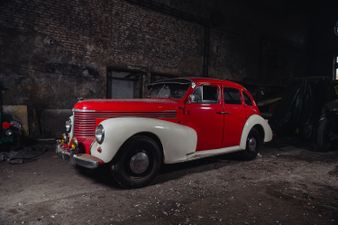
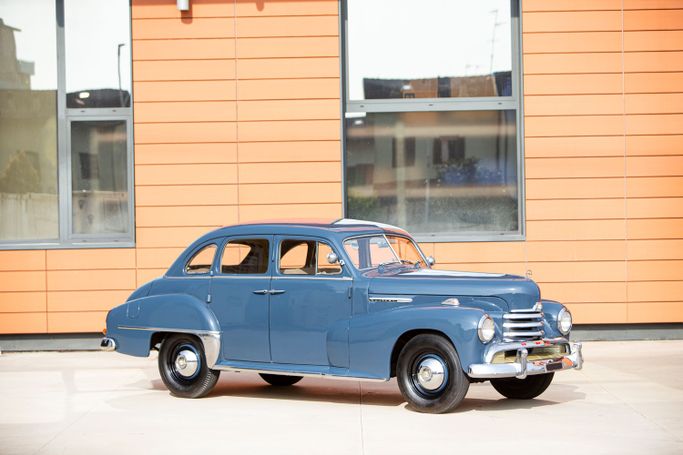
Opel Kapitän Saloon, 1952
Opel Kapitan
Opel Kapitan•
•29 views
Chassis No.: 29158
Engine No.: 10374
Estimate: €20,000 - €25,000 EUR
- Only two registered owners since 1991
- Attractive colour combination
- Rarely seen six-cylinder Opel
- Beautifully presented
- Solo due proprietari dal 1991
- Colore stupendo
- Raro modello opel a sei cilindri
Son of a locksmith, Adam Opel chose to leave the family firm in 1863, setting himself up as a manufacturer of sewing machines in his hometown of Rüsselsheim near Frankfurt, Germany. The enterprise grew rapidly. In the mid-1880s Opel diversified into bicycle making and by 1895, when its founder died, had become one of Europe's largest manufacturing concerns. It was to be expected that its next move would be into motor manufacturing but Opel's first such venture was an uncharacteristic failure. Now managed jointly by Adam's five sons, Opel acquired the rights to a design by Friedrich Lutzmann and produced its first automobile in 1898. However, by this time the horizontal-engined Opel-Lutzman was somewhat dated and production ceased after only two years.
Opel next turned to the motorcycle market, a line of business that it would carry on until 1932, and revived its motor manufacturing plans in 1902, acquiring the rights to distribute Darracqs in Germany and Austro-Hungary. The cars were imported in chassis form, bodied by Opel and sold under the 'Opel-Darracq' name. Opel soon began developing its own Darracq-based designs and by 1906 had acquired sufficient expertise of its own to severe its links with the French make.


After WWI, during which time it had built trucks and BMW aero engines under licence, Opel succeeded in weathering the financial uncertainties of the early 1920s although output remained low. Updating its Rüsselsheim factory to accommodate a Ford-type moving assembly line, Opel ditched its existing range of models to concentrate on just one design, which was a blatant copy of the successful Citroën 5CV. Known as the Laubfrosch (treefrog) because of its green livery, this new light car first appeared in the spring of 1924, setting Opel on a road to success that would see it established as Germany's largest auto maker by the end of the decade.
In 1929, American giant General Motors, seeking to further expand its European interests, acquired a controlling stake in Opel, which was followed by full ownership in 1931. Under General Motors' direction, Opel prospered and by 1938 was not only Germany's but also Europe's biggest motor manufacturer. The firm benefited from technical innovations first applied to GM's US-built products, including 'knee action' independent front suspension and, in the form of the 'Olympia' model of 1936, unitary construction of the chassis/body. As the decade progressed, Opels began to look more and more like their American cousins, a trend that culminated in the firm's final pre-war offering, the Kapitän.


Introduced in 1939 and of unitary construction like the Olympia, the Kapitän was powered by a 2.5-litre overhead-valve six and featured independent front suspension which was augmented by an anti-roll bar, a novel idea at that time.
The Kapitän that re-emerged when civilian production recommenced in 1948 was based on the 1939 version, differing only in a few minor ways, and the model remained in this form until 1953. Its replacement was mechanically very similar while featuring more modern styling along American lines and the inevitable acres of chromium plate. Up to July 1953, when it was replaced, Opel had built a little over 48,500 of this series; survivors, though, are relatively few and much less numerous than those of the equivalent Mercedes.


First registered in Italy in 1991, this is a beautifully presented example of the Opel Kapitän, which evidently had been restored to a very good standard at some point and very well looked after since. Attractively finished in mid blue with a grey cloth interior, these six cylinder Opels are a rare sight nowadays and this example is certainly worthy of the closest inspection.
With only two registered owners in Italy since 1991 and in the vendor's exclusive private collection since 2013, it is being offered with Italian registration documents, and ASI homologation (dated 1989).


Please note that these lot will require an Export License to be exported out of Italy.