Buying a car in the UAE: where to find one, how to get a good deal, and how to avoid hidden pitfalls. The complete guide, from the search to registration in Russia
Nissan Patrol VI (Y62) Facelift
Nissan Patrol VI (Y62) Facelift•
•770 views
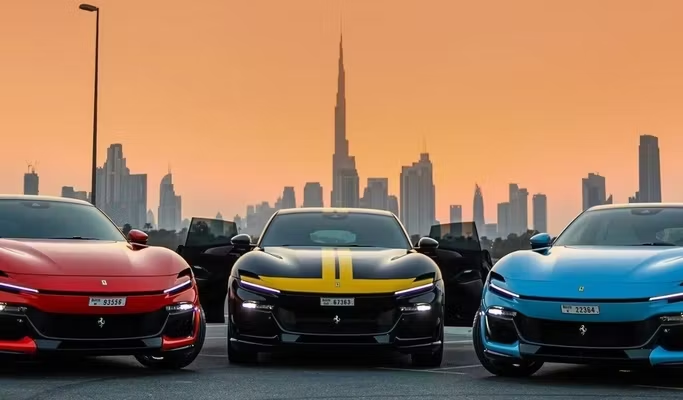
Imagine scrolling through your feed and seeing an ad for a “fresh” Nissan Patrol with air conditioning that actually blows ice-cold, or a top-spec Toyota Land Cruiser “for hot countries” at a price comparable to a Russian Kia Rio. Tempting? Very.
Going to the UAE to buy a car is no longer something reserved for a select few—it’s a perfectly viable option. Hundreds of cars from Dubai and Sharjah are shipped to Russia and CIS countries every year. But there’s a catch: the UAE car market is a real “Wild West” for the unprepared. People haggle like they’re at a market in Deira, odometers are rolled back even on expensive SUVs, and wrecked “Americans” can look brand-new on the outside.
However, if you’re reading this guide, consider yourself prepared. We’ll take you from the first thought of “I want one” to the moment you get behind the wheel of your car in Russia. We’ll explain where to look, how to avoid buying a cobbled-together car, and what customs clearance will really cost.
The UAE car market: understanding the rules and the players
Before we start Googling car-market addresses in Dubai, let’s figure out who you’ll be dealing with and what kind of car you’re most likely to be offered.
The UAE market is unique. It’s a huge transit hub. Everything is for sale here: from cars imported from the US after insurance auctions to “clean” local vehicles with a full service history from an authorized dealer.
Where the car comes from: GCC, American, or European
The first thing any seller in Ras Al Khor will tell you is:
Here’s what that actually means:
- GCC specification (Gulf Cooperation Council). This is the gold standard in the UAE. These cars were originally made for the markets of Saudi Arabia, the UAE, Kuwait, and Qatar. Their main advantages are an upgraded cooling system (the A/C condenser is generally more powerful than in European versions) and protection from sand and dust. The downside: winter features such as heated mirrors or seats are extremely rare because they simply aren’t needed. Parts for GCC-spec cars are available at any auto-parts store in the Emirates.
- American specification (USA spec). It’s a lottery. 99% of these cars arrive in the UAE after insurance auctions (Copart, IAAI). They’re usually wrecked (front-end collisions, flood damage after hurricanes) or stolen (with clean paperwork but a problematic history in the US). If you see a recent Mercedes or Lexus in Dubai priced 30% below market, you’re looking at an “American.” To avoid buying a car cobbled together from two halves, a body-geometry inspection is essential.
- European/Japanese specification. Rare finds. Most are private imports brought in for personal use. The advantage: generous features (heated components, LED lights). The downside: parts may be hard to find, and the A/C may not work as efficiently at +40°C.
Types of sellers: who should you pay?
GCC specification (Gulf Cooperation Council). This is the gold standard in the UAE. These cars were originally made for the markets of Saudi Arabia, the UAE, Kuwait, and Qatar. Their main advantages are an upgraded cooling system (the A/C condenser is generally more powerful than in European versions) and protection from sand and dust. The downside: winter features such as heated mirrors or seats are extremely rare because they simply aren’t needed. Parts for GCC-spec cars are available at any auto-parts store in the Emirates.
American specification (USA spec). It’s a lottery. 99% of these cars arrive in the UAE after insurance auctions (Copart, IAAI). They’re usually wrecked (front-end collisions, flood damage after hurricanes) or stolen (with clean paperwork but a problematic history in the US). If you see a recent Mercedes or Lexus in Dubai priced 30% below market, you’re looking at an “American.” To avoid buying a car cobbled together from two halves, a body-geometry inspection is essential.
European/Japanese specification. Rare finds. Most are private imports brought in for personal use. The advantage: generous features (heated components, LED lights). The downside: parts may be hard to find, and the A/C may not work as efficiently at +40°C.
Types of sellers: who should you pay?

The market is clearly divided into three types of players, and 80% of your success depends on choosing the right seller.
- Showrooms (dealers/companies).
This is the safest option for first-time buyers. They’re usually located in major areas (Ras Al Khor, Dubai Auto Market), have inventory, and operate officially.
- Private sellers (buying directly from the owner).
Prices are lower, and bargaining is not only acceptable but expected. But the risks increase many times over. A private seller may be an ordinary resident selling their own car—or a dealer masquerading as one.
- Auctions (Emirates Auction, Copart).
This is for experienced buyers. Emirates Auction is a government auction where cars from the police, banks, and private owners are sold. Bidding starts low, but the final price often approaches market value. The advantages are complete transparency about the car’s history (damage photos, reports). The downsides are that you need to understand the bidding process and have a local agent (an Emirates ID is required to participate).
Where to look: top car markets and locations in Dubai and Sharjah
Simply entering “Auto Market” in your navigation app isn’t enough. Every location in the UAE has its own specialty and atmosphere. If you’re a tourist who’s flown in for a week to buy a car, you’re limited to two emirates: Dubai and Sharjah.
Dubai
1. Ras Al Khor Industrial Area This is the main hub. If you’re looking for the most comfortable place to buy a car in the UAE, this is it. There are hundreds of showrooms, from budget sedans to supercars. They’re all clustered along the streets, and there are cafés, currency exchanges, and—most importantly—workshops or service centers with vehicle lifts.
2. Dubai Auto Market (DAM) Located next to Ras Al Khor. Historically, it has had more budget-friendly options: older Camrys, Sunnys, and Mitsubishi Pajeros. If your budget is limited to 20,000–30,000 dirhams, it’s worth a visit. The facilities are a little more basic, but prices are lower too.
Sharjah
Sharjah is where people go for low prices. But first-time buyers shouldn’t go there without someone to guide them.
3. Industrial Area 6 Prices here are 20–30% lower than in Dubai. But there’s a downside: this is where you’ll find the most wrecked, repainted, and worn-out cars. They often look fresh only because they’ve been detailed. The area is out of the way, and facilities for buyers (cafés, restrooms) are limited.
4. Souq Haraj (car market) A very atmospheric place. Most of the cars sold here are “Saudi specs” (cars from Saudi Arabia). Hard bargaining is the norm, and the atmosphere is like an oriental bazaar in the best sense of the word. Be extra vigilant—check the VIN especially carefully, as cars in Saudi Arabia are often driven in harsher conditions (sand, dune jumping).
Choosing a model: which cars are the best deals in the UAE?
You already know how GCC, American, and European specifications differ. Now let’s look at the specific models and situations in which they make the most sense, so your purchase is as good a deal as possible and the car is comfortable to use after being shipped to Russia, without any surprises.
1. GCC specification
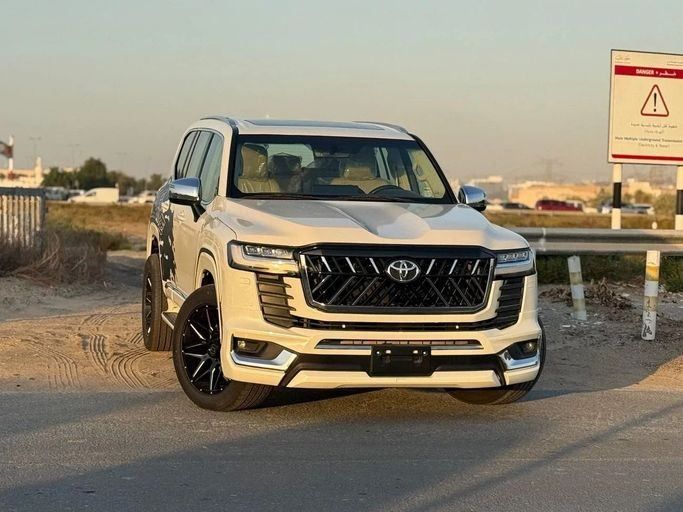
If your goal is to minimize risks and get a car that’s easy to resell in Russia or CIS countries, consider models that are valued both in the Emirates and across the post-Soviet region.
- Nissan Patrol (Y62 and Y61). The undisputed king of the local market. The Y62 with a 5.6-liter V8 is everywhere in the UAE. There are plenty of listings, so prices are competitive and the selection is huge. The Y61 (the old “boxy” Patrol) is a legend among off-road enthusiasts. One thing to note: on the Y62, check the suspension condition (the HBMC hydraulic system needs inspection) and make sure the A/C works properly—in GCC versions, it blows ice-cold air, which is normal.
- Toyota Land Cruiser (200, 300). Locally, they’re called “Al Hamra” (“the red one”)—a symbol of status and reliability. Cars with service histories from an authorized Al-Futtaim dealer are especially highly valued.
- Lexus LX / GX. A premium alternative to Toyota. The LX (especially the 570) is like a Patrol in a “suit,” with a more luxurious interior and better sound insulation. The GX (also known as the Land Cruiser Prado) is a great choice for anyone looking for a compact but powerful body-on-frame SUV. They’re often sold in excellent condition because their owners tend to be affluent and have the cars serviced strictly at dealerships.
- Ford F-150 / Raptor. GCC-spec versions of these pickups are an excellent choice for anyone who needs a powerful workhorse or a vehicle for outdoor activities. In the UAE, they’re popular for their large size, desert off-road capability, and relatively affordable parts.
2. American specification
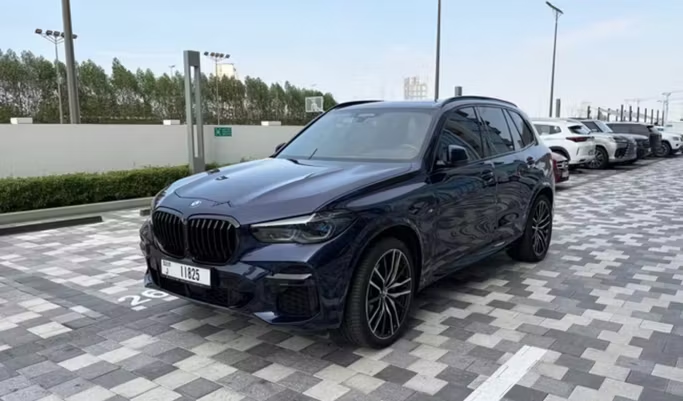
Buying an “American” car in the UAE is a deliberate risk taken to save money. To make that risk worthwhile, choose models that:
- Have inexpensive, readily available parts in Russia. For example, popular US models such as the BMW X5/X6, Mercedes GLE/GLS, Jeep Grand Cherokee, and Ford Mustang. Parts are available in any major Russian city, and the cost of repairs for hidden defects won’t be catastrophic.
- Don’t have critical design features that complicate repairs. Some models (for example, Mercedes models with air suspension or BMWs with N63 engines) require especially thorough diagnostics. If you’re not prepared for potentially expensive repairs, choose simpler versions (without air suspension and with naturally aspirated engines).
3. European/Japanese specification
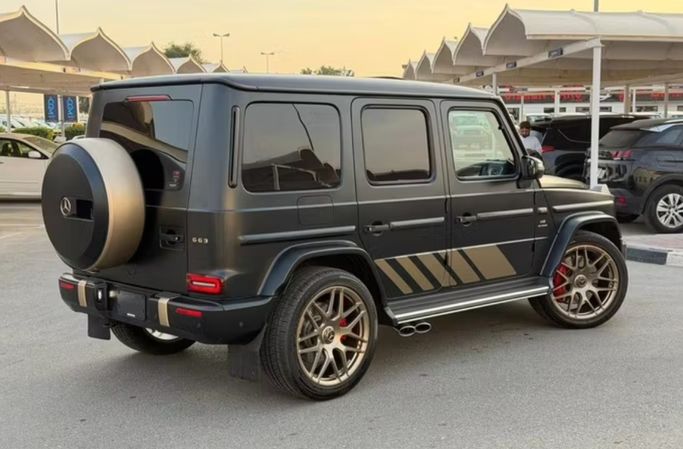
This category is for buyers willing to trade easy access to parts in the UAE for unique features and excellent condition.
When to consider these cars:
- You need a “winter package.” If you plan to drive the car in Russia, heated steering wheel, windshield and seats, as well as headlight washers, are necessities—not optional extras. European and Japanese versions have them in almost every car.
- You’re buying a rare or collectible model. For example, a Porsche 911 in a specific configuration, a limited-edition Mercedes-AMG, or a Japanese Land Cruiser with a unique interior or audio system.
- You’re prepared for a “difficult start.” You’ll need to find a service center in the UAE willing to inspect a European or Japanese car (many local shops work only on GCC and American models). Before shipping, you should also order consumables (oil, filters, brake pads) from Europe or Japan so you have them on hand after the car arrives.
Model selection summary
GCC
Best for: first-time buyers and anyone who values reliability and easy maintenance
Main risks: lack of winter features, wear from sand and heat
USA
Best for: buyers willing to take a risk to save money and familiar with body repairs
Main risks: hidden damage to the body structure, cars cobbled together from parts, cooling-system issues
EU/Japan
Best for: fans of winter features, collectors, and buyers prepared for parts-related challenges
Main risks: limited availability of parts in the UAE, difficulty getting diagnostics locally
If you’re choosing a car to export to Russia and want to minimize risks, start your search with GCC-spec cars, and focus on models that are popular in Russia too (Patrol, Land Cruiser, Lexus LX). If heated features and a rich equipment package are essential, consider European or Japanese versions, but be prepared for service-related challenges in the UAE and the need to order parts.
The legal side: how to complete the transaction correctly
Step 1. VIN check Don’t take the seller’s word for it. Ever. Download the Dubai Police or MOI UAE (Ministry of Interior) app. Enter the VIN. The system will show whether the car has been reported stolen, whether it has outstanding fines, and whether there’s a registration block (mortgage). If there’s even one outstanding debt, you won’t be able to transfer the car until the seller pays it. Step Contract and registration Step 2. Contract and registration The UAE doesn’t use the familiar three-page purchase and sale agreements we have. The process is handled through an electronic system. Mulkiya Transfer Contract. This is the official form (yellow or white) issued during the transfer.
Where to do it: at Tasjeel centers (for example, in Al Barsha or Al Awir) or Shamil.
The legal side: how to complete the transaction correctly? Step 1. VIN check Don’t take the seller’s word for it. Ever. Download the Dubai Police or MOI UAE (Ministry of Interior) app. Enter the VIN. The system will show whether the car has been reported stolen, whether it has outstanding fines, and whether there’s a registration block (mortgage). If there’s even one outstanding debt, you won’t be able to transfer the car until the seller pays it. Step Contract and registration Step 2. Contract and registration The UAE doesn’t use the familiar three-page purchase and sale agreements we have. The process is handled through an electronic system. Mulkiya Transfer Contract. This is the official form (yellow or white) issued during the transfer.
The legal side: how to complete the transaction correctly
Step 1. VIN check
Don’t take the seller’s word for it. Ever.
- Download the Dubai Police or MOI UAE (Ministry of Interior) app.
- Enter the VIN.
- The system will show whether the car has been reported stolen, whether it has outstanding fines, and whether there’s a registration block (mortgage).
If there’s even one outstanding debt, you won’t be able to transfer the car until the seller pays it.
Step 2. Contract and registration
The UAE doesn’t use the familiar three-page purchase and sale agreements we have. The process is handled through an electronic system.
- Mulkiya Transfer Contract. This is the official form (yellow or white) issued during the transfer.
- Where to do it: at Tasjeel centers (for example, in Al Barsha or Al Awir) or Shamil.
- The challenge for tourists: without an Emirates ID (residence permit), you can’t be the final buyer in the RTA system.
Step 3. Payment
The market favors cash. For large amounts (over 50,000 AED), a bank transfer is safer. Carrying a briefcase full of money around Ras Al Khor isn’t the best idea.
Step 4. Export certificate (most important!)
If your goal is to send the car to Russia, you’re buying it for export, NOT for local registration in your name.
When completing the transaction, ask for an Export Certificate instead of local registration. The plates will be removed from the car, and you’ll receive temporary export plates or the car will be marked as cleared for shipment to the port.
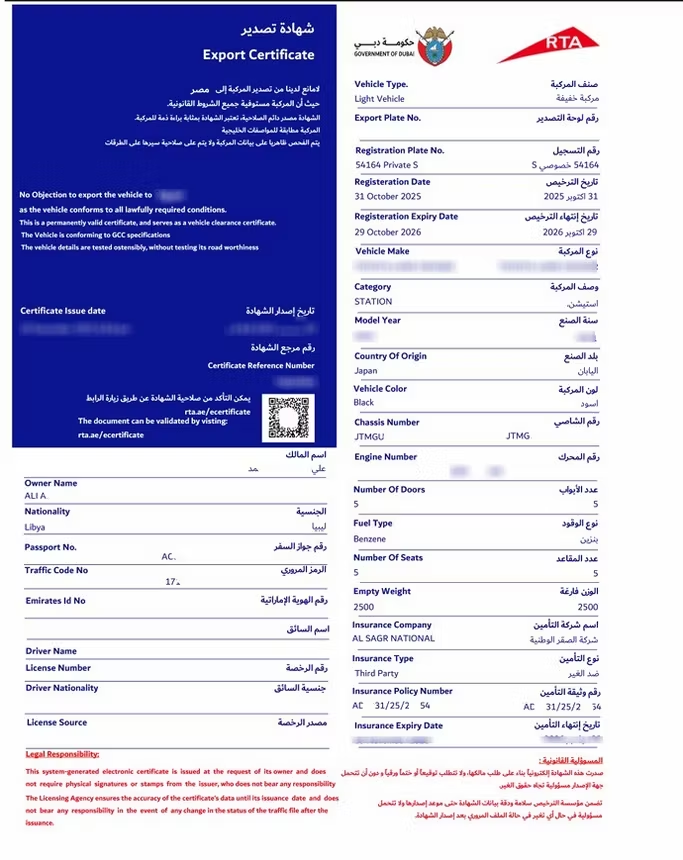
Sample Export Certificate.
Logistics: how to ship a car from the UAE to Russia
The car is bought and the documents are in hand. Now it needs to be shipped home. There are three ways to ship a car from the Emirates.
1. Container (20-foot or 40-foot)
The most popular and safest method. The car is loaded into a metal container, secured, and sealed.
- Cost: $2,500–4,000 (depends heavily on the exchange rate, port of departure, and destination—Novorossiysk or Vladivostok).
- Time: 25–45 days.
- The most cost-effective option is consolidation. If you’re buying one car rather than a whole car carrier, look for logistics companies that offer shared containers (LCL). You pay only for the space your car takes up and share the costs with other owners.
2. Ro-Ro (ferry)
The car is driven onto a ferry (car carrier ship). It’s cheaper—around $1,500–2,500.
Disadvantages: a higher risk of mechanical damage during storms (cars aren’t secured as firmly as in a container) and theft of fuel or batteries. Ferry schedules are often delayed.
3. Driving it yourself
In theory, it’s possible to drive through Saudi Arabia, Jordan, Turkey, Georgia, and Russia. In practice, it’s an extreme adventure.
Problems include difficulties obtaining transit visas for Russian citizens, the political situation in some transit countries, huge mileage (wear and tear on the car), and the risk of breakdowns without access to proper repairs along the way. Not recommended.
Where to turn: logistics companies are concentrated around Ras Al Khor and at Jebel Ali Port. They can help with the export declaration, delivering the car to the port, and cargo insurance.
Customs clearance and registration in Russia
This is the most nerve-racking stage. The car has arrived at the port (usually Novorossiysk for southern Russia or Vladivostok for the Far East). Now it needs to be legalized.
Step-by-step process
Authority No. 1: Customs
You submit a customs declaration. You’ll need:
- The original invoice from the seller (translated into Russian and notarized).
- The sales contract (the UAE export certificate).
- Your passport.
- Payment orders confirming payment of customs duties and fees.
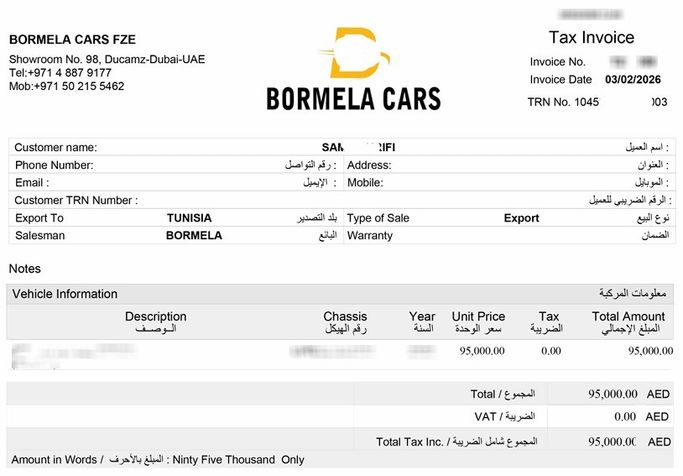
Sample invoice
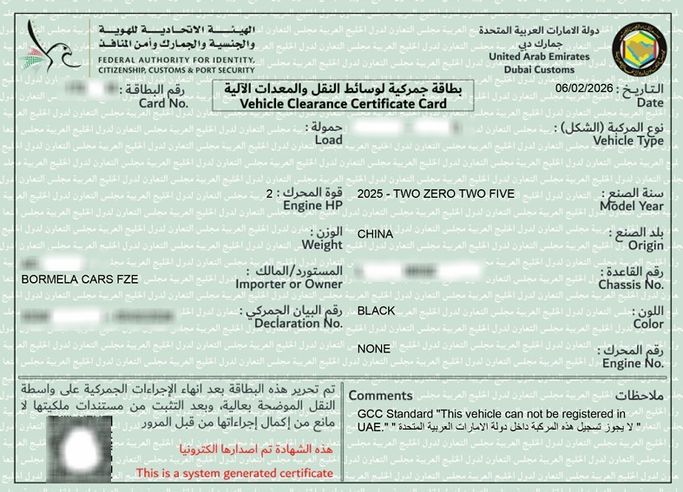
Sample vehicle customs card
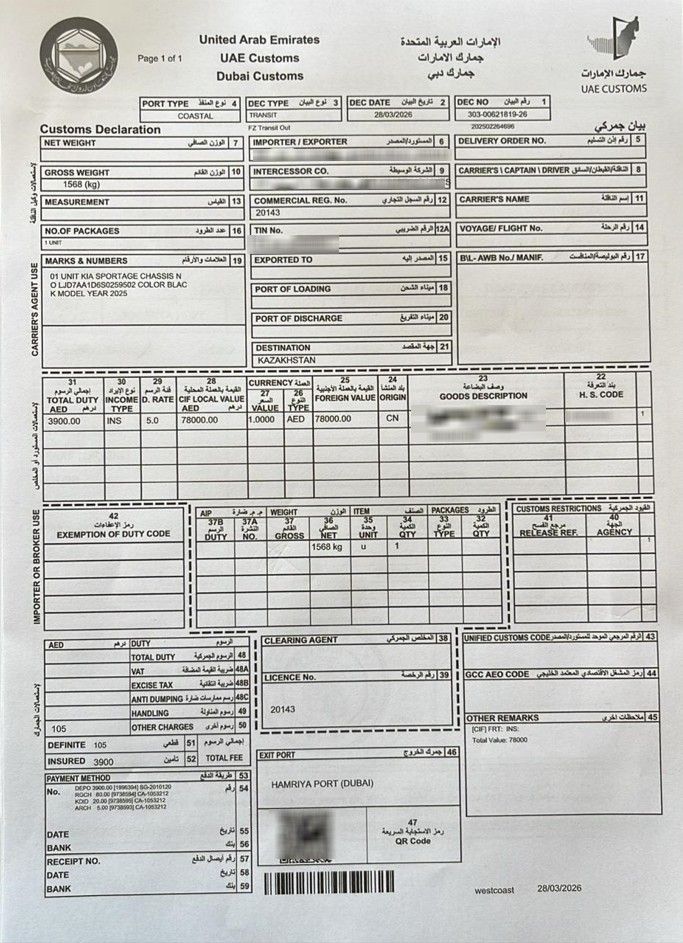
Sample bill of lading
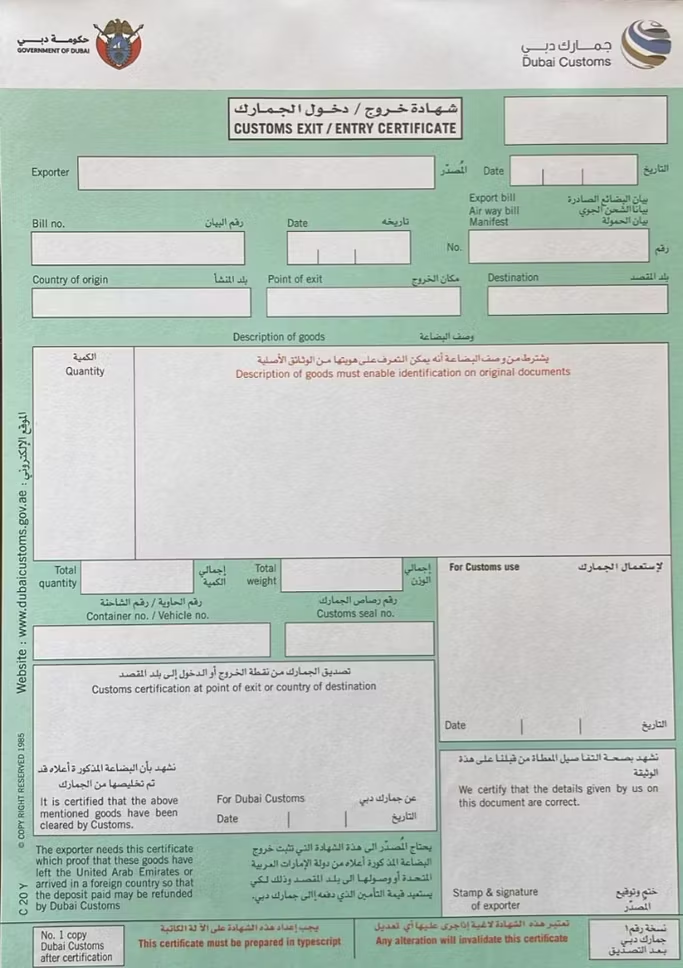
Sample official customs certificate form
What you pay:
- Customs duty. For individuals, it depends on the car’s value and engine displacement. If the car costs up to €8,500, a fixed rate applies. If it costs more, the duty is calculated as 48% of the value, but not less than €0.50 per cubic centimeter of engine displacement (it’s a complicated formula, so it’s best to use the Russian Federal Customs Service calculator on its official website).
- Recycling fee. This depends on engine displacement and the car’s age. For powerful SUVs (with engines from 3.5 to 4.5 liters), it can amount to 300,000–500,000 rubles. This is one of the largest expenses.
Authority No. 2: Testing laboratory (SBKTS)
Customs has released the car, but you still can’t drive it. You need an SBKTS (Vehicle Design Safety Certificate). The car must be taken to an accredited testing laboratory, where it will be checked for compliance with EAEU requirements (headlights, airbags, emissions class). Cars from the UAE often need their headlights replaced with “European-spec” ones (because Arabic-spec headlights have a different beam pattern). Many customs brokers offer a turnkey service and take the car to the lab and arrange the electronic vehicle passport themselves.
Authority No. 3: Traffic police
Once you have the electronic vehicle passport (EPTS), you go to the traffic police registration office (MREO).
Bring the EPTS, customs declaration (DT), compulsory motor insurance policy (OSAGO), and your passport.
The car undergoes a technical inspection (just a check of the identification numbers), and you receive your plates.
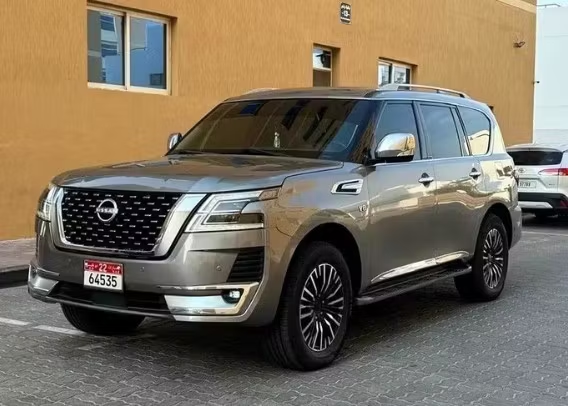
Yes, getting from an UAE car listing to Russian license plates is quite an undertaking. It takes time, patience, and a certain budget (the car itself + about $3,000 for logistics + customs clearance at roughly 30–40% of the car’s value). But the result is worth it: you get a car with a configuration that was never officially sold in Russia, a clean history, and condition that’s excellent for its age.
Let me sum it up with my own example. When I decided to take the plunge, I looked at dozens of options in Ras Al Khor, arranged three on-site inspections, and nearly bought an “American” with an attractive price but a warped body structure. In the end, I chose a 2019 Nissan Patrol Y62, GCC specification, with a 5.6-liter V8 engine (405 hp) and 78,000 km on the odometer. It had one owner, was serviced at a dealership, had ice-cold A/C, and its original suspension was in excellent condition.
Here’s how the final cost breakdown worked out (prices are rounded for clarity):
Total: approximately ₽3,850,000.
- Car price in the UAE — 95,000 AED (~₽2,400,000 at the exchange rate at the time) / Negotiated down from 105,000 AED
- Export paperwork and broker assistance — 1,500 AED (~₽38,000) / Includes the export certificate and delivery to the port
- Shipping (container, Jebel Ali → Novorossiysk) — $2,800 (~₽250,000) / Shared container, cargo insurance included
- Shipping time — 34 days / From delivery to the port to arrival in Novorossiysk
- Customs charges (duty + recycling fee) — ~₽1,100,000 / Calculated based on engine displacement using a calculator
- Federal Customs Service, SBKTS (laboratory), and broker services at the port — ₽45,000 / Includes replacement of the headlights with “European-spec” ones (the Arabic beam pattern wouldn’t have passed)
- Registration with the traffic police — ₽5,000 / Fee, license plates, and insurance
Yes, it took a long time. Almost three months passed between my first search and getting Russian plates. I had to deal with nerves while choosing a seller and waiting for the container. But now I’m driving a car that would cost around ₽5–5.5 million in Russia in this mileage and condition—and it wouldn’t even be adapted for the heat. The A/C works great at +35°C. It didn’t have heated features, so I had them installed at a local shop for ₽15,000; that was the only modification it needed at the time.
To sum up this guide: don’t rush, check the VIN in the Dubai Police app, get the car inspected on a lift, and budget an additional 35–40% of the car’s price for logistics and customs clearance. The rest comes down to patience and attention to detail.
Mileage
78,000 km
Cost
95,000 AED