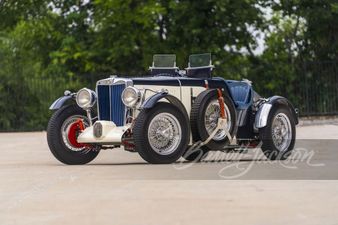
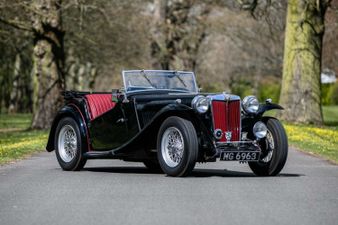
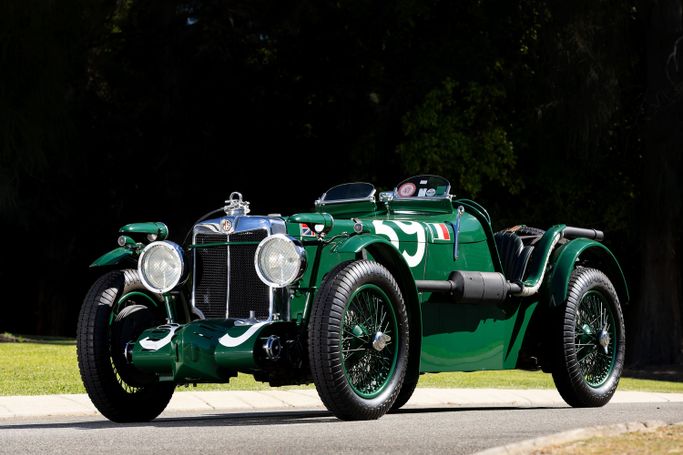
MG Magnette K3 Supercharged Sports-Racing Two-Seater, 1933
MG MGA
MG MGA•
•34 просмотра
Chassis No.: K3003 (see text)
Engine No.: R772 AC
£525,000 GBP | Sold
- Credited with use by Tazio Nuvolari, Captain George Eyston,
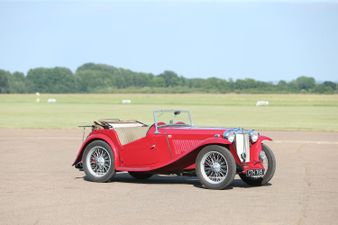
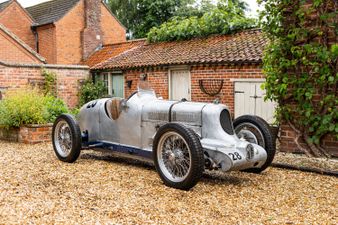
The car now known simply as a K3 by the MG fraternity is powered by a supercharged 1,087cc overhead camshaft six-cylinder engine with cross-flow cylinder head. The high-boost blower, fed by a single SU carburettor, is mounted in front of the radiator and the combination could generate in excess of 120bhp at 6500rpm in factory tune. The K3 features a four-speed ENV Wilson Pre-Selector transmission, semi-elliptic springs and live axles. This innovative gearbox enables fast gear changes on demanding road courses. The cable operated drum brakes are 13-inch magnesium with bolted-in liners. Steering is split-track operated by the unique K3 Bishop-cam steering box.
Double acting André shock absorbers are fitted, two at the front and four at the rear. The complete package marked a great step forward in British sports/racing car design and made the K3 competitive with the best small sports/racing cars of the era from France and Italy. Two prototypes (K3751 and K3752) were constructed and tested, followed by three team cars for the MG team to race in the 1933 Mille Miglia. Their chassis were numbered from 3001-3003. The car we offer here features the 'Mille Miglia' body with trademark gutter around the cabin area which was added to the design after testing a prototype in Italy.
It also has twin aero screens, dashboard-mounted Kigas to assist starting, leather bonnet straps, and spare wheel. The interior is trimmed in green leather, with a full complement of instruments. The car sits on four triple-laced wire wheels retained by knock-off spinners. Finally, it is equipped with an enormous slab-tank fuel tank with twin quick-filler caps. The first chapter in the story of the K3s is of their appearance as a team contesting the ultimate sports car racing challenge of the day, the 1933 Mille Miglia (1,000-mile) round-Italy road race. This event had been dominated by Italian marques.
The challenge to Italian supremacy was underwritten by the English aristocrat and frontline racing driver, Earl Howe, who convinced Sir William Morris that MG could create a car which would be highly competitive in this international arena. Lt. Col.
John Thornley – postwar Director and General Manager of MG – wrote of the K3 in 1950 when recollecting the race: "The members of the team, Earl Howe, Sir Henry Birkin, Captain Eyston, Bernard Rubin, Count 'Johnny' Lurani...and Hugh Hamilton...tested the prototype in Italy in January....Birkin (broke) the class record at the first control, 220 miles, by 25 minutes, then had to retire with a burnt exhaust valve...Birkin averaged 87.95mph for the 130 miles from Brescia to Bologna, and in places all three cars had exceeded 110mph. This – let us remind ourselves – was 1933; the race was 1,000 miles; the engines were less than 1.1-litres.
With Birkin out, Eyston and Lurani took the class lead and continued the headlong dash through the rest of the day and most of the following night, with Howe and Hamilton in second place. As, by shortly after half distance, both cars had overtaken all the runners in the smaller classes, the two MGs were the first cars on the course and were, in fact, the first cars to reach Brescia again and the finish.


This they did after 18 hours of the hardest possible driving, with but 90 seconds between them, having averaged 56.9 and 56.82mph respectively..." This underlines the tremendously usable character of these great little supercharged six-cylinder-engined MGs although Thornley did go on to observe that "...speeds would have been much higher had it not been for constant stops to change plugs.
Eyston and Lurani fitted 157 new sparking plugs in the course of the 1,000 miles....sufficient oil had to be fed to the (*Powerplus) supercharger to keep it happy under high-speed, full-throttle conditions, and this proved excessive on over-run...the MGs received the Team Prize (and) by the time the Italian dust settled, series production of the K3 was under way...four were entered for the JCC International Trophy (at Brooklands)...second, third and fourth places at speeds for the 260 miles in excess of 80mph...in August, Whitney Straight scored a dramatic win over a flock of single-seat Maseratis in the Coppa Acerbo at Pescara; a fortnight later Nuvolari won the RAC Ulster TT; a fortnight later still E.R.
Hall came first in the BRDC 500-mile race at Brooklands and in the following month Whitney Straight captured the Brooklands Mountain lap record". The much-publicised victory at the RAC Tourist Trophy on the Ards circuit in Ulster was a tribute to the diminutive, then 40-year old, Nuvolari's transcendent skills but also to the qualities of the MG K3 which withstood the immense stresses to which he subjected it. The Magnette's average speed for the race was 78.65mph, well over 4mph faster than the best car in the same class the previous year. This great victory, with Hugh Hamilton's MG finishing a very close second – established the MG K3 Magnette's place in British motor racing history.
During this particular car's long preservation at the Fremantle and York Motor Museums, historian Graeme Cocks produced a lavish and very well-received book on the 1933 K3 team cars, 'The Mighty MG Magnettes of 33', sub-titled 'The Cars, the Drivers, The Mystery' which references the long discussion about the fate of what has become the most successful and storied K3. It is accepted from contemporary works records that MG K3 chassis 'K3003' had been driven by Captain George Eyston/Count Giovanni Lurani to win the 1100cc class in the Mille Miglia so narrowly from team-mates Earl Howe/Hugh Hamilton in K3 '3001'.
The victorious 'K3003' was then recorded as having been the outright-winning Nuvolari/Hounslow mount in the Ards TT, for which it was fitted with a different lightweight body to meet RAC regulations. After the Nuvolari victory in the prestigious RAC Tourist Trophy race, it spent some months on an MG dealer tour for sales-promotional display. It was lightly damaged in an accident apparently en route to the Shelsley Walsh hill-climb. At about this time, Theodore Fork from Germany agreed to buy K3003 if it were returned to 1933 Mille Miglia specification so he could compete in the 1934 event.


The British MG historian and former MG employee, Mike Allison, was told by the head of the Competition Department at that time, Reg Jackson, that as K3003 was on a promotional tour and unavailable, the MG engineer HN Charles instructed that a new car be built up and fitted with an original Mille Miglia body. This new car was then given the identity of K3003 and sent to Herr Fork in Germany. The car passed to Herr Fork for 1934 had not used the actual Eyston/Nuvolari chassis at all, but "a better" replacement using the road 'identity' (presumably registration 'JB 1475') of the original.
Reg Jackson maintained that the Fork sale – in which the customer had insisted upon acquiring "the Nuvolari car" - had actually become "a bit of a fiddle". As quoted by author Graeme Cocks, Mike Allison wrote a statement in 2010 confirming the elements of a conversation with Mr Jackson who had told him: "The car after the TT was sent on a round of dealers. I had it cleaned a bit, took out the carburettor needle, although actually it was a standard RM8, and removed the rotor arm: we didn't want any of the clowns giving driving tests of the car...Anyway off the car went, in October for a three month trip around the country.
I then got a message that someone in Germany wanted that car returned to Mille Miglia trim for him to use in the '34 race in April. In the event, what with transport difficulties and so forth, I found the car wasn't due back in Abingdon until February at the earliest. I appealed to HN (Hubert Noel Charles), and he just said 'Build him another car'. So we did just that using all new chassis and running gear, built a new engine up, and fitted one of the Mille Miglia bodies.
It was given the road identity of the original car, which George (Eyston) had driven in the '33 race, and it was despatched to Jack Woodhouse about the time the Nuvolari car came back to Abingdon, but well in time for this guy Fork to drive in the '34 race." Mr Jackson's memory was that the original car was pirated for parts at the factory in 1937 and was eventually sold. He told Mike Allison that the original number had been partly ground down (to delete the zeros on the chassis) giving the new identity K33.
In 1938, one Ronald Victor Robinson of Sandsend bought a K3 – with the non-standard-style chassis number 'K33', strongly suggesting that two zeros had been filed off and it was the car mentioned by Reg Jackson. The car came with bodies in both two-seat and ex-Goldie Gardner single-seat form - from famed London sports car and aircraft dealer, Jack Bartlett. Australian author Graeme Cocks explains: "The chassis was identified as K33 which was atypical of the numbering system used by the MG Car Company. The original chassis number (K3003) was, according to Jacko, on the car which was sent to Germany, so a new identity would have had to have been created for the car in England.
It was a simple matter to remove a couple of numbers from the dumb iron - K3003 became K33". Just postwar, Robinson sold the car to Toulmin Motors of Hanworth, Middlesex. Unable to find a buyer for it in single-seat form, they converted the car to two-seat sports configuration with HRG aerodynamic bodywork and advertised the result for sale in 'Motor Sport' magazine, December, 1950 issue. The car remained road taxed in the UK until July 1959 and was subsequently retrieved from a scrapyard by Tom Davis of Toulmin Motors. MG enthusiast Mike Ellman Brown acquired it and set about the task of establishing exactly what he had in his garage.


He had a Police forensic examiner investigate its partially ground-off original frame stamping. Mr Ellman Brown stated that the tests concluded the stamp read 'K3003'. In 1966, he sold the car to Dr Stuart Milton, from whose estate it passed in early 1972 to Philip Bayne-Powell. It presented a formidable restoration project, but Mr Bayne-Powell had it running by 1975 when Captain George Eyston – the renowned former MG team member who became the Land Speed record-breaking 'Fastest Man on Earth' and was universally respected and popular - drove it at a Brands Hatch MG Car Club meeting.
As Graeme Cocks wrote: "Despite the question marks raised by doubters, Philip Bayne-Powell embarked on a five-year career of historic motor racing...The car enjoyed several race wins and was always competitive...". In 1984, it was sold to British-born Australian businessman, entrepreneur and fine car enthusiast, Peter Briggs, for his developing York Motor Museum. The price paid was £45,000 and this striking MG finally arrived in Western Australia in 1986.
Mr Briggs then had Acting Senior Sergeant R.A.Warburton of the Western Australia Police Ballistic Section apply the latest available detection technology to establish what original chassis number had been stamped into the K3 chassis frame's front dumb-iron. The officer's report of his three-hour forensic test, dated March 22, 1994 reported that "The details restored are as follows: 'k3-0-3" appearing "...to be a four (4) letter/number sequence". Content with this finding, Mr Briggs felt fully justified in presenting this car as the restored version of the original Eyston Mille Miglia/Nuvolari Ards TT K3.
He raced it hard in Australian and New Zealand historic events, displayed it in the Fremantle Motor Museum 2002-2007, and had it restored and maintained by the respected specialist, John Hunting. During restoration, Mr Hunting dismantled the car and carefully photographed the chassis and running gear. He identified elements of the chassis which conformed with the other very early production team cars and supported the conclusion that, on the balance of all the historical and physical evidence, the car was indeed 1933 team car K3003. It is perhaps understandable that the K3 restored by Philip Bayne-Powell has been the subject of a great deal of debate.
K3003 was, after all, the most successful MG in international motor sport during the 1930s and the car which typified the spirit of MG and its sports/racing reputation. For decades its history has been subject to much study and speculation by many in the MG movement.


Hard evidence supports the conclusion that this is indeed the immensely successful 1933 Nuvolari/Eyston/Lurani car.
- The rolling chassis has the attributes of the very first K3s produced and two forensic chassis-stamp examinations support the belief that the frame is indeed that of K3003.
- The historical evidence provides a plausible timeline from 1933 to its Bayne-Powell restoration.
- The car has been faithfully restored and genuine, original components have been documented as part of the process. Mr Briggs shipped the car to Italy for the 2013 Mille Miglia retro event, starting as No 65 with wife Robin as his intrepid passenger.
Today the car is offered here, fresh from running at the Goodwood Festival of Speed where it ran on the hillclimb as one of the feature cars celebrating the Centenary of the MG Car Company. It is sold with several spares including the early spec tailshaft (which helps identify it as one of the early team cars), supercharger cover etc.
As an early 1933 MG K3 with team car pedigree and a fascinating history, we recommend it for serious consideration as an immensely useable and enjoyable Post-Vintage Thoroughbred competition car linked to two of the most important race accomplishments by a British team and a British car, and not least when driven by a future 'Fastest Man on Earth' and by Italy's 'Greatest Racing Driver of All Time'. Please note that this vehicle is from outside the UK. Our customs agents, CARS UK, will manage all post sale customs administration. A fee of £350+VAT will be charged on the buyer's invoice to administer both import or export customs movements.
If the buyer also chooses to ship with CARS UK, this will be quoted separately. If this vehicle is to remain in the UK, it will be subject to Import VAT at the reduced rate of 5% on the hammer price. This vehicle will not be available for immediate collection after the sale and will only be released on completion of customs clearance formalities. If you have any questions regarding customs clearance, please contact the Bonhams Motorcar Department.
Catalogued spares are with the vendor and will be sent on after the auction.
Стоимость
2 580 503 AED