


Bentley 3-Liter Short Chassis Tourer, 1922
Bentley R Type
Bentley R Type•
•74 views
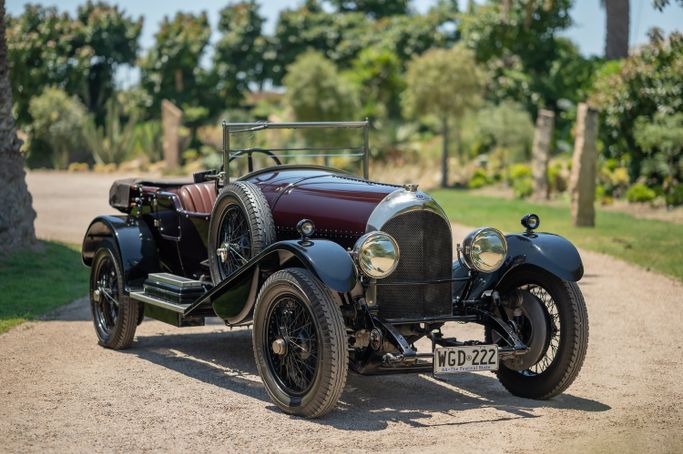
Chassis No.: 166
Engine No.: 164
US$263,200 USD | Sold
- 2,996cc Single Overhead Camshaft 4-Cylinder Inline Engine
- Dual SU "Sloper" Carburetors (see text)
- 82hp
- 4-Speed Manual Transmission
- 4-Wheel Mechanical Drum Brakes
- 4-Wheel Semi-Elliptical Leaf Spring Suspension with Live Axles
- Sporting short chassis with its original bodywork
- Uprated to 'Speed' model specifications
- In the current ownership since 1979
After the war Bentley turned its attention and talents to designing its first car, a 3-liter single overhead camshaft four-cylinder. W.O. appreciated the dual overhead camshaft designs of the pre-war Mercedes and Peugeot engines but chose instead a single overhead camshaft that could be driven by a shaft and bevel gear system. Four valves per cylinder were preferred for better volumetric efficiency and the intake and exhaust valves were disposed on opposite sides of the engine.
Layout was conventional with a ladder frame, live axles on semi-elliptical leaf springs and rear brakes only. Development, hampered by financial difficulties that never quite left Bentley alone, took two years, a consequence of W.O.'s attention to detail and his insistence that it be done right, not expediently or with concessions for cost. It was attention that would pay dividends for Bentley's reputation and racing success for decades to come.
Deliveries began in June 1921, as did competition preparation. Surprisingly, one of the first factory efforts was at the Indianapolis 500 in 1922, then winning the Team Prize at the Isle of Man TT.


Bentley's Le Mans era began in 1923, the 'round the clock race's first year, with a Bentley single entry that finished fourth overall after setting fastest lap. In 1924 the 3-Liter Bentley won, establishing forever the marque's Le Mans mastery.
THE CAR OFFERED
This very handsome Vintage Bentley is the archetypal proposition of the early days of Bentley Motors and is very much in the guise of almost all the 3 and indeed 4½ Liter racing Bentleys, built on the short 9ft 9½ inch chassis. It is arguable that the proportions of these cars were by far the best of any of its near-decade long production run.


Owing to the exhaustive research of archivists such as Dr. Clare Hay, today we know much about these cars, and for this example the abbreviated records in her latest edition of
Bentley – The Vintage Years


confirm its history. As detailed in this reference, work chassis number 166 was built and delivered to its first owner in November 1922, Alan B. Ritchie, an Australian living in London and probably the first Australian to take delivery of a Bentley. It was supplied then fitted, as today, with engine number 164. It is believed that Ritchie used the car without a body for a short while until he had the Park Ward Tourer body made, while Hay's notes state that Park Ward supplied this body, number 1999 to Bentley Motors on September 23, 1922. A particularly nice and unusual feature is that it retains Ritchie's original guarantee by Bentley Motors, dated in August 1923, signed by Hubert Pike the Service Manager.
The engine, as delivered, was the standard low compression type with a single Smiths carburetor—commonly referred to as a 'Blue Label' 3 liter. Later ownership converted the car to Speed model specifications with twin SU carburetors, higher compression, and appropriate gear ratios. Records show that the car returned to the factory for a 'light overhaul' and fitment of upgraded shock absorbers in October 1923 prior to shipment to Australia (the original factory 5-year guarantee was re-issued in 1923 and is available). By January 1924, Ritchie had returned to Australia, bringing 166 with him.
Once in the Southern Hemisphere, 166 resided at Ritchie's home in Penshurst in Western Victoria, and would remain in his family until 1927. The next chapter of its life is actually uncharted, but by the early 1950s the Bentley was the property of Laurie Lynch in Melbourne who kept the car until 1954 when he sold it to Phillip Jack Cocks of Chewton in Victoria. Both Cocks and its next owner Stan Burns kept the car for about a year apiece. Burns is known to have fitted cycle fenders and lightly modified its tail in his brief ownership.


Late in 1955 it was again sold this time to Harvey Hodgson of Sydney who kept the car for a more significant period, some 16 years, until late 1971 when it was acquired by Bill Stevens who brought it to Adelaide. In Steven's ownership a complete restoration was carried out during which any panel work that needed attention was carefully reskinned. He also fitted a slightly later front wheel braked axle (unit no. 733), and returned the wings to fully flowing VdP style pieces which suit it well.
In 1979 it was acquired by the present owner who has enjoyed and meticulously maintained it for over four decades. A prime example of a cherished and highly original 3-Liter Bentley, close inspection confirms that it retains its original engine, gearbox, rear axle (number 161), a slightly later steering box (number 879), and even detail features such as its dashboard cluster. Finished in a rich burgundy hue with black fenders it has a great look to it and on recent testing proved to drive very nicely with a smooth transmission, good power and road holding.
Cost
966,602 AED


