When to Change Transfer Case Oil in the Nissan Patrol
Nissan Patrol
Nissan Patrol•
•67 views
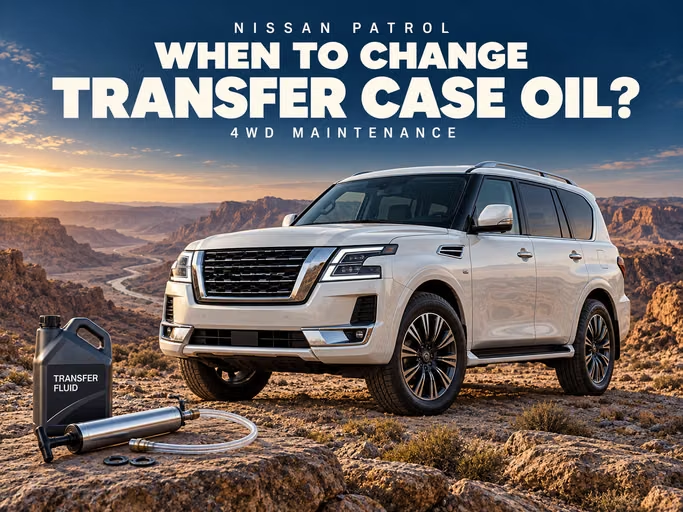
The Nissan Patrol transfer case oil change schedule depends on the generation, the unit fitted and how the vehicle is used. A Patrol Safari Y61, a Y62 and the newer Y63 do not share a single set of maintenance requirements. One mileage recommendation for every Patrol cannot replace checking the documentation for the actual vehicle.
For a vehicle in the UAE, its use matters: city driving, sand routes, towing and water crossings. Start with the VIN and workshop invoices. A record of an automatic transmission or differential oil change does not confirm that the transfer case was serviced. Here is how to check the schedule and agree the work with a workshop.
Identify the transfer case in your Nissan Patrol
The transfer case transmits torque to the axles as part of the four-wheel-drive system. Choosing its fluid requires identifying the unit itself. Ask the workshop to check the VIN, model year, original market and unit identification. This is particularly useful on a used off-roader that has had transmission repairs.
- Patrol Y61 / Safari / Super Safari. Use the documentation for your specification. A fluid or procedure listed for the Y62 must not be applied to a Safari simply because both are Patrols.
- Patrol Y62. Confirm the transfer case type. Nissan lists a dedicated fluid for the ATX90A transfer case, separately from the automatic transmission fluid.
- Patrol Y63. Request current documentation for this generation. The older regional maintenance booklet discussed below does not establish the Y63 schedule.
Separate the transfer case, gearbox and differentials
The invoice should list the transfer case, gearbox, front differential and rear differential separately. Each has its own fluid and level requirements. An offer to replace all drivetrain oils is useful only when it identifies the units, products and operations included in the price.
When an unscheduled inspection is needed
Do not wait for the next routine service if a leak, unusual noise or 4WD warning appears. Note when the problem occurs: after driving on sand, when cold, under load or while turning. This helps the workshop distinguish a fault from behaviour associated with the selected four-wheel-drive mode.
- A hum or vibration. Check the transfer case, propeller shafts, driveshafts and mounts. A noise alone is not enough to justify replacing the unit.
- Jerking or resistance while turning. Check the selected 4WD mode, surface, tyre sizes, pressures and wear. Use the drive modes as instructed in the manual for your Patrol.
- Oil on the housing or underbody protection. Identify the source and check the fluid level first. Topping up without fixing the cause is not a repair.
- An underbody impact or water crossing. Inspect the housing and seals and assess possible contamination. Tell the workshop how deep the water was and how long the vehicle was exposed.
Choosing the correct transfer case fluid
The official Patrol owner’s manual specifies Genuine NISSAN Transfer Fluid for the ATX90A transfer case. Automatic transmission and differential oils are listed separately in the same section. An ATF label, a matching viscosity or the colour of a fluid does not establish transfer case compatibility.
| Documentation reference | How to apply it |
|---|---|
| Y62 with an ATX90A transfer case | Genuine NISSAN Transfer Fluid; confirm the unit |
| Y61 / Safari and Y63 | Check the separate specification; do not assume ATX90A requirements apply |
Source: Nissan Patrol owner’s manual, section 9, page 9-3. Apply the ATX90A requirement only after confirming the unit fitted.
What the maintenance schedule says
Nissan’s 2021 regional maintenance booklet lists normal-use level and leak checks every 10,000 km or six months; for the Y61, replacement is every 40,000 km or 24 months, whichever comes first. Confirm that this booklet applies to your vehicle.
An I inspection entry is not an R replacement instruction at every visit. That inspection row does not establish a universal Y62 replacement interval. Ask the workshop to identify the basis for its recommendation and record the next service date or mileage on the invoice.
Nissan also notes that off-road sand, mud or water exposure may require more frequent maintenance. Review the normal schedule before applying it to this use.
Agree the scope before work starts
Confirm the fluid name, applicability and service refill quantity. If the service history is unknown, assess the unit first. An oil change should not take the place of diagnosing a noise, leak or four-wheel-drive fault.
- Set the level using the procedure for the actual unit. The drained quantity is not a reliable refill target after a leak, and dry capacity is not necessarily the same as a routine service refill.
- Confirm any required new plug seals and the correct tightening torques. Do not automatically add flushing or additives; their use needs a technical basis.
- For the Y62, Nissan’s booklet requires a controller reset after transfer fluid replacement. Ask for this to be recorded and for a post-service leak check.
Assessing the result of the service
| Inspection result | What to ask the workshop |
|---|---|
| Noise or jerking remains | Were 4WD mode, tyres and other units checked? |
| Fresh oil reappears on the housing | Was the leak source found and the level checked? |
| Contamination or particles in the fluid | Were the source and the unit’s condition assessed? |
| Work completed without concerns | Are the fluid, mileage and required operations recorded? |
Owner’s checklist
☐ Record the VIN, generation, model year and original market.
☐ Confirm the transfer case actually fitted to the vehicle.
☐ Find the applicable schedule and previous service records.
☐ List the transfer case, gearbox and differentials separately.
☐ Agree the fluid, refill quantity and required seals.
☐ Report sand use, towing, water exposure and new symptoms.
☐ For the Y62, confirm that the controller reset is included.
☐ Obtain an invoice showing the date, mileage and fluid name.
☐ Record when the next inspection or replacement is due.
Common mistakes
- Using gearbox or differential oil in the transfer case without confirming compatibility.
- Assigning one interval to every Patrol without distinguishing Y61, Y62 and Y63.
- Expecting a fluid change to guarantee a cure for jerking, noise or a 4WD warning.
- Accepting a general service stamp without a record of the actual unit and work performed.
Conclusion
Nissan Patrol transfer case maintenance starts by identifying the generation and unit. Check the correct fluid, applicable schedule and operating conditions next. If symptoms are present, diagnose the cause first. A detailed invoice confirms what was done and helps you plan the next visit without guesswork.
When browsing current offers for the Nissan Patrol, compare the four-wheel-drive service history. Records showing mileage, fluid names and completed operations are more useful than a general claim that everything has been serviced.