How Often Should You Change Differential Oil in a Mercedes-Benz G-Class AMG?
Mercedes-Benz G-Class AMG
Mercedes-Benz G-Class AMG•
•12 مشاهدة
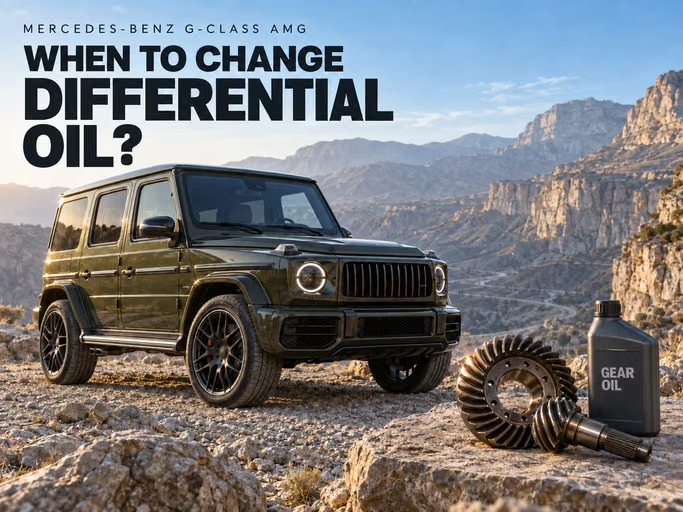
Change Mercedes-Benz G-Class AMG differential oil according to the schedule for the specific variant, including any running-in service and operating conditions. One interval cannot cover every G 55, G 63 and G 65. Before off-road driving, pay particular attention to front and rear differential condition, leaks and the required oil approval.
When Is an Oil Change or Differential Inspection Due?
Start with the service schedule for the VIN, or vehicle identification number. Check both the recurring mileage interval and any time limit. A new vehicle may have a separate running-in oil change. That initial operation does not mean subsequent changes should follow at the same short interval.
For example, the G-Class owner’s manual issued in June 2017 specifies an axle differential oil change after 3,000 km of running-in for Mercedes-AMG vehicles. It also instructs drivers to avoid off-road use before that first change. This applies to vehicles covered by that edition; it should not automatically be extended to every G-Class AMG or later generation.
At a scheduled service, ask which operations apply to each axle. A transmission-oil entry is too vague: it may refer to the gearbox or transfer case. If maintenance history is incomplete, inspection and documentation checks provide the starting point for an agreed plan. Quiet operation alone does not establish that oil was changed on time.
- After deep-water driving or flooding, assess possible water entry into the assemblies. Do not wait for a whine before arranging checks.
- After an underbody impact, inspect housings, plugs and joints. Oil near an impact mark calls for a level and leak check.
- Investigate a new hum, leakage or metal particles regardless of the next scheduled service date.
- Following differential repair or replacement, confirm the running-in and follow-up requirements for the fitted assembly.
Why the G-Class AMG Name Is Not Enough
The distinctive body has remained recognisable for decades, while the drivetrain has changed. The new-generation G 63 introduced in 2018 gained independent front suspension and retained a rigid rear axle. Instructions for an earlier G-Class therefore cannot replace the repair information for a later car. The full model designation and assembly identification are more useful than the description in an advert.
The front and rear axle differentials are separate service items. The centre differential belongs to the transfer case: three locking switches do not mean three identical oil reservoirs. Special versions with portal reduction gears have additional service points. These must be identified separately rather than assumed to be included in a conventional axle-oil change.
What Happens When the Oil Level Is Low or the Oil Is Contaminated?
The final drive and bearings work under load during acceleration, climbing and towing. Oil protects contacting surfaces and helps carry heat away. An insufficient level, water or an unsuitable formulation compromises those functions. On a heavy off-roader, seal damage following a rocky route can matter more immediately than the age of the lubricant.
| Problem | Risk to the assembly | What to check |
|---|---|---|
| A leaking seal or plug | Insufficient lubrication, overheating and accelerated wear. | Leak source, oil level and housing condition. |
| Water following a crossing | Corrosion and reduced lubricant protection. | Seals, ventilation and the water-entry route. |
| An incorrect approval | The oil does not provide the required properties. | Assembly identification and the exact product used. |
| Large metal particles | Possible component damage and further wear. | Gears, bearings and the need for repairs. |
Dark colour alone cannot establish the remaining useful life of the oil. Assess contamination, level, particle type and noise together. The technician needs to distinguish ordinary signs of use from debris that warrants further investigation. Fresh lubricant will not restore damaged teeth or bearings.
Account for Sand, Heat and Water
Dune driving can combine sustained tractive effort, wheelspin and abrupt recovery of grip. Describe how the vehicle is used, particularly if engine output has been increased or wheel size changed. Additional inspection and preventive oil-change decisions should take these conditions into account rather than rely on ambient temperature alone.
Dust on an axle does not prove that the oil inside is contaminated. After off-road use, cleaning and inspection should cover ventilation, seals and housing damage. The wading depth in the vehicle instructions does not eliminate water-entry risks in every condition. Unknown depth, stopping in water and damaged seals each warrant attention.
If water contamination is suspected, do not postpone assessment until the next routine service. Identify and address the entry route as well as replacing contaminated lubricant. Washing the underbody or drying the cabin says nothing about fluid condition inside a sealed assembly.
How Do You Choose the Oil and Arrange the Service?
The official Mercedes-Benz Sheet 231.1 lists off-road vehicle axles separately. Its front and rear differential entries for model series 463, 464 and 465 include Sheets 235.31 and 235.33. Certain G 63 variants have an additional warm-climate provision. Viscosity or the AMG name alone is therefore insufficient for selecting a product.
| Example application in MB 231.1 | Approval sheet | Condition |
|---|---|---|
| Front and rear differentials in series 463, 464 and 465 | 235.31 / 235.33 | Match the actual assembly to the applicable entry. |
| Certain G 63 variants, for example 463.272 and 463.273 | 235.61 | A specific warm-climate provision, not a rule for every G-Class AMG. |
| Portal wheel reduction gears on special versions | Select separately | Check the model designation, equipment code and portal-gear entry. |
These examples help locate the relevant section; they do not replace selection by VIN and assembly identification. The table contains footnotes and conditional alternatives. For a vehicle used in the UAE, have the workshop confirm whether the warm-climate provision applies, then identify the precise product in the current approved-oil list.
In that table, Sheet 235.61 is associated with 75W-140, while 235.31 and 235.33 are associated with 75W-85. These are not quality rankings or permission to choose thicker oil at will. A requirement for a particular G 63 version cannot simply be applied to every G 55, G 65 or later assembly.
Mistakes to Avoid When Selecting Oil
- Buying solely by a 75W-85, 75W-140 or for-AMG label without checking the approval.
- Using one specification for axles, transfer case and portal gears without checking each requirement.
- Expecting a differential additive to correct an unsuitable formulation or mechanical wear.
- Treating an oil seller’s recommendation as confirmation of the manufacturer’s service schedule.
Checklist Before Collecting the Vehicle
☐ The work order identifies the front and rear differentials and the actual work completed.
☐ The approval, product name and fill quantity are recorded for each serviced assembly.
☐ Housings, seals, plugs and ventilation have been checked, and leak causes addressed.
☐ Unusual contamination or metal particles have been assessed and documented.
☐ The level has been set to the repair procedure and oil tightness checked after servicing.
☐ The date, mileage and next due operation are recorded, including any running-in service.
Before draining, the workshop should establish that it can open the filling point and complete the refill. Plug and seal requirements must match the assembly. Keep the detailed invoice: a general service stamp does not show which fluids were actually replaced.
Will Fresh Oil Cure a Hum or Driveline Jerking?
If the problem involves a low level, repairing the leak and refilling correctly restores lubrication conditions. Even if the sound disappears, that does not prove there is no damage. Worn bearings or gears still require repair. Increasing viscosity solely to make the assembly quieter is not a substitute for finding the fault.
On a G-Class, sound and vibration can travel through axles, propeller shafts, the transfer case and body. Tyres and wheel bearings are other possible sources. Note whether symptoms occur under power, on accelerator release, after warming up or on a particular surface. These details help the workshop investigate.
If jerking begins after off-road use, check the lock-disengagement indicators as described in the vehicle instructions. Differential locks must not be used on firm surfaces with good grip. A locking-system fault or driveline wind-up is not cured by changing oil; diagnose the cause while observing the manual’s operating restrictions.
When browsing current listings for a G-Class AMG, ask about off-road use, axle replacements and records of running-in maintenance. For a special version, check that every additional reduction gear has been accounted for. A recent fluid change is useful history, but does not demonstrate that the entire drivetrain is sound.
Stop driving if there is severe grinding, knocking or substantial oil loss. Choose a recovery method permitted for the specific drivetrain. Do not test differential locks with abrupt manoeuvres or prolonged wheelspin on tarmac.
Conclusion
G-Class AMG differential care requires the correct schedule, separate attention to each assembly and the applicable oil approval. Check running-in requirements, off-road damage and leaks. Diagnose any hum first: timely servicing protects components but cannot reverse mechanical damage.