When to replace spark plugs and glow plugs in a Mercedes-Benz E-Class
Mercedes-Benz E-Class
Mercedes-Benz E-Class•
•7 views
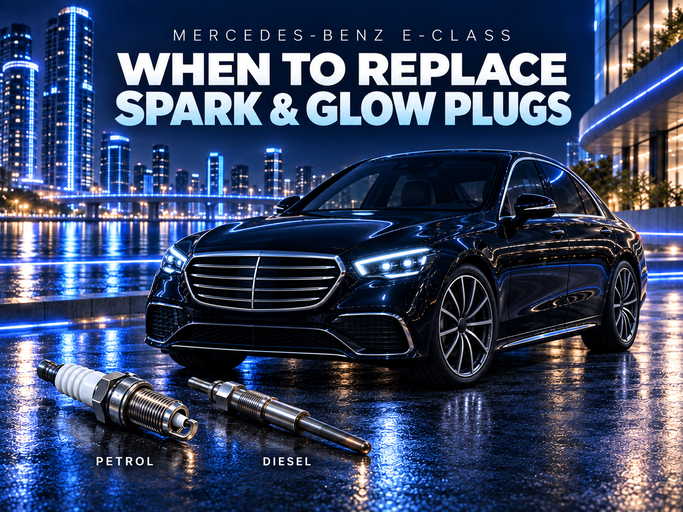
Replace Mercedes-Benz E-Class spark plugs according to the schedule for the particular engine, and investigate misfires before the next scheduled replacement. Diesel glow plug servicing depends on the variant’s requirements and diagnostic findings. There is no single interval for every E-Class: the model name covers different generations, engines and hybrid systems.
This article focuses on W213 and W214 saloons used daily and encountered on the used-car market. The four-cylinder examples below refer to the W214. Earlier cars, six-cylinder engines and AMG variants require their own parts checks. Start with the VIN, the vehicle identification number, rather than relying solely on the boot badge.
Which plugs different E-Class versions use
The Mercedes-Benz technical specifications distinguish the E 200, E 220 d, E 300 e and E 300 de by fuel and hybrid type. These four W214 versions each have four cylinders. The table identifies the systems; it does not replace a vehicle-specific part-number check. Availability varies with the original market specification.
| W214 example | Plug type | What matters |
|---|---|---|
| E 200 petrol mild hybrid | 4 spark plugs | Electric assistance retains spark ignition |
| E 300 e petrol plug-in hybrid | 4 spark plugs | Electric driving does not remove engine servicing |
| E 220 d diesel mild hybrid | 4 glow plugs | Check the diesel preheating system |
| E 300 de diesel plug-in hybrid | 4 glow plugs | The e and de badges identify different powertrains |
| W213, AMG and other engines | Variant-specific | Do not copy quantities or part numbers from the rows above |
Petrol engines
A spark plug receives high voltage from the ignition coil and creates a spark inside the cylinder. Electrode wear makes ignition more demanding, so hesitation can first appear during acceleration. Smooth idling does not establish that combustion will remain stable under load.
Petrol and diesel hybrids
Inspect petrol ignition on an E 300 e and diesel glow control on an E 300 de. Connecting the car to a charger does not change that distinction. A brief engine start during a change of operating mode can be normal hybrid behaviour, but repeated jolts and fault codes need investigation.
Diesel engines
A diesel does not use a spark plug to ignite fuel: ignition occurs in air heated by compression. Glow plugs add heat during starting and, depending on the control strategy, afterwards. They also help the engine run steadily while warming up.
Signs that the plugs need checking
Petrol engine misfires
- The engine runs unevenly after starting or develops a shake at warm idle.
- Repeated hesitation appears during acceleration when it was previously absent.
- Starting takes longer, accompanied by uneven running and an engine warning.
Symptoms do not identify a plug as the cause. A technician needs to distinguish combustion misfires from vibration through engine mounts, and ignition faults from injection or intake leaks. If the problem occurs only when a hybrid’s engine joins in, record the temperature, driving mode and load.
Glow system problems
On a diesel, difficult starting after parking, rough initial running and glow circuit faults justify a check. These complaints can accompany glow plug faults, but wiring, the controller or its power supply may be responsible. In warm weather, starting can seem almost normal despite a stored fault.
Why plugs can fail early
Replacing a part does not remove whatever damaged it. If a new plug quickly becomes fouled or the fault returns to the same cylinder, further diagnosis is needed. Comparing cylinders and repair history is more useful than judging one removed part in isolation.
| Cause | Possible effect | Checks |
|---|---|---|
| Wear or incorrect gap | Unstable ignition | Application and plug mileage |
| Oil in a plug well | Insulation or boot damage | Seals and ignition coil |
| Combustion problems or oil consumption | Electrode deposits | Injection and cylinder condition |
| Glow supply fault | Insufficient or excessive heating | Wiring, connectors and controller |
| Installation error | Thread or seat damage | Procedure and tightening torque |
In heat, dust and urban traffic, keep intake servicing up to date and repair leaks promptly. Ambient temperature alone is not a reason to impose the same shortened plug interval on every E-Class. Agree additional checks according to usage and engine condition.
Why diagnosis should not be delayed
Severe misfires can send unburned fuel into the exhaust and overheat the catalytic converter. Acceleration also deteriorates. Pressing the accelerator harder to overcome hesitation increases load without correcting the fault.
A glow fault needs a different approach: identify the affected circuit and check its control. A diesel running smoothly once warm does not prove its glow plugs are sound. Equally, one fault code does not establish that every plug and the controller must be replaced.
Important. If the engine warning flashes, the car shakes severely or power drops sharply, stop accelerating and pull over safely. If severe misfiring continues, arrange diagnosis and recovery instead of driving on under load.
How to establish the interval and select the parts
The schedule and ASSYST PLUS reminder
ASSYST PLUS helps plan a service visit; it does not measure the physical wear of each plug. Replacement requires the schedule entry for your engine, including mileage and any time limit. Check the owner’s manual and VIN-specific service documentation.
A Service A or Service B entry without an itemised work record does not confirm plug replacement. Ask for an invoice showing the date, mileage and fitted part numbers. With a plug-in hybrid, do not subtract electric mileage from the odometer to invent a new interval; any such method must come from the applicable schedule.
For a diesel, establish separately whether scheduled glow plug replacement is specified. If it is not, base the decision on system checks. A proposal to replace a functioning set preventively should explain both the reason and the removal risks.
What to verify before buying
| Parameter | Spark plug | Glow plug |
|---|---|---|
| Application | VIN, engine, model year | VIN, engine, glow system |
| Operating specification | Heat range, electrodes, gap | Voltage and heater design |
| Geometry | Thread, reach, seat | Thread, tip, seat, connector |
| Installation | Torque and fitting conditions | Removal and fitting procedure |
“Iridium” describes a material, not compatibility with an E-Class. Parts that look alike may have different thermal and electrical specifications. Confirm the current part number and any official supersession; obtain the gap and torque from the applicable procedure rather than a generic chart for a similar thread.
How to assess an unknown service history
When comparing current listings for the Mercedes-Benz E-Class, ask about the last plug replacement as well as the latest service. An invoice for work on a hybrid’s electrical system does not establish that its engine was serviced. If records are missing, start by identifying the schedule and checking the car; a missing entry is not proof of failure.
What removed plugs can reveal
Keep removed petrol spark plugs in cylinder order. Differences between them can guide diagnosis, but appearance alone cannot settle the cause. Fault codes, the conditions that trigger misfiring and measurement results also matter.
| Observation | Possible meaning | Next check |
|---|---|---|
| Heavy deposits on one plug | A local combustion problem | That cylinder and its injector |
| Crack or flashover marks | Insulation damage | Plug, coil boot and coil |
| Oil outside the plug above its seat | Leak into the plug well | Seals; distinguish this from oil in the cylinder |
| Glow circuit fault | Plug, wiring or control fault | Electrical tests before removal |
Do not remove glow plugs merely for a visual inspection whenever starting is poor. Begin with electrical tests specified for the engine. If removal is necessary, assess seizure risk and tip integrity: a broken plug requires investigation of where its missing fragment is located.
Diagnosis and preparation for replacement
The diagnostic sequence
- Save fault codes and their operating conditions. Establish whether the symptom occurs at the first start, after warm-up or under load.
- Check the power supply and accessible connections. Inspect petrol coils and plug wells, or diesel plug circuits and the glow controller.
- Perform the engine-specific tests. Where necessary, examine injection, intake sealing and the mechanical condition of the cylinders.
- After repairs, reproduce the complaint conditions and check for returning faults. Record the fitted parts, date and mileage.
Pre-work checklist
☐ Confirm the engine, part numbers and plug quantity by VIN.
☐ Prepare the correct tools and removal and tightening procedure.
☐ Prevent an automatic engine start; a silent hybrid is not necessarily switched off.
☐ Clean the work area and protect open holes from sand.
☐ Agree additional work after checking the associated components.
For spark plug installation, correct tightening matters: both insufficient and excessive torque can damage a plug or impair its operation. The procedure determines engine temperature, thread condition and whether lubricant is permitted. Glow plug removal has separate force limits. Using a longer lever on a seized plug risks breakage. Work on a hybrid’s high-voltage system belongs with a trained specialist.
Selection and installation mistakes
- Treating the E 300 e and E 300 de as using the same plug type.
- Copying a plug set or interval from another E-Class generation.
- Adjusting the gap or lubricating threads without procedural approval.
- Connecting an unidentified glow plug directly to the battery.
- Clearing faults before recording data and replacing every coil without testing.
Frequently asked questions about spark plugs
Is there one replacement mileage for every E-Class
No. Requirements differ by engine and model year. Observe any time limit in the schedule as well. Severe misfiring needs diagnosis regardless of how far away scheduled replacement is; a healthy engine should follow its applicable schedule.
Can an E 300 e have longer spark plug intervals
Only if the documentation for that version permits it. Electric driving does not authorise the owner to disregard a time limit or double the replacement mileage. Spark plugs remain necessary whenever the petrol engine runs.
Must coils be replaced with the spark plugs
Not automatically: assess the coils separately. If testing finds a damaged boot or another fault, agree the repair on that evidence. A healthy coil set does not become a routine replacement item merely because the plugs are due.
Frequently asked questions about glow plugs
Does an E 300 de use glow plugs
Yes. The diesel engine in this hybrid uses a glow system. The E 300 e instead has a petrol engine with spark plugs. Parts ordering therefore needs the full variant identification, not just the word hybrid.
Do glow plugs need to work in a hot climate
Yes. Warm weather can make starting easier and mask symptoms, but it does not repair a circuit fault. Assess the system through its faults and operating conditions, not simply whether the car started that morning.
Why can a fault return after replacement
Possible causes include an unsuitable plug, poor contact, damaged wiring or a faulty controller. Distinguish an old stored record from a recurring active fault. Erasing the code alone does not establish that the system works.
Should one plug or the whole set be replaced
Decide after checking the other circuits and assessing the parts. Age and access may justify replacing the set, but one failed plug does not mean all have failed. Ask which test results support the proposed work.
Conclusion
Start E-Class plug servicing by identifying the fuel, engine and generation. Petrol versions, including the E 300 e, need spark plugs; diesels, including the E 300 de, use glow plugs. Then check the schedule and service history, and investigate the cause of any running problem. This approach helps select compatible parts and avoids replacing healthy components by guesswork.