


When to replace spark plugs in the Lexus NX
Lexus NX
Lexus NX•
•10 views
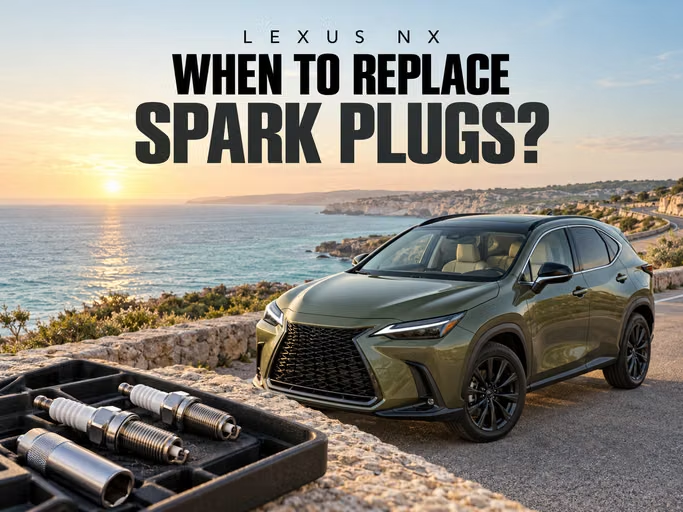
Spark plug replacement timing for the Lexus NX depends on its engine. The regional manuals reviewed here specify 60,000 km for the NX 350 and 100,000 km for the NX 200, NX 250 and hybrid NX 350h. These figures apply to the versions covered by those documents, rather than every NX built since the model was introduced.
The letter h does not remove the need for ignition maintenance: a hybrid retains a petrol engine. The NX 350 and NX 350h also use different plugs despite their similar badges.
This guide explains how to check your vehicle’s schedule, recognise symptoms that need diagnosis and select the correct plugs. It also addresses the question of glow plugs.
Why the exact NX version matters
The NX and NXh comparison on lexus.ae describes a 2.4-litre turbo petrol version and a hybrid powertrain. These are different configurations, so searching for service parts using only the name Lexus NX is insufficient.
Start with the VIN, model year and engine code. Then find the owner’s manual and service book for that specification. For a vehicle imported into the UAE, check its original specification carefully: local registration alone does not change the factory maintenance schedule.
| Version in the manuals | Engine | What to check |
|---|---|---|
| NX 350 | 2.4-litre turbo | Different from NX 350h |
| NX 250 | A25A-FKS, 2.5-litre | Naturally aspirated petrol |
| NX 200 | M20A-FKS, 2.0-litre | Confirm the generation |
| NX 350h | A25A-FXS, 2.5-litre hybrid | Still needs spark plugs |
| NX 200t / NX 300 / NX 300h | Earlier versions | Their own schedules and catalogues |
How the NX 450h+ differs
The NX 450h+ technical description identifies it as a plug-in hybrid with a 2.5-litre petrol engine. It also needs spark plugs, but the NX 350h manual should not automatically be treated as its maintenance schedule.
Do not calculate plug life from the proportion of electric driving. Follow the service documentation instead of subtracting kilometres travelled with the petrol engine switched off.
Replacement intervals: 60,000 or 100,000 km
Page 494 of the NX 200/250/350 manual places the NX 350 spark plug replacement mark at 60,000 km. For the NX 200 and NX 250, it separately specifies 100,000 km. These entries refer to the versions included in that document.
The table on page 540 of the NX 350h manual specifies replacement every 100,000 km. This mileage does not remove the need for earlier diagnosis if the engine starts running poorly.
| Version covered | Scheduled replacement | Before applying it |
|---|---|---|
| NX 350, 2.4-litre turbo | 60,000 km | Match your service schedule |
| NX 200 / NX 250 | 100,000 km | Check engine and model year |
| NX 350h | 100,000 km | Confirm hybrid specification |
| Other NX versions | Their own documentation | Do not transfer figures by name |
What UAE operating conditions mean
Congestion and extended idling with the air conditioning running can add hours of engine operation without much mileage. Explain your driving pattern to the workshop and check the additional maintenance requirements. Do not arbitrarily halve the plug interval solely because of hot weather.
The cited table entries give no separate limit in months. If your vehicle’s service book includes a time limit, take it into account. With an unknown service history, establish which jobs were actually completed instead of relying on a general service stamp.
When checks are needed before the scheduled date
Hesitation during acceleration, an unstable idle and difficult starting justify an engine check. Plugs are among the possible causes, but coils, injectors, intake leaks and mechanical faults can produce similar symptoms.
| Symptom or finding | Possible explanation | What to investigate |
|---|---|---|
| Jerking under load | Misfires | Plugs, coils and fuel system |
| Deposits on the firing end | Poor combustion | Mixture and driving pattern |
| Oil in a plug well | Leaking seal | Leak source and coil boot |
| Rough running after replacement | Selection or installation | Part numbers, insulators and connectors |
| Shaking as a hybrid engine starts | Uneven engine operation | Codes and operating conditions |
The ignition troubleshooting article on ngkntk.com explains how carbon, fuel or oil fouling on a plug’s firing end can interfere with ignition. Replacing plugs without correcting the source of contamination may therefore provide only temporary relief.
What to tell the technician
Note whether the problem occurs with a cold engine, after warming up or during acceleration. Mention whether it began after servicing. Stored faults and the conditions in which they appeared are more useful than an assumption that the plugs must be due.
A misfire code points the investigation in a direction; it does not prove a plug fault. Keep removed plugs in cylinder order so their electrode and insulator condition can be compared with diagnostic findings.
If the engine shakes severely and the malfunction indicator flashes, stop accelerating and pull over safely. Severe misfires can damage the catalytic converter. Arrange transport to a workshop if the rough running continues.
Selecting plugs and preparing for replacement
The specifications on page 666 of the NX 200/250/350 manual list different plugs for the three engines. The document requires iridium-tipped plugs and prohibits adjusting their gaps.
| Version covered | Plug designation | Nominal gap |
|---|---|---|
| NX 350 | NGK DILZKAR8E7H | 0.7 mm |
| NX 250 | DENSO FC16HR-Q8 | 0.8 mm |
| NX 200 | DENSO FC20HR-Q8 | 0.8 mm |
| NX 350h | DENSO FC16HR-Q8 | 0.8 mm |
The NX 350h specification appears on page 718 of the separate hybrid manual. Sharing a designation with the NX 250 does not make that plug suitable for every NX: confirm final applicability using the VIN and parts catalogue.
Pre-replacement checklist
☐ Confirm the VIN, engine and current part number.
☐ Prepare a set of four correctly specified plugs.
☐ Switch the ignition off; confirm READY is off on a hybrid.
☐ Let the engine cool and clean the plug wells.
☐ Inspect coil boots and electrical connectors.
☐ Check torque requirements for the engine and selected plug.
The installation guide on ngksparkplugs.com describes the effects of insufficient and excessive tightening. Start each plug without cross-threading, then tighten to the applicable specification. A single torque value should not be used for every NX.
Do not bend an electrode to adapt an unsuitable plug. Do not lubricate the threads unless the manufacturer specifically instructs it. If rough running appears after the work, check installation and connections before resuming normal use.
Frequently asked questions about Lexus NX plugs
Does the NX have glow plugs
The petrol and hybrid NX versions discussed here use spark plugs. Glow plugs provide heat in diesel engines; the listed NX versions have no corresponding glow plug service requirement. A hybrid system does not turn its petrol engine into a diesel.
Should coils be replaced at the same time
Working coils do not automatically need replacing whenever a new set of plugs is fitted. For a fault, check the coil, boot, power supply and connector. It helps to separate scheduled maintenance from repairs to a confirmed defect on the invoice.
How can service history be checked before buying
When browsing current offers for the Lexus NX, request invoices showing the date, mileage and designation of the fitted plugs. A full-service entry without an itemised list does not confirm their replacement.
If records are unavailable, compare the mileage with the correct version’s schedule and agree on inspection with a workshop. Keep parts details after servicing so the next replacement decision does not depend on memory.
Can cleaning replace a new set
Cleaning cannot restore worn electrodes or damaged ceramic. Recurring fouling needs its cause investigated, while a tidy appearance does not cancel scheduled replacement when it is already due.
Conclusion
For the Lexus NX, begin by identifying the engine and the applicable maintenance schedule. Distinguish the NX 350 from the NX 350h, confirm plug fitment by VIN and avoid transferring intervals between generations. Investigate rough running with the workshop, and record the mileage and installed part numbers after replacement.


