


How often should you replace the Lexus ES fuel filter?
Lexus ES
Lexus ES•
•13 views
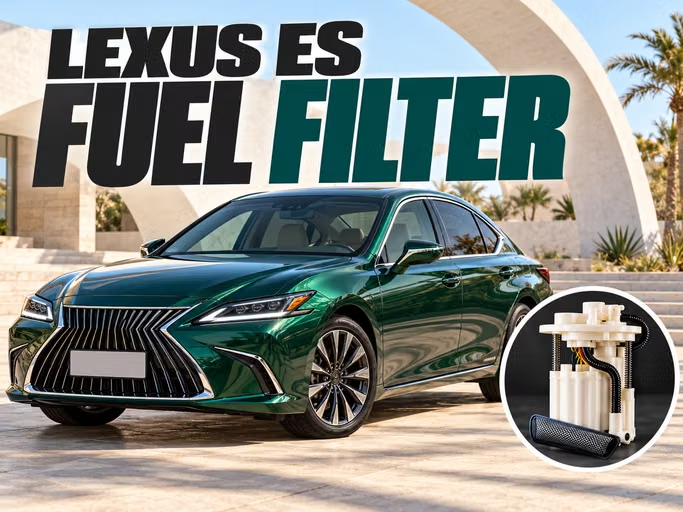
The published Lexus ES 200/250/350 manual specifies fuel-filter replacement at 80,000 km or 96 months, whichever comes first. Confirm that this schedule covers your model year and specification. Hybrid ES versions require a separate schedule check, while a fully electric ES has no petrol fuel filter. Difficult starting or power loss calls for diagnosis before the scheduled replacement point.
Engine changes that need investigation
An ES may develop a fault when leaving a parking space, accelerating onto a highway or restarting after a long stop. A precise account of the conditions is more useful to the workshop than an assumed blocked filter. Note when the issue began, the fuel level and any recent fuel-system work.
- Starting takes longer. Note whether this happens with a cold engine, after a brief stop or only after refuelling.
- Acceleration comes with hesitation. Record speed and load; do not recreate the fault through repeated hard acceleration in traffic.
- Jerking or uneven running develops. Note any connection with engine warm-up or gear changes.
- The engine stalls. If the fault recurs or accelerator response deteriorates, stop safely and arrange assistance.
- The change follows refuelling. Keep the receipt and fuel details. This helps diagnosis but does not prove filter contamination.
Check Engine alone does not establish that the filter needs replacement. Preserve fault codes first, then have fuel delivery, the pump, its power supply and related components checked. Do not disconnect fuel lines yourself to assess pressure.
Why petrol and hybrid ES versions need separate guidance
The technical brochure on lexus.com.bh lists both a petrol engine and an electric motor for the ES 300h. The hybrid therefore still has a fuel system. However, its assembly design and service interval must be checked against its own documentation; the ES 200/250/350 schedule does not replace the ES 300h schedule.
The range on lexus.ae also includes the new-generation ES 350h and electric ES 500e. The former needs its own maintenance schedule; petrol-filter replacement advice does not apply to the latter. Check the VIN, model year and powertrain before ordering, rather than relying on the ES name alone.
What restricted fuel delivery can cause
The information on boschaftermarket.com lists impaired fuel supply, reduced power and engine stalling among the possible effects of a blocked fuel filter. These symptoms are not unique to the filter: replacement helps only when it addresses the established cause.
- Acceleration becomes less consistent. A fault can appear under load even when the engine idles smoothly.
- Starting remains unreliable. Repeated attempts drain battery charge without replacing proper diagnosis.
- An unexpected stop becomes more likely. Resolve a recurring fault before a long trip or daily working route.
- Contamination may affect several components. If a fuel problem is confirmed, the workshop determines any additional work needed.
- Unnecessary replacement adds cost. A serviceable pump or module should not be replaced solely because the car has lost power.
Lexus ES fuel-filter replacement interval
The ES 200/250/350 manual on lexus.com.bh lists Fuel filter on page 361, with replacement at 80,000 km or 96 months. Note 5 on page 363 includes the filter in the tank. This is a specific schedule for vehicles covered by that manual, so check it against the VIN and service booklet.
| Version or situation | Reference point | Action |
|---|---|---|
| ES 200/250/350 covered by cited manual* | 80,000 km / 96 months | Replace under the applicable schedule |
| Hybrid ES 300h / ES 350h | Own year and specification | Check its separate schedule |
| Fully electric ES | No petrol fuel filter | This operation is not required |
| Unknown maintenance history | Before ordering parts | Review records and establish due work |
| Hard starting or hesitation | Before routine service | Diagnose the system |
* Interval from the cited manual. Use it only when the schedule covers your vehicle; the earlier distance or time limit applies.
Tracking the interval and operating conditions
In the maintenance table, R means replacement. Eight years equals 96 months: low mileage does not cancel the time limit when this schedule applies. Keep the date and mileage of the completed replacement so the next service can be planned from records.
When buying a used ES, establish exactly which filters were replaced. A record of “service with filters” may refer to oil, engine-air and cabin filters. Fuel-filter work should have its own invoice entry showing the part number and mileage.
The manual identifies special operating conditions, including dusty roads and extensive idling. Check the additional schedule for the affected tasks; do not automatically halve every interval. Symptoms or suspected contaminated fuel call for diagnosis before the next scheduled mileage point.
Selecting the filter and avoiding unnecessary replacement
The fine fuel filter, pump inlet strainer and complete fuel module have different roles. Start with the VIN-specific catalogue to identify the design and separately serviceable components. A photograph, similar appearance or generic “for Lexus ES” description does not establish fitment.
- Prepare the vehicle details. Include the VIN, production date, engine and previous replacement records.
- Confirm the part number and any supersessions. Check year and specification restrictions even if the seller lists the ES.
- Check package contents. Agree on the seals and other consumables required by the repair procedure.
- Ask why a complete module is being replaced. The repair scope should follow the diagnostic findings.
- Agree on the total cost. Include access work, reassembly, consumables and leak testing.
Assessing the result after servicing
After reassembly, the workshop checks connections for leaks and reassesses the original complaint. If the issue followed parking or occurred during acceleration, the check should reflect those conditions. The job record should capture the result of the final check as well as the parts replaced.
| Observation | What is checked | What to report | What is not yet established |
|---|---|---|---|
| Difficult starting | Starting and fuel delivery | Cold or warm engine | Filter is at fault |
| Hesitation | Delivery under load | Acceleration conditions | Whole module is needed |
| Jerking | Engine and transmission | When it occurs | Fuel is the cause |
| Noise by tank | Pump and power supply | Fuel level | Pump has failed |
| Issue after repair | Assembly and original fault | Previous replacements | New part is defective |
Lexus ES owner checklist
Gather service documents and a concise description of the problem before the visit. If the history is unclear, establish what work was previously performed. This helps distinguish scheduled replacement from a repair prompted by symptoms.
☐ Confirm the VIN, model year and powertrain.
☐ Find the applicable schedule and its notes.
☐ Establish the last filter replacement date and mileage.
☐ Record symptoms and preserve fault codes.
☐ Obtain diagnostic findings before ordering parts.
☐ Agree on part numbers, consumables and cost.
☐ Check for leaks and confirm the original fault is resolved.
☐ Keep the invoice for future maintenance.
Mistakes to avoid
- Giving every ES the same interval. Different generations and powertrains require their own documents.
- Assuming an in-tank filter needs no servicing. The cited schedule includes it in planned replacement.
- Ignoring the time limit. Where the schedule applies, 96 months matters even at low mileage.
- Treating any service as fuel-filter replacement. Check the specific operation in the records.
- Assuming a hybrid has no petrol system. An electric motor does not remove its servicing needs.
- Ordering a pump from one symptom. Power loss or difficult starting does not establish pump failure.
- Selecting a part from a photograph alone. Confirm the part number and VIN-specific fitment.
Conclusion
The published ES 200/250/350 manual gives an interval of 80,000 km or 96 months, but its applicability must be checked for the individual car. Hybrids have their own schedules, while engine-running problems require diagnosis regardless of the interval. When browsing current offers, verify fuel-filter replacement history through the service records.


