


When to replace spark plugs and glow plugs in a Range Rover Velar
Land Rover Range Rover Velar
Land Rover Range Rover Velar•
•10 views
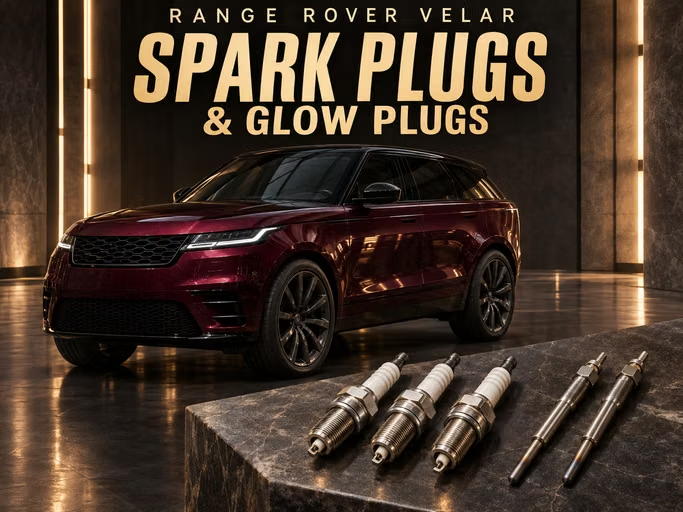
The cover shows examples of a spark plug and a glow plug for different engine types. It illustrates the subject; component shape, scale and placement do not establish compatibility with a particular vehicle.
The Range Rover Velar is associated with calm, smooth progress, so a new vibration at idle or hesitation during acceleration is easy to notice. Yet “it needs plugs” is not a diagnosis. Identify the engine, establish what maintenance has already been done and record the conditions in which the problem occurs before ordering parts.
Petrol Velars use spark plugs; diesel versions use glow plugs. Hybrid technology does not remove this distinction: a P400e and a diesel MHEV need different approaches. This guide covers scheduled replacement, signs worth investigating, parts selection and the questions that help you assess a workshop recommendation.
This article concerns the Range Rover Velar. Advice for the Range Rover Sport, Evoque or full-size Range Rover should not be transferred without checking applicability. For service parts, the VIN, model year, engine and market specification matter more than a similar model name.
Which plugs are fitted to a Range Rover Velar
A spark plug creates the ignition spark in a petrol engine. A glow plug heats the working area of a diesel to support starting and subsequent running. R-Dynamic or Autobiography trim does not determine the component type. Engine identification matters more than exterior styling.
The original Velar range announcement on media.jlr.com lists P250 and P380 petrol versions alongside D180, D240 and D300 diesels. The powertrain range subsequently changed. A matching number on the badge therefore does not establish that two vehicles have the same engine.
| Example versions | Engine type | What is required |
|---|---|---|
| P250, P380; later P340/P400 | Petrol; some versions use MHEV | Engine-specific spark plugs |
| P400e | Petrol plug-in hybrid | Spark plugs; not a P400 set by default |
| D180/D240; D200 MHEV | Four-cylinder diesel | Glow plugs and control-system checks |
| D300 across model years | V6 or straight-six MHEV diesel | Fitment by engine code and VIN |
The updated Velar description specifies a 2.0-litre four-cylinder petrol engine for P400e. It is different from the six-cylinder P400. The table illustrates the distinction; availability varies with model year and market.
Why D300 and Hybrid need further identification
The early D300 used a V6 diesel. The powertrain update announcement describes a later straight-six D300 MHEV. Both require glow plugs, but parts interchangeability needs separate confirmation. P400e is a petrol plug-in hybrid; diesel MHEV technology does not turn its combustion engine into a petrol unit.
When comparing current offers, examine the maintenance history as well. A statement that “the plugs were replaced” should be supported by the date, mileage and part numbers. That is more useful than a general assurance that the vehicle has been fully serviced.
When spark plugs should be replaced
Scheduled spark plug replacement requires the maintenance schedule for the particular Velar. A single figure, such as 60,000 or 100,000 kilometres, does not cover every engine and model year. Ask to see the relevant service item for its market specification. Where the document specifies both time and distance limits, follow its rules for both.
The official iGuide is a useful starting point for identifying the vehicle: entering the VIN helps select information appropriate to its market and specification. Ask the workshop to show the actual maintenance schedule and spark plug replacement item for your car. A handbook selection page alone does not establish an interval.
Discussing UAE driving conditions
For an urban Velar, describe the journeys as well as the distance travelled. Short commutes, extended stationary running and regular towing create different operating conditions. Hot weather alone is not a basis for assigning the same shortened replacement interval to every version.
- Frequent short trips and prolonged stationary engine running.
- Sand driving, towing and sustained high-load use.
- Recent hesitation, fault messages or changes after refuelling or repairs.
- Engine modifications and changes to its software.
These details make the servicing discussion more useful. They do not replace the schedule or justify converting engine hours into kilometres using an arbitrary formula. Ask the workshop to distinguish scheduled work from repairs proposed because a fault has been found.
When previous replacement cannot be confirmed
Gather invoices and job sheets. The Online Service History page describes electronic servicing records for vehicles from 2013 onwards. Review available entries alongside the owner’s documents: a brief service entry may not explain every additional operation performed.
If records are unavailable, ask the workshop to compare mileage and age with the applicable maintenance schedule. A justified replacement may establish a clear starting point, but a starting complaint needs diagnosis before a parts decision. Retain the date, mileage and part numbers on the new job sheet.
When a petrol engine runs unevenly
New hesitation during acceleration, an unstable idle, a noticeable change in starting or an engine warning message warrants investigation. Spark plugs may contribute, but ignition coils, injectors, wiring and other systems can produce similar symptoms.
On a P400e, note whether hesitation occurs specifically when the petrol engine starts after electric driving. On other petrol versions, note whether it follows an overnight stop, warm-up or refuelling. This observation helps testing but does not prove a plug is faulty. Do not provoke severe misfires through hard acceleration.
Why a fault code is not a diagnosis
A misfire code provides a direction for testing; it does not prove that a spark plug is faulty. Preserve codes and their recorded operating conditions before clearing them. The HELLA technical explanation also highlights the influence of engine mechanical condition, including compression, on ignition assessment.
| Observation | Discuss with the workshop | Avoid assuming |
|---|---|---|
| One cylinder runs unevenly | Ignition, fuelling and mechanical checks | Only the spark plug can be responsible |
| Hesitation after servicing | Part numbers, fitting and connections | New parts rule out an installation error |
| Complaint as a PHEV engine starts | Starting conditions and diagnostic data | The traction battery must be responsible |
| Increased fuel consumption | Routes, load and vehicle condition | A set of plugs guarantees savings |
The table suggests diagnostic questions, not instructions to replace every component mentioned. Ask which measurement or test supports each proposed repair. If the same cylinder develops a fault again, fitting another plug without investigating the cause is unlikely to provide a satisfactory answer.
Should the ignition coils be replaced too
Scheduled spark plug replacement does not automatically require a complete set of ignition coils. Assess their condition separately. Equally, new plugs will not repair a damaged coil, boot or connector. The scope of work should follow the findings rather than a standard bundle of extra parts.
When diesel glow plugs need checking
On a diesel Velar, changes in starting, uneven running immediately afterwards, unusual smoke or a warning message warrant attention. Tell the workshop whether the engine was cold. Difficult starting with a warm engine should not automatically be attributed to glow plugs: starting conditions and diagnostic data need assessment.
Before the visit, note how long the vehicle had been parked, whether cranking time changed and how long the uneven running lasted. Mention battery condition and recent repairs. These details help determine the diagnostic sequence; smoke or prolonged cranking alone does not identify the cause.
Are glow plugs needed in hot weather
Yes, the installed system should remain functional in warm weather too. The technology explanation on ngkntk.com describes post-glow operation that supports combustion during warm-up. The exact strategy depends on the engine. Easy summer starting does not prove that every plug and its control circuit is working correctly.
Likewise, the absence of a long pre-start indicator period does not prove that the system is unused. Check the meaning of indicators and the starting procedure in the instructions for your version. New warnings need to be assessed with fault data and actual operating conditions.
Is there one replacement mileage for diesels
Applying a petrol spark plug interval to a diesel is incorrect. Check the servicing requirements for its engine. If no separate periodic replacement is specified, base the decision on diagnosis. An average service-life figure in a general catalogue is not a mandatory interval for a particular Range Rover Velar.
What should be checked besides the plugs
The DENSO explanation of glow plug faults describes how control problems, excessive voltage and overheating can damage components. Checks should therefore include supply, connections and control, with investigation of other combustion problems where necessary. A new set can fail again if the underlying cause remains.
Ask for findings for the individual cylinders and an explanation of how the defect was confirmed. If one plug has failed, discuss replacement of the set in relation to the others’ condition, access and the repair procedure. Neither “always replace everything” nor “the others need no checks” is an adequate technical explanation.
Selecting the correct replacement parts
Before ordering, provide the VIN, model year, engine code and details of any modifications. For the Velar, avoid grouping P400 with P400e, or an early D300 with a later D300 MHEV. An old part number is useful background information but still needs verification: a previous owner may have fitted an unsuitable component.
Choosing spark plugs for a petrol engine
Confirmed fitment, dimensions, seating, heat range and the required gap all matter. Platinum or iridium describes electrode material, not universal compatibility. A more expensive component of the wrong specification is not an upgrade.
As the NGK explanation of heat range makes clear, this characteristic concerns heat dissipation from the firing end rather than “spark strength”. Do not change it solely because summer temperatures are high. A modified engine requires information about its calibration and a reasoned specification; changing plugs does not resolve a mechanical defect.
Do not copy a gap setting from another engine because its plugs look similar. Ask the workshop to check the engine and component documentation. Fine electrodes should not be bent with an arbitrary tool: whether adjustment is permitted depends on the design and manufacturer’s instructions.
Choosing glow plugs for a diesel
The NGK technical questions and answers explain the relationship between a glow plug and its engine’s electrical characteristics and control requirements. Matching thread and length is not enough. A promise of faster heating does not establish suitability for the original controller.
For a diesel Velar, the labels “3.0” and “D300” are insufficient. Check the engine family, catalogue fitment and electrical specification. If a replacement part number is proposed, ask for confirmation of a documented supersession or catalogue application rather than accepting visual similarity.
Agree the details before dismantling
- Part numbers, quantities and confirmation of compatibility.
- Whether the job is scheduled replacement or repair of a specific fault.
- Any additional consumables genuinely required by the procedure.
- How access, thread or removal problems will be discussed and authorised.
For scheduled petrol-engine servicing, spark plugs are normally replaced as a set. An early failure of one component needs a separate explanation. Do not add ignition coils or other assemblies simply to create a complete package: ask why they are required on this particular vehicle.
Installation and checking the outcome
The correct component cannot compensate for an installation error. The DENSO spark plug fitting guidance highlights a clean working area, a cool engine, starting the threads by hand and tightening to specification. Thread lubricant should not be added automatically; it requires appropriate vehicle-manufacturer instructions.
Glow plugs require the separate procedure for their engine. Do not transfer petrol spark plug tightening values to them. If a component resists removal, a technician should determine the next step. Simply applying more force can turn routine servicing into a much more involved repair.
Particular considerations for a hybrid
On a Velar P400e, a silent engine does not establish that the vehicle is ready for maintenance. The workshop must prevent unintended starting and apply the required hybrid-system precautions. Owners should not disconnect high-voltage components themselves to prepare for plug replacement; the repair documentation determines the preparation procedure.
Frequent electric driving does not justify extending an interval by subtracting electric kilometres from the odometer reading. Follow the applicable schedule, including any specified time limits. A low proportion of combustion-engine use does not remove its servicing requirements.
Comparing workshop quotations
Separate the quotation into diagnosis, parts and labour. Establish whether checking the original complaint after repair is included. For a diesel, assessment of glow control matters; for a petrol engine, ask what supports any extra coil replacement. A set price for a different Velar version is not a reliable comparison.
A difference in total price may reflect access, the scope of work or different components. Compare quotations covering the same job. Agree in advance that additional work discovered after dismantling will be discussed separately before proceeding.
Collecting the vehicle
After scheduled replacement, the engine should run without new hesitation or warning messages. If the complaint occurred after an overnight stop, checking a warm engine alone is insufficient. Discuss a test start under suitable conditions and whether the vehicle needs to remain at the workshop.
Ask for photographs of unusual damage on removed plugs, identified by cylinder. If part of the working end has broken away, the cause and possible consequences need investigation rather than simply installing another component. Record the date, mileage, part numbers and checks performed. This information will be useful if the complaint returns and when planning the next service.
Frequently asked questions
Do all hybrid Velars use spark plugs?
No. The petrol P400e uses spark plugs. Diesel MHEVs use glow plugs. Hybrid describes electrification, but does not by itself establish the fuel or the component required.
Are plugs necessarily a Velar weak point?
Uneven running alone cannot establish that. A worn service part, incorrect fitment, a failed coil and an engine mechanical problem call for different solutions. Before buying, examine the particular engine, maintenance history and recurring faults instead of treating every complaint as a model-wide characteristic.
Does easy diesel starting rule out a glow system fault?
No. The system can operate after starting, while warm weather can make some symptoms less obvious. Follow the diagnostic findings and requirements for your version.
Does a P400e need plug servicing if it mainly runs on electricity?
Yes. Its petrol engine retains its maintenance requirements. Do not subtract electric kilometres from the odometer or disregard a calendar limit. Follow the applicable servicing schedule.
Is clearing the fault code enough after replacement?
No. The original fault needs to be checked. Clearing a code does not establish that the component, wiring or control system is working correctly.
Checklist before servicing
☐ Confirm the VIN, model year, fuel and engine.
☐ Verify plug type, part numbers and compatibility.
☐ Establish the service schedule and previous replacement history.
☐ Record symptoms and the conditions in which they occur.
☐ Agree diagnosis, costs and arrangements for additional work.
☐ Include an outcome check and supporting documents.
Conclusion
Range Rover Velar plug servicing starts with precise engine identification. Petrol versions need correctly specified spark plugs and scheduled maintenance; diesels need a functioning glow system. P400e, P400 and different D300 engines should not be grouped together for parts selection because their badges look similar. Identifying the cause of uneven running, agreeing the scope of work and documenting the outcome help maintain smooth operation without unnecessary replacements.


