


When to change differential oil in the Land Rover Range Rover Velar
Land Rover Range Rover Velar
Land Rover Range Rover Velar•
•6 views
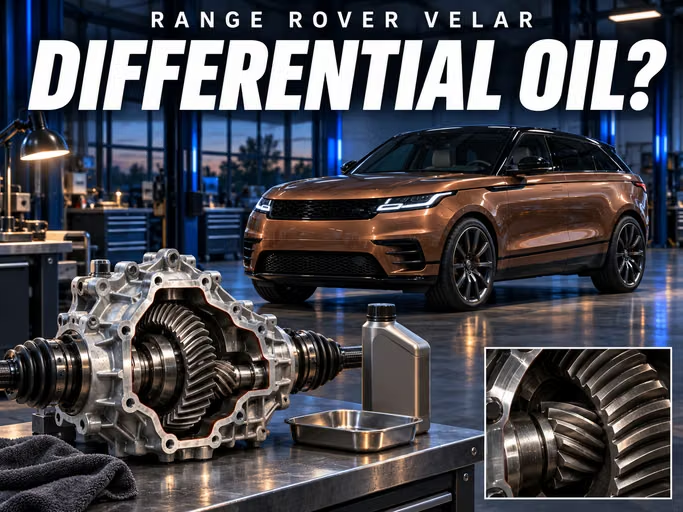
Illustration for this article. The vehicle and differential are illustrative; the actual assembly, oil and service parts must be identified for the individual vehicle.
Differential oil for a Range Rover Velar must match the assemblies fitted to the vehicle. The front and rear differentials are serviced separately, and the rear unit’s requirements depend on whether it has electronic locking. The model name, engine output or a general recommendation to use gear oil is not enough to select the correct product.
Four questions matter: which assembly is fitted, which maintenance schedule applies, what fluid it requires, and whether a fault needs attention before routine servicing. A leak, evidence of water contamination or a new noise warrants investigation even at low mileage. However, a whine or a judder does not by itself establish that a differential has failed.
This article covers Velar differential servicing, the records to check on a used vehicle and symptoms that call for diagnosis. Automatic transmission fluid and transfer case fluid have their own procedures; they are mentioned here only where distinguishing the assemblies helps avoid a servicing mistake.
Identifying the differentials fitted to your Velar
A differential allows the two wheels on an axle to turn at different speeds when cornering. The final drive changes the drive ratio and transmits torque towards the half shafts. Workshops may describe the complete housing and its internal mechanisms as a differential assembly or final drive. Ask which assembly a quotation covers: front or rear.
Rear differential construction and control can vary. Four-wheel drive alone does not establish that an electronic locking differential is fitted. An exterior styling package, trim name or wheel design is also insufficient evidence, because equipment depends on the vehicle version and market.
| Assembly to identify | Why it matters for servicing |
|---|---|
| Front differential | It has its own oil change and level-setting procedure. Rear differential information cannot automatically be applied. |
| Rear non-locking differential | The fluid and maintenance requirements must match the conventional rear unit actually fitted. |
| Rear electronically locking differential | Check the fluid specification and maintenance schedule for this particular configuration. |
| Transfer case | This is a separate four-wheel-drive assembly. A transfer case fluid invoice does not establish that either differential was serviced. |
Start with the VIN and build details. The official iGuide can provide vehicle-related owner information; selecting only a model and year may also display equipment absent from your particular car. For technical fluid selection, the workshop should check the build specification and the identity of the installed assembly.
If a differential has previously been replaced, the original factory specification may not fully describe what is now fitted. Ask for the replacement invoice and check the housing identification. This is particularly useful when a complete used assembly was installed and the repair record gives no more detail than “differential replacement”.
This also makes workshop quotations easier to compare. A lower price may cover only one assembly or omit the repair of an existing leak. The total alone does not show whether two workshops are proposing the same work.
When differential oil needs changing
There is no single interval that can safely be applied to every Velar. Identify the maintenance schedule for the VIN, model year and original market, then find the entry for the relevant assembly. Where both distance and elapsed time are specified, use whichever comes first.
One published maintenance schedule for 2.0-litre and 3.0-litre petrol Velar models lists the first rear locking differential oil change at 102,000 km or four years. Its front and rear non-locking differential entries show 230,000 km or nine years. These figures belong to that specific schedule; they are not universal intervals for every model year, diesel or hybrid. Confirm applicability to your own vehicle separately.
A long scheduled interval does not mean the housing should go uninspected until that mileage. Planned replacement assumes an otherwise serviceable assembly operating within the relevant conditions. A leak or contamination requires its own response, regardless of how much time remains before the scheduled oil change.
Conditions that justify an additional inspection
Prolonged towing, repeated sand driving and demanding off-road use place extra demands on the driveline. The manufacturer addresses arduous operation in its maintenance guidance. Discuss additional inspections and an appropriate service plan for this use rather than treating a commonly quoted workshop interval as a universal factory requirement.
Tell the technician about deep wading or prolonged immersion of driveline components. If water contamination is confirmed, the investigation should include its entry route, breathers and seals. Changing the oil without addressing the cause does not establish that the contamination will not return.
Low annual mileage does not cancel a calendar limit where the applicable schedule specifies one. Record the previous oil change date as well as the odometer reading. After extended storage, check for leakage and seal problems before returning the vehicle to regular use.
What to do when the service history is unclear
Request invoices identifying the assembly and oil specification. A routine service stamp or an engine oil receipt does not establish that the differential oil was changed. If records are unavailable, have the assemblies inspected and any existing symptoms investigated before agreeing preventive servicing. Missing paperwork leaves the previous change date uncertain; it does not prove a fault.
Do not rely on a general service reminder as a separate oil-life indication for each differential. Keep your own dated record of the completed work, including mileage and the products used. Clear records make the next service decision considerably easier.
Choosing the oil and establishing the correct quantity
Begin with the manufacturer’s specification for the individual assembly. A viscosity grade describes only some of a fluid’s properties. Matching an SAE grade or a broad gear-oil classification does not establish suitability for the locking mechanism or other requirements of the fitted differential.
The workshop should check current requirements in the TOPIx technical information system, including any superseded product numbers. If an alternative oil is proposed, request its manufacturer’s technical information showing the required specification. A seller’s statement that an oil suits all Land Rover vehicles is not a sufficient basis for selection.
| Check before purchase | Information required |
|---|---|
| Intended application | A precise match to the front differential or the particular rear differential fitted. |
| Specification and product reference | Compliance with the current technical requirement or a documented replacement for the previous product. |
| Quantity | The service fill quantity for the particular housing and its level-setting method. |
| Plugs and seals | Whether the procedure requires new items and which parts are needed. |
Do not assume that the same bottle size will cover each Velar differential. Capacity depends on the assembly, and a routine drain-and-refill quantity can differ from the dry fill after an overhaul. Nor is the amount drained a reliable target: a previous leak may already have reduced the oil level.
Set the level using the procedure for that assembly. It may specify vehicle position, temperature or a measured quantity. Filling to the edge of an opening is appropriate only where the relevant instructions prescribe it. Extra oil does not provide an extra margin of protection and can create problems of its own.
Whether a locking differential needs an additive
Do not add a friction modifier simply because electronic locking is fitted. The specified fluid must already meet the assembly’s requirements. Use an additional additive only where it is expressly required for that assembly and product. A treatment advertised as a cure for noise cannot restore worn bearings or damaged gear teeth.
If the previous fluid is unknown, topping up with an arbitrary product makes the result harder to assess. With a minor leak, establish both the cause and the correct fluid before deciding between a suitable top-up and an oil change. An aggressive flush should not become a routine extra without a technical reason.
When collecting the vehicle, retain the product details with the invoice. This is more useful for future servicing than a verbal assurance that a premium oil was used, particularly if another workshop will maintain the vehicle later.
Symptoms that need diagnosis before an oil change
A road-speed whine, vibration under load and judder when turning can have different causes. Note the speed at which a symptom appears, whether it changes under acceleration or on a trailing throttle, and whether the vehicle is cold. These observations help a technician reproduce the complaint, but do not replace inspection and a road test.
JLR’s differential and transfer case diagnostic guidance, covering Velar from the 2018 model year, also identifies propeller shafts, suspension and mountings as possible sources. It calls for tyre and wheel checks. Dark oil and fine wear material alone do not establish a need for assembly replacement; where a fault is suspected, the drained oil should be retained for examination.
A noise needs to be assessed alongside its actual source. A sound resembling differential whine can come from a wheel bearing or the tyres. Replacing fluid before locating the cause may simply add cost. Large fragments, excessive play or housing damage require a separate assessment by a qualified technician.
Why a Velar may judder during a tight turn
A technical communication about driveline judder includes 2018–2020 model-year Velar vehicles. For the described low-speed turning complaint, it addresses ABS and transfer case control module software updates. This does not mean that every turning judder can be cured by programming. The workshop must check whether the communication and current repair procedure apply to the vehicle and its symptoms.
A report that a rear wheel seems to skip during a parking manoeuvre should therefore not automatically become an order for rear differential oil. The technician should reproduce the complaint and establish which assembly or system is responsible. Ask for the diagnosis in writing, particularly if complete assembly replacement is proposed.
Driveline weaknesses to check on a used vehicle
Questions about Velar weaknesses are most useful when turned into checks on the actual car. Look for leakage, review previous repair invoices and assess its behaviour after warming up. When discussing current offers, request the VIN and maintenance records in advance. Trim level and low mileage cannot substitute for examining the condition of the differentials.
What a differential oil service should include
Before starting, the technician identifies the assembly and checks for leakage. If there is an existing noise or judder complaint, it should be documented before the oil is drained. Otherwise, assessing what was present beforehand and whether servicing changed it becomes more difficult.
A routine service includes cleaning the working area, confirming access to the filling point, draining by the specified method and examining the used oil. Plugs and sealing parts are handled as directed, followed by filling with the correct product and establishing the proper level. Tightening torques must match the actual housing; excessive force can damage threads.
Afterwards, check for leaks. If servicing formed part of an investigation, repeat the test under comparable conditions. The invoice should record the date, mileage, assembly serviced, oil name and specification, and quantity actually used. This gives the next owner or technician a usable record rather than another uncertainty.
Whether both differentials should be serviced together
Combining the work is convenient when both assemblies are due or their histories are unknown. However, an oil change in one assembly does not automatically require a change in the other. Consider each unit’s requirements and condition separately. If a leak is found, allow for addressing its cause rather than simply replacing the lost fluid.
Whether fresh oil can cure a whine
Correct servicing may affect operation where insufficient or unsuitable oil contributed to the complaint. However, damage may already have occurred. Nobody should promise that an oil change will eliminate a whine before inspection. Persistent noise calls for further diagnosis rather than a succession of different oils chosen by trial and error.
Whether adaptation is required afterwards
Resets and calibrations should not automatically follow every differential oil change. Their necessity depends on the procedure for the fitted assembly and the work performed. Routine fluid servicing, replacement of electronic components and a repair under a diagnostic communication are different situations and may involve different actions.
Conclusion
Servicing a Range Rover Velar’s differentials starts with identifying its front and rear assemblies. Confirm the vehicle-specific schedule, choose oil by the exact specification and keep a detailed record of the work. Where a whine, judder or leak is present, investigate its cause first: routine maintenance looks after a serviceable assembly, while a fault requires a repair based on the diagnosis.


